When commercial gym operators compare weight plate options, the conversation usually centres on price per kilogram. Coating material — whether a plate is finished in rubber, TPU, or powder-coated cast iron — is frequently treated as a secondary aesthetic decision. In practice, material choice is one of the most operationally consequential specifications on the free weight floor. It determines how the facility smells on a humid Tuesday afternoon. It determines whether plate surfaces show visible degradation after two years or ten. It determines maintenance hours, floor damage risk, colour legibility, and ultimately how members perceive the quality of the space they are paying to use.
This guide compares the three dominant plate material categories — rubber-coated, TPU-coated, and powder-coated cast iron — across the dimensions that matter in commercial gym operations: durability under multi-user load, odour characteristics, handling ergonomics, aesthetics over time, and total cost of ownership.
The Three Plate Material Categories: What Each Actually Is
Before comparing properties, it is worth clarifying what these materials are at a compositional level, since the terms are used loosely in the fitness industry.
Rubber-coated plates use a vulcanised rubber overmoulding bonded to a cast iron core. The rubber compound may be virgin (higher quality) or recycled (lower cost, inconsistent quality, stronger odour). Recycled rubber contains sulphur compounds introduced during the vulcanisation process — the source of the characteristic gym smell that becomes more pronounced as the material ages and in humid conditions.
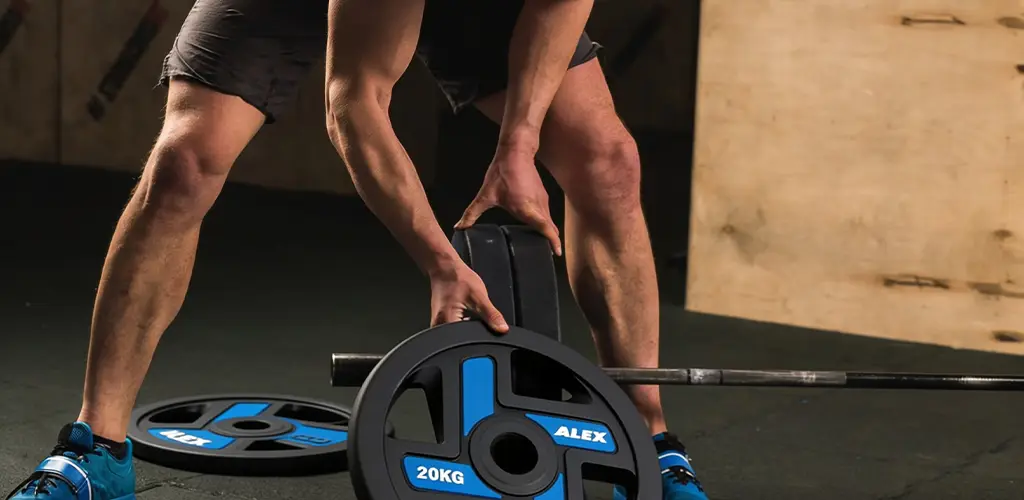
TPU-coated plates use a Thermoplastic Polyurethane overmoulding on a cast iron core. TPU is a distinct polymer class: a thermoplastic elastomer with block copolymer structure (alternating hard and soft segments) that provides high abrasion resistance, chemical inertness, UV stability, and odour-free surface chemistry. Alex Athletics’ 4-Holes TPU Plate uses this material — bonded to a precision steel centre ring for smooth bar loading and cast iron core for mass density.
Powder-coated cast iron plates have no overmoulding: the metal is coated directly with an electrostatic powder coat finish, then cured. The Alex Athletics 4-Holes Cast Iron Plate uses this approach. Powder coating provides rust protection and a professional finish, but offers no shock dampening or noise reduction compared to coated alternatives.
Rubber-Coated Plates: Commercial Advantages and Operational Limits
Rubber-coated plates have been the dominant commercial gym plate category for decades, and for good reason. The rubber overmoulding provides meaningful shock absorption when plates are placed down hard, reduces noise from plate contact and collisions, and protects both the plate and the flooring substrate from damage. These properties are genuinely valuable in high-volume commercial settings where controlled plate handling cannot be guaranteed for every user at every session.
The operational limitations of rubber-coated plates in commercial environments are equally real. Vulcanised rubber — particularly recycled rubber compound — releases volatile sulphur compounds that produce the characteristic “rubber smell” of high-volume gyms. This odour intensifies with heat, humidity, and the accumulation of sweat. In enclosed spaces, ventilated or not, a large rubber plate inventory can make the free weight area noticeably less pleasant than other zones of the facility. For premium commercial gyms, boutique studios, and hotel fitness rooms where member experience is a primary value proposition, this is a non-trivial consideration.
Rubber coatings also degrade visibly in commercial environments. Surface cracking, UV-induced fading, delamination at the inner ring joint, and rubber flaking are typical failure modes under heavy daily use. In facilities where plates are loaded and unloaded by dozens of users per day, visual degradation typically becomes noticeable within three to five years. Recoating is not commercially practical — degraded rubber plates require full product replacement.
TPU-Coated Plates: Why the Premium Is Commercially Justified
Thermoplastic Polyurethane has emerged as the leading premium alternative to rubber in commercial fitness equipment coatings, driven by measurable material property advantages. According to Covestro, one of the world’s leading TPU manufacturers, TPU combines rubber-like elasticity with higher productivity, recyclability, and a significantly reduced environmental footprint compared to vulcanised rubber — a combination that makes it an increasingly preferred material across premium industrial applications.
In a commercial gym context, three TPU properties are operationally decisive. First, abrasion resistance: as documented by SpecialChem, standardised wear tests consistently show TPU outperforming rubber and PVC in measured material loss under repeated friction — the exact mechanical stress that weight plates experience during commercial use. This translates directly to longer surface life and fewer replacement cycles. Second, odour profile: TPU is chemically inert and odourless. There are no sulphur vulcanisation compounds, no off-gassing under humidity or heat, and no accumulated rubber smell. For premium commercial gyms, this is a member experience differentiator. Third, colour stability: TPU’s resistance to UV degradation and chemical exposure (including gym cleaning agents and body oils) means colour coding remains vibrant and legible over the product’s service life — maintaining the professional appearance of the weight floor without the colour fade typical of rubber plates under heavy use.
The commercial case for TPU plates is strongest in premium gyms and boutique studios where member perception of quality is a revenue variable, in enclosed or less-ventilated spaces where odour accumulation has an outsize impact on member experience, and in facilities with a long investment horizon — where the higher unit cost of TPU is recovered through fewer replacement cycles over time.
Powder-Coated Cast Iron Plates: The Value and Performance Equation
Powder-coated cast iron plates occupy a distinct position in the commercial plate hierarchy. Without overmoulding, they are the thinnest and densest option at any given weight — allowing significantly more load per sleeve than rubber or TPU alternatives. For facilities serving heavy lifters who regularly approach maximum bar loading, this sleeve efficiency is a practical performance advantage. The Alex Athletics 4-Holes Cast Iron Plate achieves a weight tolerance of ±2%, compatible with general strength training standards and more economical to manufacture than precision-calibrated alternatives.
The operational trade-offs are equally clear. No overmoulding means no shock absorption — cast iron plates placed down hard produce significantly more noise and floor impact than coated alternatives. Facilities with neighbours, shared building infrastructure, or acoustic standards will find the noise profile of bare cast iron plates problematic in high-volume zones. The powder coat finish provides rust resistance but is not impervious: prolonged exposure to moisture, sweat, and gym cleaning chemicals can cause localised corrosion at coating break points over multi-year commercial service.
Cost efficiency is the cast iron plate’s primary commercial advantage. Per kilogram of loaded weight, powder-coated cast iron plates represent the most economical procurement path — a meaningful factor for facilities needing to stock 1,000+ kg of plate inventory and for operators entering a new facility with capital constraints.
Material Property Comparison: The Numbers That Matter
| Property | TPU-Coated Plates | Rubber-Coated Plates | Powder-Coated Cast Iron |
|---|---|---|---|
| Abrasion resistance | Very high — superior to rubber in standardised wear tests | Good — degrades faster under repeated friction | N/A — no overmoulding; powder coat can chip |
| Odour profile | Odourless — chemically inert, no off-gassing | Sulphur odour — intensifies with heat and humidity | Minimal — metallic smell only; no sulphur |
| Shock / noise dampening | Good — TPU elasticity absorbs impact | Good — rubber dampens impact and plate noise | None — metal-on-metal contact; loudest of three |
| Colour durability | Excellent — UV and chemical resistant; vibrant for years | Moderate — UV fading and discolouration over 3–5 years | N/A — typically black powder coat; no colour coding |
| Surface crack/peel risk | Very low — high elasticity prevents surface cracking | Moderate — cracking common after 3–5 years heavy use | Low — coating chips rather than cracks; limited area |
| Plate thickness (25kg) | Moderate — thicker than bare iron due to coating | Thick — bulkiest per kg; limits sleeve loading | Thin — most compact; maximises weight per sleeve |
| Unit cost (relative) | Highest — precision materials and manufacturing | Medium — standard commercial pricing | Lowest — most economical per kg |
| Estimated surface life (heavy commercial) | 8–15+ years | 3–7 years | 5–10+ years (powder coat dependent) |
| Eco-material profile | Recyclable thermoplastic; lower production footprint | Vulcanised rubber not recyclable; recycled rubber variable quality | Iron recyclable; coating adds limited waste |
The Odour Issue: What Buyers Usually Underestimate
The odour characteristics of rubber plates are consistently underweighted in procurement decisions — until the facility is operational. In a newly installed free weight area, rubber plate odour is noticeable but manageable. After twelve to eighteen months of commercial use in a high-volume gym — where hundreds of members handle the plates daily, where body heat and sweat contact the surface repeatedly, and where the rubber compound begins to oxidise — the smell profile of a large rubber plate inventory can become a persistent member experience issue.
This effect is most pronounced in three commercial contexts: enclosed boutique studios with limited air exchange, hotel gym facilities where guests have high environmental sensitivity, and facilities in humid climates where moisture accelerates rubber oxidation. The Health & Fitness Association (IHRSA) consistently identifies member experience and facility environment quality as primary drivers of retention — and indoor air quality and odour are material components of that experience.
TPU plates and powder-coated cast iron plates both avoid this issue entirely. For facilities where environmental quality is a competitive differentiator, the absence of rubber odour is a genuine operational advantage, not a minor preference.
Which Coating Material Fits Which Commercial Facility?
| Facility Type | Recommended Primary Plate Material | Rationale |
|---|---|---|
| Premium commercial gym / flagship club | TPU-coated | Member experience quality; no odour; long-term colour vibrancy; brand positioning |
| Boutique fitness studio / PT studio | TPU-coated | Enclosed space; odour-sensitive environment; premium positioning requires premium equipment |
| Hotel / hospitality gym | TPU-coated or high-grade rubber | Guest sensitivity to odour; enclosed environment; appearance maintenance priority |
| Mid-market commercial gym | High-grade rubber-coated | Cost-effective solution with adequate durability; noise dampening for multi-floor facilities |
| Powerlifting / hardcore strength gym | Powder-coated cast iron | Maximum sleeve loading; authentic iron experience; acoustics acceptable; cost efficiency at scale |
| Budget commercial gym / new facility launch | Rubber-coated (standard grade) | Lower initial capital outlay; adequate durability for first 3–5 years |
| Corporate / hotel / senior fitness | TPU-coated light range (1.25–10kg) | Odour-free; safe, soft surface; colour-coded for accessibility; floor protection |
Frequently Asked Questions
Why do rubber weight plates smell, and does TPU eliminate this issue?
Rubber plate odour originates from sulphur compounds introduced during the vulcanisation process used to cure rubber. These compounds off-gas over time, particularly in warm and humid conditions, and the smell intensifies as the rubber oxidises with age and repeated contact with sweat. TPU (Thermoplastic Polyurethane) does not use vulcanisation chemistry — it is processed through thermoplastic moulding without sulphur compounds. TPU plates are chemically odourless under all normal gym operating conditions, making them a direct solution to this specific operational issue.
How much longer do TPU plates last compared to rubber in commercial use?
Under heavy commercial use — daily multi-user handling, repeated loading and unloading, exposure to sweat and cleaning chemicals — rubber-coated plates typically show surface cracking, fading, and delamination within three to seven years. TPU-coated plates, due to TPU’s superior abrasion resistance and UV stability, maintain surface integrity for eight to fifteen years or more under equivalent conditions. This extended service life materially affects total cost of ownership: a higher upfront unit cost can be recovered through one or more fewer replacement cycles over a ten-year facility horizon.
Are cast iron plates appropriate for a premium commercial gym?
Powder-coated cast iron plates are appropriate for commercial facilities where member population includes serious strength athletes and heavy loading is prioritised. Their thin profile and cost efficiency make them well-suited for powerlifting-focused gyms and high-volume free weight areas where noise is acceptable. For premium facilities positioning on member experience and environmental quality, TPU-coated plates are generally the better fit — they provide comparable durability with superior aesthetics, no odour, and noise dampening. A mixed approach — TPU plates for the general free weight area, cast iron plates for dedicated lifting platforms — combines the strengths of both categories.
What is the weight tolerance difference between TPU and rubber plates?
Weight tolerance in commercial plates is a function of manufacturing process rather than coating material. Alex Athletics’ TPU and cast iron plates are manufactured with defined weight tolerances (±2% for cast iron plates). The coating material itself does not change the plate’s mass accuracy — tolerance is controlled during casting and calibration before the coating is applied. For precision training applications, calibrated steel plates (rather than coated cast iron plates of any type) are the appropriate specification.
Can TPU or rubber plates be used for Olympic weightlifting drops?
Neither standard rubber-coated nor TPU-coated Olympic plates are designed for repeated intentional drops from overhead. Both have cast iron cores that do not absorb the impact of being dropped onto a platform. Bumper plates — which use a high-density rubber overmould around a thin steel or iron hub, designed specifically to absorb repeated drops — are the appropriate product category for Olympic weightlifting platforms where the bar is routinely dropped from overhead. Standard commercial plates (rubber or TPU) should be used for controlled placement, not intentional drops.
Conclusion
The choice between TPU and rubber weight plates for a commercial gym is not a minor equipment specification detail — it is a decision that will affect how the facility smells, how the equipment looks after three years, how much noise the free weight area generates, and how much the facility spends on plate replacement over a ten-year horizon. TPU plates represent the premium tier for good material science reasons: superior abrasion resistance, complete odour elimination, UV-stable colour vibrancy, and a longer commercial service life. Rubber plates remain a viable mid-market option where upfront cost is the binding constraint and noise dampening is valued. Cast iron plates serve the specific performance contexts where sleeve loading efficiency and budget scale outweigh the acoustic and aesthetic limitations.
To review Alex Athletics’ full range of commercial weight plates or discuss the right plate configuration for your facility’s context, contact our team for a specification consultation.