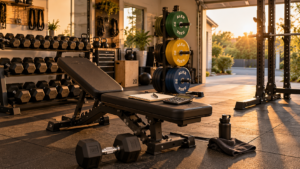
Most decisions in gym equipment design involve trade-offs. More weight means more material cost. Softer surfaces absorb noise but wear faster. Precision machining increases accuracy but raises price. The hexagonal dumbbell head is one of the few design choices where the geometry solves multiple problems simultaneously — roll prevention, floor exercise stability, storage efficiency, and ergonomic grip — without introducing meaningful compromises. Understanding why the hexagon specifically (and not other polygons) is the optimal shape for commercial dumbbells, and what it took to add Braille accessibility to that geometry, is the subject of this article.
Why Not Round, Square, or Octagonal?
The round dumbbell head is the oldest form — and the most problematic for commercial gym environments. A round surface contacts the floor at a single tangent point, creating no friction resistance to lateral movement. Any slight incline, floor vibration, or contact with another object sets a round dumbbell in motion. In a commercial gym where dozens of dumbbells are in use simultaneously, where members set weights down at unpredictable angles, and where floor inclines of even 1–2 degrees are common, round dumbbells become a persistent falling-hazard liability. This is not a theoretical concern: rolling dumbbells are a documented cause of ankle injuries and trip-related falls in commercial gym environments.
The square head solves rolling with absolute certainty — but creates a new set of problems. Four corners produce harsh contact points during plate-down movement, generate concentrated floor impact stress, and make knuckle contact a hazard during exercises close to the floor. Square dumbbells also feel mechanically unnatural in the hand during exercise transitions, interrupting the ergonomic flow of compound movements.
The octagonal head — eight sides — provides anti-roll characteristics comparable to the hexagon. The engineering question is whether the additional manufacturing complexity and material cost of adding two more faces delivers meaningful functional benefit. In practice, the answer is no: six flat faces provide sufficient contact area to prevent rolling under all commercial gym conditions, while keeping the overall head diameter compact and the casting process straightforward at scale.
Six sides is the geometric optimum: it provides the minimum number of flat faces needed for reliable anti-roll stability, keeps the dumbbell head compact, reduces manufacturing complexity relative to higher-sided polygons, and creates contact face angles (120° interior angle) that are ergonomically compatible with a range of grip positions. This is why the hexagonal form has become the de facto commercial standard — not by convention, but by geometry.
Six Operational Advantages of the Hexagonal Form in Commercial Settings
The hexagon’s commercial advantages extend well beyond the obvious anti-roll property. The table below maps the six primary benefits to their operational impact in a commercial gym environment.
| Hexagonal Property | Operational Benefit | Commercial Impact |
|---|---|---|
| Six flat faces | Anti-roll stability — dumbbell stays where placed | Eliminates rolling hazard in high-traffic zones; reduces injury liability |
| Flat face-to-floor contact | Stable base for floor exercises (push-ups, rows, plank variations) | Expands exercise repertoire without specialist equipment |
| Parallel flat faces | Efficient stacking — dumbbells rest flat on each other | Compact storage; reduces rack footprint per pair |
| 120° face angles | Natural grip at head — comfortable for goblet squats, overhead holds | Versatility across exercise types without handle modification |
| Defined corner geometry | Visual weight identification from rack distance | Faster weight selection; improved member workflow |
| Compact profile vs octagonal | Lower manufacturing cost at same functionality | Better price-to-performance ratio for facility procurement at scale |
Floor Exercises That Only Hexagonal Geometry Makes Safe
The practical difference between round and hexagonal dumbbells becomes most apparent during floor-based exercise programming — one of the highest-growth segments in commercial gym programming over the past decade. Renegade rows, dumbbell push-ups, plank rows, floor presses, and supported single-arm rows all involve placing the dumbbell head in direct contact with the floor and bearing load through it.
With round dumbbells, these exercises require continuous active stabilisation of the dumbbell to prevent it from rolling laterally under load. This diverts attention and motor control resources from the target movement, compromises form, and creates a realistic fall or wrist-roll injury risk that makes the exercises unsuitable for independent use without a spotter. The practical result is that coaches and trainers either avoid programming these exercises or limit them to small supervised groups.
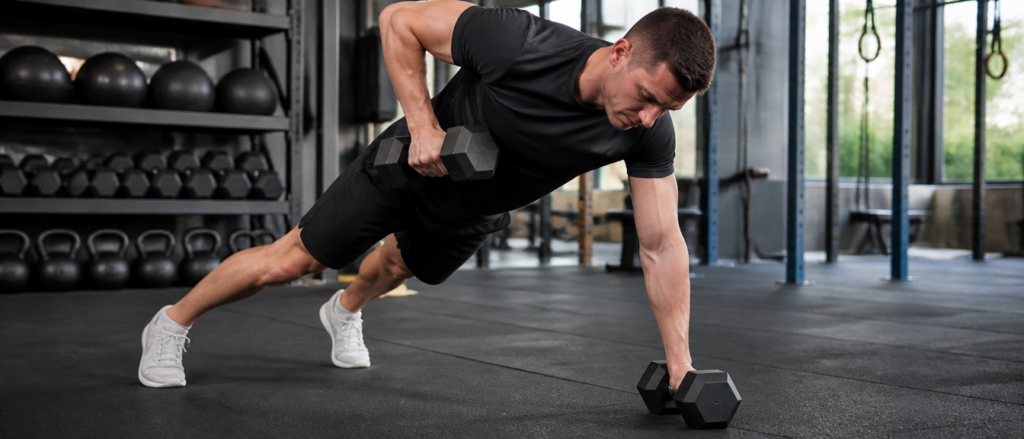
With hexagonal dumbbells, the flat face provides a defined, non-mobile contact point with the floor surface. The dumbbell is stable under load in all three axes — it will not roll longitudinally, laterally, or rotationally. This stability allows floor-based exercises to be performed by independent gym members without supervision, which is a prerequisite for programming them in a commercial context where a 1:30 trainer-to-member ratio is typical.
The Braille Marking Innovation: Design With a Different Purpose
The geometric optimisation of the hexagonal head has been understood for decades. What Alex Athletics’ Hexagon Braille Dumbbell (C4) adds to this established design is a recognition that the free weight area — historically one of the most navigationally challenging zones in a commercial gym for members with visual impairments — can be made fully accessible without changing the fundamental form.
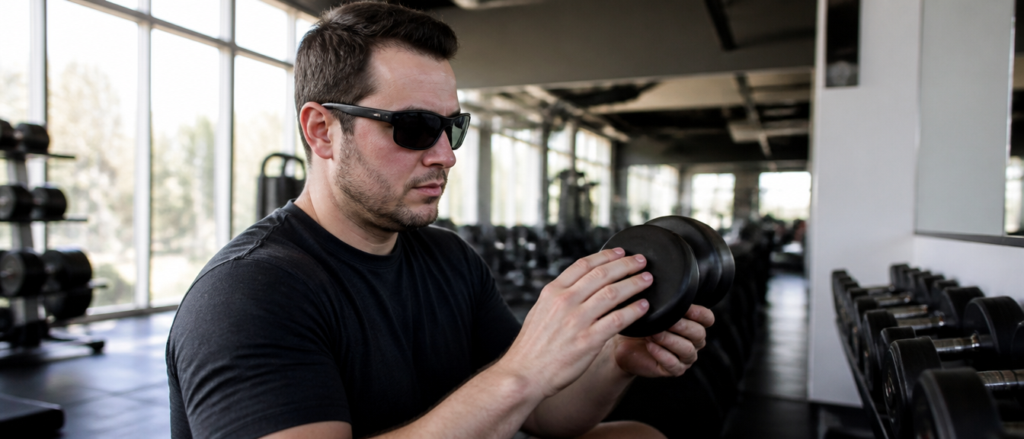
The integration of raised Braille weight markings alongside standard numerals on the dumbbell head is a tactile identification system that allows visually impaired athletes to independently identify any weight in a rack by touch alone. The numerals and Braille are embossed directly into the rubber head material — not printed or adhesive-applied, which would degrade under cleaning and handling — ensuring the marking system remains legible for the commercial service life of the dumbbell.
For visually impaired gym users, the absence of tactile weight identification on standard dumbbells creates a dependency on staff assistance for every weight selection — a practical barrier to independent training that accumulates into a significant membership experience disadvantage. Braille-marked dumbbells remove this dependency entirely: the member can navigate the rack, select their weight, and progress through their session without requiring intervention.
ADA Compliance and the Business Case for Inclusive Equipment
The accessibility requirement for commercial fitness facilities is established in law. Under ADA Accessibility Guidelines published by the U.S. Access Board, commercial fitness facilities are required to ensure that equipment and facilities are accessible to individuals with disabilities. Title III of the Americans with Disabilities Act specifically addresses public accommodations and commercial facilities — which includes commercial gym operations — and requires that these facilities provide equal access to all members regardless of disability status.
In practice, ADA compliance for free weight areas has historically been interpreted primarily in terms of physical access — clearance widths, equipment spacing, accessible routes. The tactile identification challenge for visually impaired members has been addressed inconsistently, typically through staff assistance rather than equipment design. Braille-marked dumbbells represent a direct equipment-level solution to this accessibility gap.
Beyond legal compliance, the Health & Fitness Association (IHRSA) consistently identifies community inclusion and diverse membership as growth drivers for commercial gym operators. Facilities that visibly signal an inclusive training environment — through equipment choices as much as programming and marketing — expand their addressable market to include the estimated 253 million people globally living with visual impairment in various degrees. Stocking Braille dumbbells is a visible, practical signal of that commitment that goes beyond signage.
Facility Type Fit: Who Benefits Most From the Hexagon Braille Dumbbell
| Facility Type | Primary Benefit | Programming Application |
|---|---|---|
| Inclusive commercial gyms | ADA-aligned free weight area; independent training for visually impaired members | Full dumbbell range replacement or supplementary Braille set |
| Rehabilitation clinics | Safe floor exercise base; Braille for patients with visual impairment | Low-weight range (1–10 kg); therapist-supervised and independent protocols |
| Community recreation centres | Inclusive facility signal; diverse member population support | Braille sets at commonly used weights (2–20 kg) |
| Senior fitness facilities | Anti-roll safety critical for balance-compromised users; tactile ID for low vision | Light weight range (1–10 kg); anti-roll critical at floor level |
| University / campus gyms | ADA compliance; serves student body with diverse accessibility needs | Full dumbbell range; integrates with accessible facility audit requirements |
| Premium boutique studios | Brand differentiation through inclusive design; versatile floor exercise use | Full set as primary dumbbell inventory; floor circuit programming |
Commercial Construction Specifications of the C4
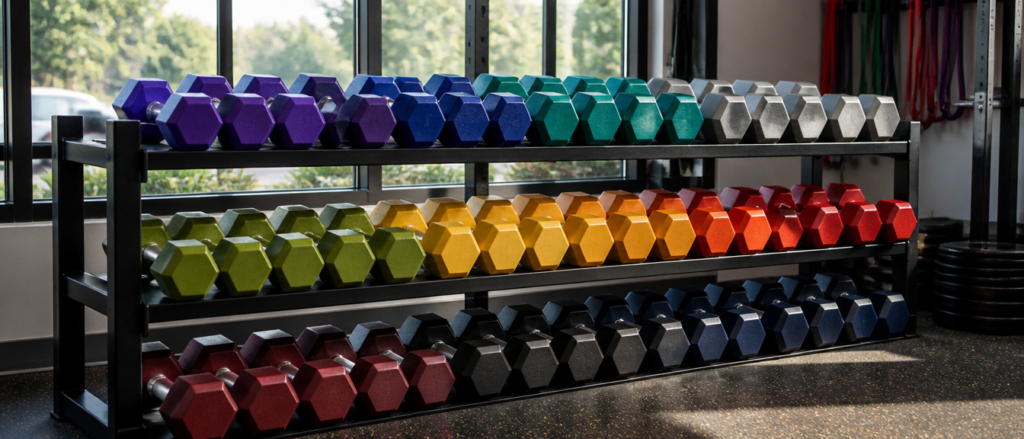
The Hexagon Braille Dumbbell’s design principles are only as useful as the commercial-grade construction behind them. The C4 uses a solid cast iron core for consistent mass distribution and dimensional stability. The premium rubber coating bonds securely to the core, providing shock absorption, noise reduction, floor protection, and the abrasion resistance required for multi-user commercial use. The Braille and numeral markings are moulded directly into the rubber during the vulcanisation process — not applied post-production — ensuring long-term tactile legibility under repeated handling and cleaning. The chrome-plated steel handle features ergonomic knurling that provides consistent grip across the full weight range (1–50 kg), with corrosion resistance appropriate for high-humidity gym environments. The C4 is available in standard weight increments across the full commercial dumbbell range, making it viable as a complete primary commercial dumbbell inventory or as a Braille-supplementary set alongside an existing floor.
Frequently Asked Questions
Why is hexagonal the standard shape for commercial dumbbells rather than round?
The hexagonal shape solves two commercial gym safety problems that round dumbbells cannot address: rolling hazard and floor exercise instability. Six flat faces provide sufficient contact area to prevent rolling under all commercial gym conditions — inclined floors, vibration, adjacent equipment contact — while keeping the head profile compact and manufacturing cost efficient. Round dumbbells have no flat contact surface with the floor, making them inherently mobile and inappropriate for floor-based exercises in unsupervised commercial settings.
What exercises specifically require hexagonal dumbbells for safe commercial use?
Renegade rows, dumbbell push-ups, floor presses, plank rows, and supported single-arm rows all require placing the dumbbell head in direct load-bearing contact with the floor. With round dumbbells, the single tangent contact point provides no lateral stability, creating a roll risk under load. Hexagonal flat faces provide a stable, multi-point contact base that allows these exercises to be performed safely by independent commercial gym members without continuous active stabilisation or supervisor oversight.
How are the Braille markings integrated into the dumbbell head?
The Braille and numeral weight markings on the Hexagon Braille Dumbbell are moulded directly into the rubber head during the manufacturing process — not printed, painted, or adhesively applied. This means the markings are three-dimensional and permanent: they maintain tactile legibility through years of commercial handling, cleaning agent exposure, and rubber surface wear. The raised dots remain identifiable by touch in the same way regardless of environmental conditions.
Are Braille dumbbells required for ADA compliance in US commercial gyms?
ADA Title III requires that commercial fitness facilities provide equal access and independent usability for members with disabilities. While specific equipment-level Braille requirements for dumbbells are not explicitly mandated in current ADA standards, the ADA’s equal access principle creates a compliance context in which tactile weight identification directly addresses a documented accessibility gap for visually impaired gym users. Many facilities proactively stock Braille dumbbells as part of a comprehensive ADA compliance and inclusive design programme rather than as a response to a specific mandate.
Can Hexagon Braille Dumbbells replace a standard dumbbell set, or are they a supplement?
The Hexagon Braille Dumbbell is a full-specification commercial dumbbell available from 1 to 50 kg in standard increments — it is designed and built to serve as a complete primary dumbbell inventory, not a specialist supplement. Facilities can replace an existing standard hex dumbbell set with Braille-marked equivalents at no functional compromise: the geometry, materials, weight range, and commercial durability are identical to standard commercial hex dumbbells, with the addition of the Braille identification system.
Conclusion
The hexagonal dumbbell head is one of the most consequential design choices in commercial gym equipment. It eliminates rolling hazards, enables the full range of floor-based functional training, optimises rack storage density, and provides ergonomic grip versatility — all through a geometric decision that adds no complexity to the manufacturing process relative to round alternatives. The Braille marking system on the C4 extends this functional design to one of the most consistently underserved populations in commercial gym environments: athletes with visual impairments who want to train independently.
For facility operators looking to specify free weight training equipment that serves a broad member population without compromise, contact our team to discuss the Hexagon Braille Dumbbell specifications, volume pricing, and configuration options for your facility.