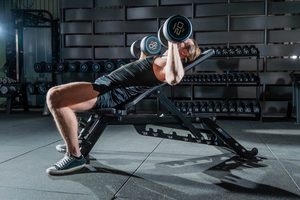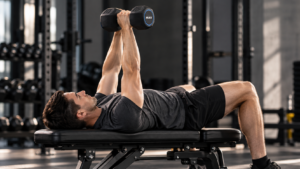
Every experienced strength coach has observed the same pattern: a trainee who can bench press 100 kg with a barbell but cannot press 50 kg with each arm unilaterally. The numbers do not add up. Bilateral pressing should require each side to produce exactly half the total load. It does not — and the reason why is a neuromuscular phenomenon called the bilateral deficit. Understanding it is the entry point to understanding why iso-lateral training produces outcomes that bilateral training cannot, and why the design principles behind independent-arm pressing machines like the IsoMotion Press are grounded in documented training science rather than marketing positioning.
What Is Iso-Lateral Training?
Iso-lateral training refers to any movement pattern in which each limb operates independently — moving through its own range of motion, generating its own force, and receiving its own neuromuscular stimulus without being mechanically connected to the contralateral limb. In the context of pressing equipment, an iso-lateral machine provides two independently pivoting arms rather than a single fixed bar connecting both handles. Each arm can move at a different speed, through a different range, and under different loads from the other — either simultaneously or alternately.
This is distinct from both traditional bilateral training (both limbs connected and moving as one unit) and pure unilateral training (one limb operating while the other is inactive). Iso-lateral training occupies a specific position: both limbs are active simultaneously, but their mechanical paths are decoupled. The dominant side cannot compensate for the weaker side, and the weaker side is required to produce full load independently.
The Bilateral Deficit: The Neuromuscular Gap That Bilateral Training Conceals
The bilateral deficit (BLD) is the most well-documented evidence base for iso-lateral training’s advantages. It describes a consistent neuromuscular phenomenon: when both limbs contract simultaneously to produce maximal force, each limb generates measurably less force than it would when contracting alone. Research published in PLOS ONE (PMC) characterises the bilateral deficit as a well-known neurophysiological phenomenon attributable to modifications in neuromuscular and cortical control — with reported deficits ranging from 5% to 25% depending on the muscle group, movement velocity, and population tested.
The mechanism is neural rather than structural. During bilateral contractions, cortical inhibition reduces the neural drive to each limb relative to what either could generate independently. In practical terms, this means that a barbell bench press provides each pectoral muscle with a smaller neuromuscular stimulus than an equivalent unilateral or iso-lateral press at the same per-limb load. The bilateral setup literally suppresses the motor output each side can achieve.
This has direct implications for commercial gym programming: athletes and members who train exclusively on bilateral machines and bilateral free weight movements may never fully develop the neuromuscular capacity of each limb independently. The gap between bilateral performance and true unilateral capability — often 10–20% in trained individuals — represents both an untapped performance reserve and an undetected risk factor for asymmetry-driven injury.
How Strength Asymmetry Develops and Why It Persists
Strength asymmetry — a measurable difference in force production capacity between the dominant and non-dominant side — is present in nearly every training population. A comprehensive scoping review and meta-analysis published in Scientific Reports (Nature) documented upper limb strength asymmetry across a broad research base, finding that between 21% and 38% of participants showed limb dominance reversals between testing sessions — evidence of how dynamic and variable these asymmetries are, and how poorly they are captured by single-session bilateral assessments.
In bilateral training, the dominant side naturally contributes a disproportionate share of the total movement load. A barbell bench press involves a single bar connecting both hands: if the right side is stronger, it produces more force and the bar accommodates by rotating imperceptibly, or the weaker side simply reduces its range of motion fractionally. Neither the coach nor the trainee can see this happening in real time. Over months of bilateral training, the dominant side continues to develop while the weaker side is systematically under-loaded — the asymmetry compounds rather than corrects.
The problem is not the bilateral movement itself but the absence of a mechanism to detect and correct the deficit. Iso-lateral training forces the correction structurally: each arm must lift its own load, and if the weaker arm cannot complete the rep at the prescribed load, the stronger arm cannot compensate. The asymmetry becomes immediately visible and measurable — and the training intervention for correcting it is built into the exercise by design.
Four Biomechanical Advantages of Iso-Lateral Movement
The training science behind iso-lateral movement extends beyond bilateral deficit correction to four distinct biomechanical advantages.
1. Natural convergence path. The human pectoral muscle’s optimal pressing path is not a straight horizontal line — it is a slight inward convergence as the arm approaches full extension. A fixed barbell constrains both hands to move on an identical path regardless of individual shoulder anatomy. Independent pressing arms naturally allow each hand to follow the convergence arc its shoulder joint biomechanics dictate, maximising pectoral fibre recruitment throughout the range and reducing the compensatory shoulder capsule loading that occurs when anatomy is forced to adapt to a fixed movement path.
2. Reduced shoulder capsule stress. The American College of Sports Medicine (ACSM) emphasises that movement pattern selection should consider the individual’s anatomical variability, particularly at complex joints like the shoulder. Iso-lateral pressing allows each shoulder to operate within its own anatomically appropriate range and path, eliminating the rotational and translational stress that arises when bilateral equipment forces bilateral symmetry on asymmetrical anatomy. This is particularly relevant in commercial gym populations where a proportion of members have prior shoulder injury, impingement, or structural variation that makes fixed-bar pressing uncomfortable or contraindicated.
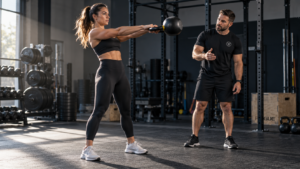
3. Increased core stabiliser demand during alternating patterns. When iso-lateral exercises are performed in an alternating pattern — one arm pressing while the other returns — the anti-rotation demand on the core musculature is substantially higher than in bilateral pressing. The unilateral force vector creates a moment arm that the core must resist, engaging the obliques, transverse abdominis, and deep spinal stabilisers in a functional, loaded context. This represents a training stimulus with direct transfer to sport and daily function that bilateral machine pressing does not provide.
4. Independent range of motion and load progression. Iso-lateral training enables differential loading — a protocol in which each side is loaded at its actual training maximum rather than at the maximum the weaker side can manage. When recovering from an injury, the rehabilitating side can be loaded at therapeutic intensity while the unaffected side is trained at full performance load. This is impossible on bilateral equipment, where the load is constrained to the weaker side’s capacity by the mechanical coupling of both arms.
Bilateral vs Iso-Lateral Training: Outcome Comparison
| Training Dimension | Bilateral Training | Iso-Lateral Training |
|---|---|---|
| Neuromuscular stimulus per limb | Reduced by bilateral deficit (5–25%) | Maximised — each limb receives full neural drive |
| Asymmetry detection | Concealed — dominant side compensates invisibly | Immediately visible — weaker side cannot mask deficit |
| Asymmetry correction | Not addressed — imbalance may compound over time | Structurally enforced — both sides trained equally |
| Movement path | Fixed by bilateral bar — no anatomical adaptation | Each arm follows its natural anatomical arc |
| Shoulder capsule stress | Higher where anatomy deviates from bar path | Lower — each shoulder self-selects its optimal path |
| Core stabiliser engagement | Minimal during machine pressing | High during alternating patterns — anti-rotation demand |
| Rehabilitation application | Limited — load constrained to weaker side | High — differential loading possible for each side |
| Progressive overload precision | Total load only — no per-side visibility | Per-arm load — exact monitoring of individual limb progress |
Iso-Lateral Training in Rehabilitation and Injury Prevention
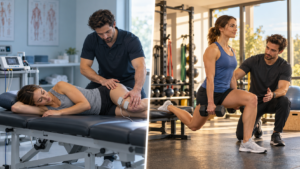
Beyond performance training, iso-lateral movement patterns have established clinical relevance in post-injury rehabilitation. The ability to train the affected limb at therapeutic load while maintaining full training intensity on the unaffected side is a significant advantage over both bilateral machines (which constrain load to the weaker side) and traditional bilateral free weights (which create a safety risk when one side is significantly compromised).
For athletes returning from unilateral shoulder injuries, rotator cuff conditions, or post-surgical reconstruction, iso-lateral pressing allows a controlled, progressive return-to-load protocol on the affected side within a familiar and commercially available equipment footprint. The movement path freedom of independent arms also accommodates the modified ranges of motion that rehabilitation protocols frequently require during early loading phases — something that a fixed bar cannot provide.
The IsoMotion Press: Applying the Science at Commercial Scale
The IsoMotion Press by Alex Athletics applies each of the principles above in a commercial-format machine. Its independent arm design eliminates bilateral coupling entirely — each arm moves, loads, and provides neuromuscular stimulus independently. The convergence arc of each arm follows the natural inward path of human pressing biomechanics rather than the straight horizontal path of a fixed bar machine. The maximum load of 100 kg per arm exceeds the capacity requirements of elite training populations, and the quick-adjust link-arm system enables transitions between exercise variations — flat press, incline press, hip thrust — without plate reloading.
Dimensioned at W1478 × H1158 × D1658 mm, the IsoMotion Press’s footprint is appropriate for boutique studio deployment as well as commercial gym performance zones. Its reinforced steel frame and industrial-grade powder coating are aligned with commercial gym durability requirements — appropriate for multi-user, high-frequency daily use in a professional facility context. As part of Alex Athletics’ commercial strength equipment range, it represents the application of 40+ years of engineering experience to a specific biomechanical problem: how to make independent-arm training accessible, safe, and effective at commercial gym scale.
Which Training Populations and Facilities Benefit Most
| Population / Facility | Primary Iso-Lateral Benefit | Key Application |
|---|---|---|
| Performance athletes | Bilateral deficit correction; maximum neuromuscular stimulus per limb | Pressing strength development; return-to-sport programming |
| Rehabilitation patients | Differential loading; natural movement path for injured shoulder | Post-surgical pressing rehabilitation; rotator cuff recovery |
| General commercial gym members | Asymmetry correction; safer pressing path for variable anatomy | Primary pressing station alternative to barbell for non-specialist members |
| Personal training studios | Versatility; differential load for uneven client progression | Single machine covers chest, shoulder, hip thrust — efficient space use |
| Senior fitness facilities | Shoulder-safe path; controlled independent movement | Upper body strength development without shoulder capsule stress |
| Sports performance centres | Functional pressing with core stabiliser demand; asymmetry monitoring | Integration with team-sport conditioning programme |
Frequently Asked Questions
What is the bilateral deficit and why does it matter for gym training?
The bilateral deficit (BLD) is a documented neuromuscular phenomenon in which each limb generates less force during bilateral contractions than it would contracting alone — typically 5–25% less per limb depending on the exercise and population. In practical terms, it means that bilateral pressing machines and barbell exercises provide each side of the body with a smaller neuromuscular stimulus than equivalent iso-lateral or unilateral training. For athletes and serious trainees, this represents an untapped performance reserve and an undetected asymmetry risk.
How does iso-lateral training correct strength asymmetry?
Iso-lateral training corrects strength asymmetry structurally: when each arm operates independently, the dominant side cannot compensate for the weaker side. If the weaker arm cannot complete the prescribed load, the set ends regardless of the dominant arm’s capacity. This makes the asymmetry immediately visible and requires each session to develop both sides toward a common standard, rather than allowing the dominant side to perpetually mask the deficit of the weaker one.
Is iso-lateral training appropriate for beginners, or is it only for advanced athletes?
Iso-lateral training is appropriate across the full experience range, though the primary benefits are most pronounced in trainees with measurable bilateral deficits — which research suggests is the majority of trained individuals. For beginners, iso-lateral machines provide a safer alternative to barbell pressing because the movement path adapts to the user’s anatomy rather than requiring the user to adapt to the bar. The load can also be adjusted per side, allowing each arm to work at its appropriate training load from the first session.
Does iso-lateral pressing provide better muscle development than barbell pressing?
Iso-lateral pressing provides a different — and in some dimensions superior — neuromuscular stimulus to barbell pressing. By eliminating the bilateral deficit, it maximises neural drive to each pectoral, deltoid, and tricep through the full range of motion. The natural convergence arc also ensures that pectoral fibres are recruited through the full contraction path that their anatomy dictates, rather than the compromised path of a fixed bar. Whether this produces superior muscle development depends on the individual’s bilateral deficit magnitude, existing asymmetries, and training history.
How is the IsoMotion Press different from standard plate-loaded or selectorised pressing machines?
Standard plate-loaded and selectorised pressing machines use a single resistance mechanism connected to both arms — either a common weight stack or a single pivot bar. This mechanical coupling creates bilateral compensation: the dominant side can compensate for the weaker side within the coupled system. The IsoMotion Press uses completely independent arms with separate pivot points and loading mechanisms for each side, eliminating compensation entirely. It also provides natural arm convergence, unlike most fixed-path selectorised machines whose arms move on a fixed arc determined by the manufacturer rather than the user’s anatomy.
Conclusion
The training science behind iso-lateral movement is well-established: the bilateral deficit, documented at 5–25% per limb in the published literature, represents a consistent gap between what each limb can produce in isolation and what it produces during bilateral training. Iso-lateral movement corrects this gap structurally — by decoupling the arms, it eliminates compensation, maximises per-limb neuromuscular stimulus, enables natural convergence paths, reduces shoulder capsule stress, and adds core anti-rotation demand that bilateral pressing machines cannot provide. These are not incremental advantages over bilateral training; they are qualitatively different training stimuli with distinct clinical and performance implications.
For facility operators interested in adding iso-lateral pressing capability to their functional training equipment floor, contact our team to discuss the IsoMotion Press specifications, installation requirements, and commercial pricing.