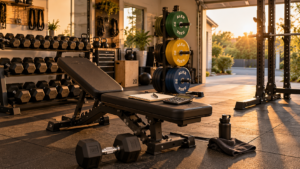
When we began developing what would become the Keynimax™ Bench, we were not trying to produce a better version of an existing design. We were trying to solve a problem that conventional bench design had accepted as inherent: the trade-off between structural load capacity and biomechanical freedom. Standard commercial benches are built wide for stability and rated at load capacities appropriate for most users. What they are not designed to accommodate is the full, unrestricted movement of the scapulae during pressing — and across four decades of manufacturing commercial strength equipment, we had accumulated enough feedback from coaches, athletes, and physios to know that this restriction is not a minor inconvenience. It is a consistent source of shoulder loading that limits performance and, over time, accumulates into injury.
The Keynimax™ required us to solve both problems simultaneously: achieve a load capacity that would satisfy the world’s strongest competitive pressers, while fundamentally redesigning the pad geometry to eliminate the scapular restriction that has always been assumed to be inseparable from bench stability. This article documents the engineering decisions behind that solution.
Why We Designed for 1,000 lbs
The question of load capacity in a commercial bench is partly about numbers and partly about what those numbers communicate. A bench rated at 450 kg (approximately 992 lbs) covers all practical commercial use cases: even at the elite end of competitive powerlifting, the International Powerlifting Federation (IPF) world records in raw bench press sit well below 350 kg — meaning a 1,000 lb bench provides a safety factor of more than 2:1 against the heaviest loads in competitive sport. For the commercial gym population, the practical operating range is far lower: most members train bench press between 40 kg and 150 kg.
We chose 1,000 lbs as the Keynimax™ design target for three reasons. First, it provides the structural safety factor required to certify the bench for commercial deployment in facilities where user weights, loading behaviour, and maintenance discipline are variable. A bench used by hundreds of members per week must be engineered to accommodate not just the peak expected load but the unpredictable loading events — the user who loads the bench and sits on the edge, the step-up movement at unexpected angles, the sudden eccentric overload. Second, a 1,000 lb rating communicates clearly to facility operators that this bench does not require a weight limit sign — any member can train on it at any load they are capable of producing. Third, hitting that threshold required us to build the frame with structural specifications that translate into long-term rigidity and stability, not just peak load tolerance.
The Biomechanical Problem We Were Solving
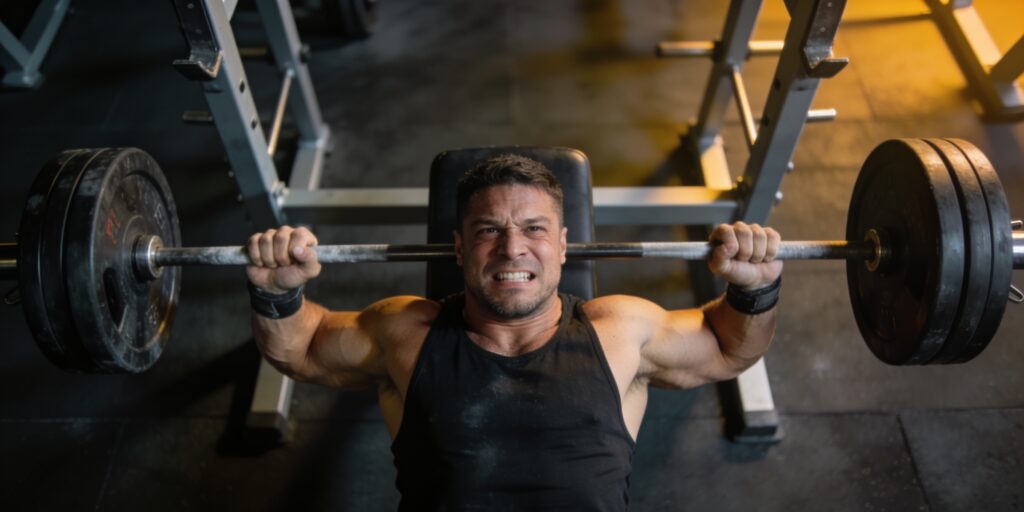
The starting point for the Keynimax™’s shape was a biomechanical reality, not a design preference. Research published in Frontiers in Physiology documented precisely the problem we were engineering around: limitation of scapular mobility on a conventional bench is attributed to the fixation of the scapula against the bench surface, which limits natural movement and creates abnormal loading patterns that increase shoulder injury risk. When the scapulae cannot retract and protract freely during the bench press, the humeral head is forced into hyperextension relative to the glenoid, concentrating stress on the anterior capsular ligament and rotator cuff structures.
This is not a coaching problem that better technique can fully solve. The constraint is geometric: a standard rectangular bench pad contacts the scapulae directly and prevents the full retraction arc. The wider the pad, the more secure the lateral stability — and the more the scapulae are pinned in place. This is the fundamental trade-off that conventional bench design accepts. We did not accept it.
The Patented Key-Shape: The Design Decision That Defines the Bench
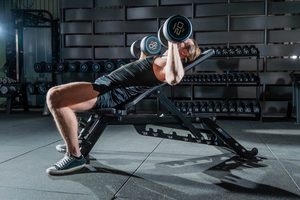
The Keynimax™’s defining innovation is the key-shaped contour of the upper pad. Rather than maintaining the full pad width across the entire contact zone, the upper section narrows significantly — creating a profile that contacts the mid-spine and lumbar regions normally while deliberately removing the pad material that would otherwise pin the scapulae against the bench surface. The shoulder blades can now retract and protract freely through the full natural range, uninhibited by the bench geometry.
This narrowing is where the name and the patent originate. The “key” shape — wider at the base, narrowing at the top — is not an aesthetic choice. It is the precise geometric solution to the scapular restriction problem. Every dimension of the narrowing is calculated to the minimum pad width required to maintain trunk support during pressing, while maximising the clear zone available for scapular movement at the shoulder contact level. Getting this geometry wrong in either direction produces the same functional failure — too wide and the scapulae are still partially restricted; too narrow and the bench loses the trunk contact that enables stability at high loads.
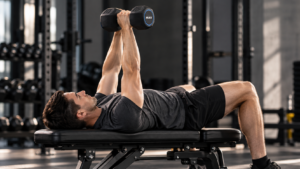
The practical effect on the pressing movement is significant: users experience a deeper stretch at the bottom of the rep — the pectoral muscles reaching full lengthening without the scapulae being arrested by the pad — and a stronger peak contraction at the top, because the shoulder mechanics are not being compensated through anterior capsule loading. The American College of Sports Medicine (ACSM) emphasises that equipment design should support rather than constrain the natural biomechanics of the intended movement — the Keynimax™ key-shape is the design expression of that principle.
The Stability Wing: Solving the Consequence of Narrowing
Narrowing the upper pad creates an immediate structural problem: if the pad is not supporting the shoulder blades laterally, what prevents lateral roll during heavy pressing? The answer is the Stability Wing — the patent-protected structural extension that branches outward from the upper pad at shoulder level, providing lateral contact and stabilisation precisely where the narrowed pad cannot.
The Stability Wing geometry is designed to contact the posterior shoulder — specifically the posterior deltoid region — rather than the scapula. This contact point supports lateral balance without interfering with the scapular movement plane. The result is a bench that provides the lateral stability of a wide commercial pad while maintaining the scapular freedom of a design that contacts nothing in the inter-scapular zone. The two elements — the narrow key-shape pad and the Stability Wing — work as an integrated system. Neither functions as designed without the other.
Frame Architecture: The Engineering Behind 1,000 lbs
Achieving 1,000 lbs load capacity in an adjustable bench — one that must also maintain its rated load at every angle from flat to full incline — requires a frame architecture that addresses a specific structural challenge: the adjustable mechanism creates geometric variability in how load transfers through the frame. At flat, the load passes almost directly vertically through the leg structure. At incline, the load vector shifts, creating bending moments at the adjustment mechanism and the frame-to-leg connection that do not exist at flat.
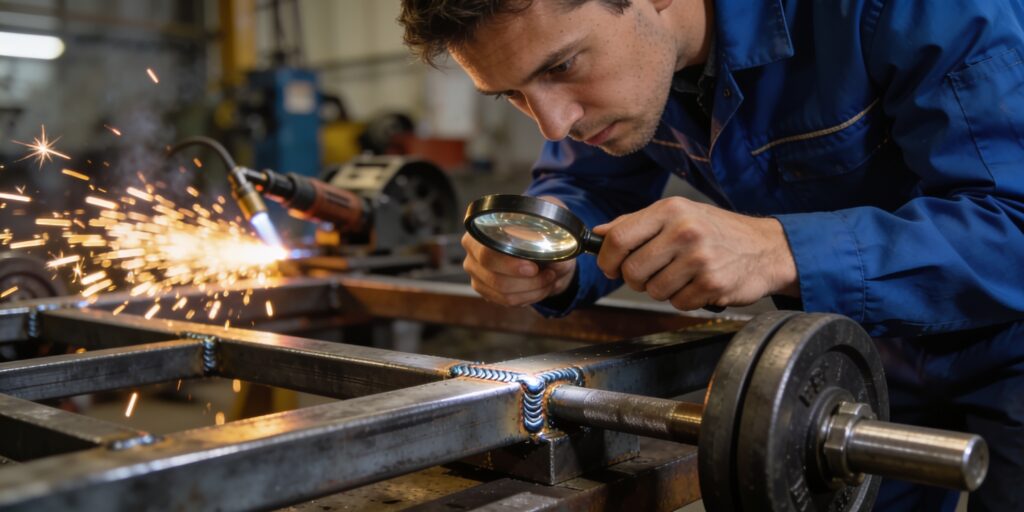
The Keynimax™ frame uses heavy-gauge steel throughout — the wall thickness is specified for commercial use, not home gym economics. The adjustment mechanism is engineered to lock rigidly at every setting, eliminating any flex or play in the locked position. The leg geometry distributes load to a wide base footprint (W1510 mm) that ensures lateral stability is maintained even when load is applied unevenly across the pad — the practical condition during step-ups, seated exercises, or uneven dumbbell presses where one side loads ahead of the other.
Our QC process validates the 1,000 lb rating through structural load testing on a production sample basis — not just design analysis. Every batch of Keynimax™ benches is manufactured to the same steel specification and weld procedure, and our 40+ years of manufacturing commercial strength equipment inform the material and process specifications at every stage of production.
The Slim Central Pad: Proprioception as a Design Principle
The third distinct design element of the Keynimax™ is the slim central pad. Where most benches use the broadest possible lumbar support surface, the Keynimax™ deliberately reduces the central pad width to the zone that provides essential spinal support while reducing the area that dampens proprioceptive feedback.
Proprioception — the body’s real-time awareness of its own position in space — is a critical component of stability under heavy load. A wide, padded bench surface distributes pressure so broadly that the neural signals from pressure receptors in the skin and subcutaneous tissue are muted. The narrower central pad concentrates pressure on a smaller contact zone, increasing the proprioceptive signal clarity and forcing the core stabilisers to engage more actively to maintain balance during the press. This is not simply a training benefit — it is a safety mechanism. Greater core engagement and better positional awareness under heavy load reduce the risk of involuntary movement or loss of control at the sticking point.
Keynimax™ vs Standard Commercial Bench: A Specification Comparison
| Specification | Keynimax™ Bench | Standard Commercial Bench |
|---|---|---|
| Load capacity | 1,000 lbs (454 kg) — certified | Typically 400–600 lbs depending on model |
| Pad geometry | Patented key-shape — narrowed upper section | Uniform rectangular pad full length |
| Scapular freedom | Full — inter-scapular zone cleared by design | Restricted — pad pins scapulae against surface |
| Lateral stability | Stability Wing at shoulder contact zone | Full-width pad provides lateral contact |
| Core activation | Enhanced — slim central pad increases proprioceptive demand | Standard — broad surface reduces proprioceptive signal |
| Range of motion | Maximum — full scapular retraction and protraction | Reduced — scapular mobility partially blocked |
| Adjustability | Multi-angle flat to full incline; quick-lock mechanism | Varies; most commercial models adjustable |
| Dimensions | W1510 × D713 × H420/1310mm | Varies; typically similar footprint |
| Patent protection | Yes — key-shape contour and Stability Wing | No — standard geometry |
Facility and User Profile Fit
| User / Facility Context | Primary Keynimax™ Benefit | Application |
|---|---|---|
| Competitive powerlifters | 1,000 lb capacity; full range pressing; confidence under maximum load | Primary competition-prep bench; no weight limit for any load encountered in training |
| Bodybuilders / hypertrophy focus | Maximum ROM at bottom of rep; superior pectoral fibre recruitment | Primary flat and incline press station; eliminates anterior shoulder compensation |
| Athletes with shoulder history | Scapular freedom eliminates anterior capsule overloading | Safer pressing alternative for users with prior impingement or rotator cuff conditioning |
| Personal training studios | Versatility across flat, incline, step-up, hip thrust; single station covers multiple movements | Space-efficient premium bench for client-facing studio environment |
| Premium commercial gyms | Patent differentiation; visible engineering quality; no member weight limit | Flagship bench for strength zones; signals equipment investment to discerning members |
| Functional trainers / coaches | Enhanced proprioception; core engagement; movement quality feedback | Primary pressing tool in movement-quality focused programming |
Frequently Asked Questions
What makes the Keynimax™ Bench’s 1,000 lb capacity credible compared to standard commercial benches?
The 1,000 lb rating on the Keynimax™ is achieved through heavy-gauge steel frame construction, a locking adjustment mechanism tested to maintain rated capacity at all incline positions, and wide-base leg geometry that distributes load safely under asymmetric and off-centre loading. Unlike some commercially cited load capacities that reflect static centre-load testing only, the Keynimax™’s 1,000 lb rating accounts for the variable loading conditions of commercial gym use — including step-ups, seated loading, and asymmetric pressing.
Why does scapular restriction on a standard bench matter for training outcomes?
Scapular restriction on a standard bench pad limits the natural retraction and protraction arc of the shoulder blades during pressing. Research published in Frontiers in Physiology confirms that this restriction creates abnormal loading patterns on the shoulder complex — concentrating stress on the anterior capsular ligament and rotator cuff structures. Beyond injury risk, the restriction reduces the range of motion available to the pectorals at the bottom of the press, which limits the effective muscle length change and the depth of the eccentric stretch that drives hypertrophy adaptation.
How does the Stability Wing provide lateral support without restricting the scapulae?
The Stability Wing contacts the posterior shoulder region — specifically behind the deltoid — rather than the inter-scapular zone where conventional pad width would pin the scapulae. This contact point is lateral to the scapular movement plane, providing resistance against lateral roll during heavy pressing without interfering with the scapulae’s ability to retract and protract freely. The geometry of the Stability Wing is engineered to this specific anatomical relationship — it is not a simple pad extension but a purpose-designed structural element.
Is the Keynimax™ Bench appropriate for users who are not competitive powerlifters?
Yes — the 1,000 lb capacity is an engineering specification that ensures stability and confidence for all users, not a claim about who should use the bench. The biomechanical benefits of the key-shape design are relevant to any user who presses: the scapular freedom improves range of motion and reduces shoulder loading for recreational gym members as much as for competitive athletes. The enhanced proprioception from the slim central pad benefits any user developing body awareness under load. The Keynimax™ is engineered for the full spectrum of gym populations, not only elite lifters.
What adjustable positions does the Keynimax™ Bench support?
The Keynimax™ adjusts from flat through a full range of incline positions. The adjustment mechanism locks firmly at each setting, maintaining the bench’s full rated capacity at every angle. This multi-position capability makes it the primary flat and incline press station for any facility, eliminating the need for separate flat and incline benches within the same zone. The quick-lock mechanism supports fast transitions between positions, appropriate for circuit training and superset programming as well as single-exercise sessions.
Conclusion
The Keynimax™ Bench is the result of a design process that started with the problem, not the product. Standard bench design accepts scapular restriction as an inherent cost of lateral stability. We rejected that trade-off and built a structural and geometric solution that achieves both simultaneously: full scapular freedom through the patented key-shape contour, lateral stability through the Stability Wing, and load capacity through a heavy-gauge steel frame that carries 1,000 lbs at any angle and under any realistic commercial loading condition. The result is a bench that performs better biomechanically, supports heavier loads safely, and engages the core more actively than any conventional design.
To learn more about the full commercial bench series or discuss the Keynimax™ Bench for your facility, contact our team.ㄊ