The commercial Pilates market is in the middle of a sustained boom that shows no signs of slowing. Studio counts are increasing, franchise operators are accelerating their rollouts, and consumer demand for reformer-based training is expanding well beyond the demographic that historically drove Pilates participation. For anyone opening a new Pilates studio, expanding an existing one, or adding Pilates to a multi-modality commercial gym, the equipment decision is the most consequential capital investment they will make — and it is one where the wrong choice is difficult and expensive to reverse.
This article breaks down what is driving the commercial Pilates boom, explains how the commercial market differs from home and rehabilitation equipment, and provides a structured framework for evaluating Pilates equipment brands before committing to a major studio investment.
The Commercial Pilates Market in Numbers
The global Pilates equipment and gear market is growing rapidly across all segments. According to Market Research Future, the Pilates Equipment and Gear Market was estimated at USD 5.35 billion in 2024 and is projected to grow to USD 11.07 billion by 2035 at a CAGR of 6.83%. Within that broader category, the reformer segment is expanding at an even faster rate. The global Pilates reformer market, valued at USD 7.65 billion in 2025, is projected to reach USD 16.8 billion by 2035 at a CAGR of 8.2%, according to Future Market Insights.
These figures reflect the convergence of multiple demand streams. More than 27 million people worldwide now participate in Pilates, with over 130,000 studios and fitness centers offering dedicated Pilates services globally. Franchise expansion has been particularly aggressive: Xponential Fitness added 300 new Club Pilates studios worldwide in late 2025 alone, extending its lead as the largest organized Pilates studio chain globally. At the same time, Pilates is expanding into rehabilitation, physiotherapy, and senior wellness settings — broadening the commercial demand base well beyond traditional boutique studio operators.
The market is also seeing significant investment in innovation. Smart reformers with app connectivity and guided workouts, modular studio setup kits designed for compact footprints, and biodegradable materials in accessories all reflect an industry responding to the demands of a rapidly diversifying commercial buyer base. Technavio’s market analysis projects the Pilates equipment sector to grow at a CAGR of 14.2% from 2025 to 2030 when technology-integrated products are included in the scope — a rate that substantially outpaces most adjacent fitness equipment categories.
What Is Driving the Commercial Pilates Boom
The growth of commercial Pilates is not a single-cause phenomenon. Several independent forces are converging to create sustained demand expansion that is structurally distinct from earlier Pilates market cycles.
Aging Demographics and Low-Impact Fitness Demand
As population demographics age across North America, Europe, and increasingly Asia-Pacific markets, demand for low-impact exercise modalities that deliver genuine fitness outcomes without joint stress is rising sharply. Pilates is particularly well-positioned to serve this demographic: it builds core strength, improves posture, enhances balance, and reduces injury risk — all outcomes that resonate strongly with adults over 50 who are seeking to maintain functional capacity and quality of life. Rehabilitation facilities, senior wellness centers, and medical fitness providers are now significant commercial buyers of Pilates equipment, a channel that barely existed in the early boutique studio era of Pilates expansion.
Post-Injury Rehabilitation and Clinical Integration
The clinical evidence base for Pilates-based rehabilitation has strengthened considerably in recent years. Physical therapists, sports medicine practitioners, and orthopedic rehabilitation specialists increasingly prescribe Pilates reformer work as part of recovery protocols for back injuries, knee rehabilitation, post-surgical recovery, and neurological conditions. This clinical adoption creates a distinct commercial equipment demand stream from rehabilitation clinics and hospital-affiliated wellness centers that prioritize different specifications — particularly durability, ease of adjustment, and carriage stability — compared to boutique studio buyers focused primarily on the training experience.
Celebrity and Influencer Normalization
Pilates has undergone a cultural repositioning over the past five years. What was historically perceived as a specialist discipline for dancers, post-rehabilitation patients, and dedicated enthusiasts has been transformed by social media into a mainstream fitness identity. Consistent documentation of Pilates training by high-profile athletes, entertainers, and fitness influencers has driven a new generation of consumers — including significant numbers of men, who were historically underrepresented in Pilates participation — toward reformer-based training. This cultural shift is directly translating into new studio memberships, new studio openings, and new equipment procurement cycles.

Commercial vs. Home Pilates Equipment: A Critical Distinction
One of the most common and costly mistakes made by new Pilates studio operators is procuring equipment that is appropriate for home or light-duty use rather than genuine commercial deployment. The distinction matters profoundly in practice, and understanding it is prerequisite to any serious equipment evaluation.
| Specification | Home / Light-Duty Equipment | Commercial-Grade Equipment |
|---|---|---|
| Daily use cycles | 1–3 sessions per day | 8–14 sessions per day (back-to-back class schedule) |
| Frame material | Lightweight aluminum or engineered wood | Heavy-gauge aluminum or steel with reinforced joints |
| Carriage rail system | Plastic or nylon wheels on basic rails | Precision-machined aluminum rails with sealed bearing wheel sets |
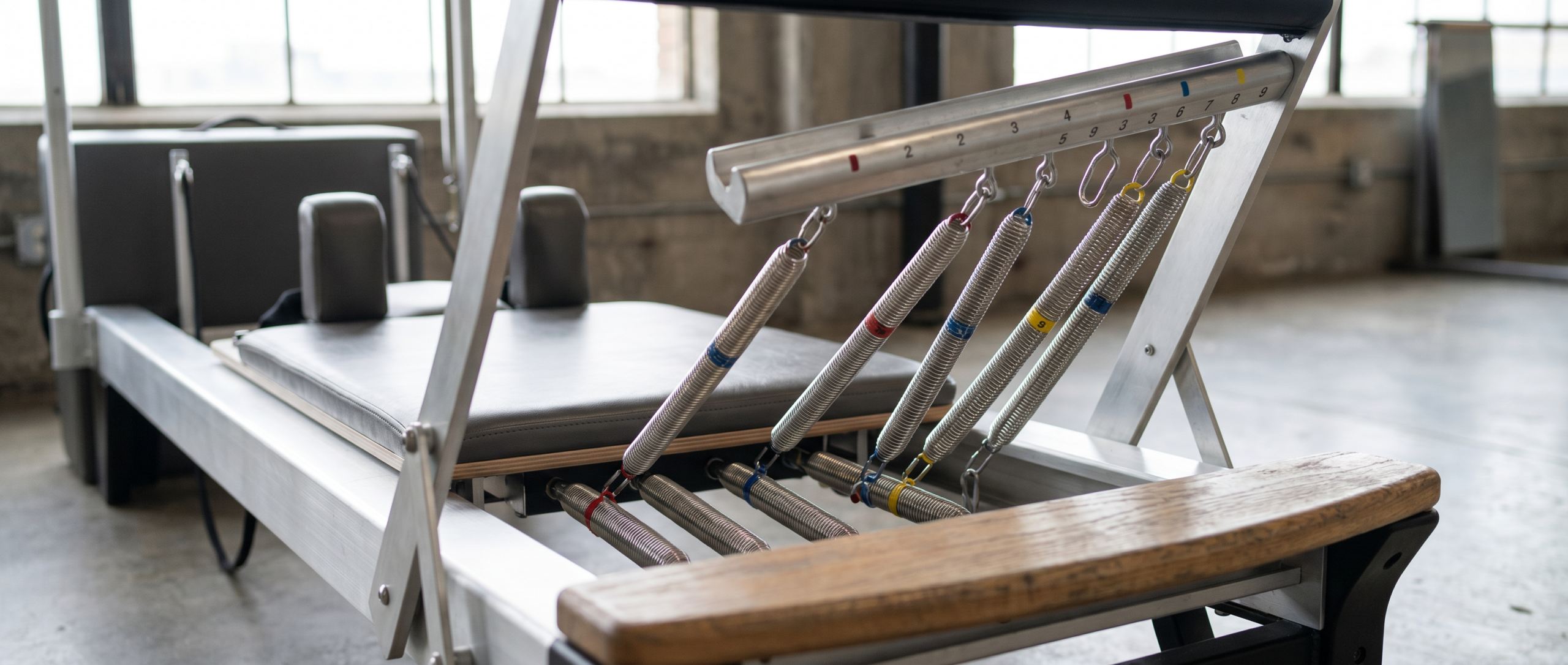
| Spring system | Standard coil springs, light calibration | Precision-calibrated springs with published resistance ratings, replaceable |
| Upholstery | Standard foam density, fabric or vinyl cover | High-density closed-cell foam, commercial-grade antimicrobial upholstery |
| Weight capacity | 100–150 kg | 150–200 kg |
| Footbar adjustment | Fixed positions, manual repositioning | Quick-release or tool-free multi-position adjustment for class transitions |
| Warranty expectation | 1–2 years | 5–10 years frame, 2–3 years parts and upholstery |
| Service life expectation | 3–5 years | 10–15+ years with proper maintenance |
A reformer that performs adequately in a home setting — where it may be used once or twice daily by a single user — will begin to show material degradation within months in a studio running six to eight classes per day across multiple users. Carriage rail wear, spring fatigue, footbar loosening, and upholstery compression failures all arrive far earlier than expected when home-grade equipment is placed in a commercial use pattern. Beyond the replacement cost impact, degraded equipment creates a safety risk and a member experience problem that directly undermines studio retention.
Key Equipment Categories for a Commercial Pilates Studio
A fully equipped commercial Pilates studio requires a complete apparatus ecosystem, not just reformers. Understanding the role of each piece and its commercial specification requirements allows buyers to make coherent investment decisions across the full setup.
Reformers are the centerpiece of any reformer-based Pilates studio. Studio-grade reformers should be specified with precision-machined aluminum carriage rails, sealed bearing wheel sets, calibrated spring systems with individually replaceable springs, quick-release footbar adjustment, and commercial-grade antimicrobial upholstery. A boutique studio running group reformer classes typically operates 6 to 12 reformers at peak, with additional units creating backup capacity for equipment rotation during servicing.
Cadillac / Trapeze Table extends the exercise vocabulary available to instructors and is particularly valued in rehabilitation and advanced training contexts. Commercial Cadillac specifications should emphasize the structural integrity of the overhead frame and the load rating of the spring bars and trapeze attachment points — these are under significant dynamic load during certain movement patterns and must be engineered for sustained commercial use.
Pilates Chair / Wunda Chair offers a high versatility-to-footprint ratio and is increasingly common in studios that program combination sessions combining reformer work with chair-based exercises. Commercial chair specifications should focus on the stability of the split pedal system and the precision of the spring resistance calibration at each position.
Ladder Barrel and Spine Corrector serve specialized functions in advanced programming and rehabilitation protocols. While not primary volume equipment, their presence in a fully equipped studio signals programming depth and allows instructors to deliver the full range of classical Pilates methodology.
Explore the full range of commercial Pilates equipment including reformers, Cadillac tables, chairs, and barrels, and review the Pilates equipment specifications for each category in detail.
How to Evaluate a Commercial Pilates Equipment Brand
Equipment brand selection in commercial Pilates is a high-stakes decision with long consequences. A studio built around a particular reformer system is difficult and expensive to change: replacement parts, spring specifications, instructor familiarity, and service relationships all become embedded in the operation. The following evaluation framework helps operators make the decision systematically rather than on the basis of catalog aesthetics or initial price point alone.
| Evaluation Criterion | What to Assess | Why It Matters |
|---|---|---|
| Frame and rail specification | Material grade, joint reinforcement method, rail machining tolerance | Determines structural durability under daily commercial load cycles |
| Spring calibration consistency | Published resistance ratings, tolerance range, individual replaceability | Calibration consistency directly affects exercise programming accuracy |
| Carriage smoothness | Wheel bearing type (sealed vs. unsealed), rail-to-wheel fit | Smooth, quiet carriage is a primary quality signal for instructors and members |
| Upholstery specification | Foam density (ILD rating), antimicrobial treatment, seam construction | High-use studio upholstery must resist compression set and sweat degradation |
| Footbar adjustment system | Number of positions, release mechanism, stability when locked | Class transition speed depends on quick, reliable footbar repositioning |
| Parts availability and lead time | Regional inventory, minimum order for spare springs and wheels | Equipment downtime during class schedules is a direct revenue loss |
| Manufacturer warranty and service | Frame warranty period, parts warranty, on-site service availability | Warranty terms reveal how much confidence the manufacturer has in their own product |
| Reference studios and trial access | Whether manufacturer can provide reference studios using the same equipment | Seeing equipment in daily commercial use is the most reliable evaluation method |
One practical evaluation step that many buyers skip is requesting the opportunity to trial equipment in a live commercial environment before committing to a full studio order. Reputable manufacturers who are confident in their commercial-grade specifications will accommodate this request. A trial on a reformer that has been in daily studio use for 12 to 18 months reveals far more about long-term performance than any catalog specification or showroom demonstration.

Common Procurement Mistakes in Commercial Pilates Studio Setups
Buying on price rather than specification. The price differential between home-grade and commercial-grade reformers is real and significant — typically 40% to 80% more for genuine commercial product. Operators who buy on initial price and discover the performance gap within the first year of operation face the choice of absorbing progressive member experience degradation or absorbing the capital cost of equipment replacement far earlier than planned.
Under-specifying carriage rail systems. The carriage rail is the component under the highest repetitive stress in a reformer system, and it is also the component most often under-specified in mid-range equipment. Buyers should request explicit information about rail material, machining tolerance, and the wheel bearing system before signing any purchase order.
Ignoring parts and service infrastructure. A reformer manufacturer without regional parts inventory or service network capability is a liability in a commercial studio context. Spring replacement, wheel bearing service, and upholstery replacement are all routine in a busy studio’s maintenance calendar. These should not require long-lead international shipping for a studio operating in North America, Europe, or Asia-Pacific.
Overlooking footprint planning. Commercial reformers require approximately 1.0 to 1.2 meters of clearance on each long side and 0.8 to 1.0 meters on each end for safe instructor access and movement. Studios that do not plan their reformer layout against these clearances before ordering equipment discover on delivery day that their capacity plan does not fit their physical space.
Our manufacturing process and quality assurance standards are designed specifically for the commercial use context — learn more about our manufacturing advantages and how they translate into equipment that performs reliably across years of daily studio use.
Frequently Asked Questions
What is the minimum number of reformers for a viable commercial Pilates studio?
A boutique Pilates studio running group reformer classes typically requires a minimum of 6 reformers to generate sufficient class revenue to cover operating costs in most commercial rental markets. Studios aiming for a full class schedule with back-to-back sessions benefit from 8 to 12 reformers, which also provides backup capacity during equipment servicing. The optimal number depends on class size, session frequency, and studio floor area.
What is the difference between a classical and a contemporary Pilates reformer?
Classical reformers follow the specifications established by Joseph Pilates in his original apparatus design — typically featuring a longer carriage, specific spring resistance ratios, and a box system integral to the equipment. Contemporary reformers modify these specifications to accommodate a wider range of body types, offer more adjustability, and integrate additional accessories. Commercial studios should select the equipment type that aligns with their programming methodology and instructor training.
How long does commercial Pilates reformer equipment last with proper maintenance?
A commercial-grade reformer from a reputable manufacturer, used in a studio running 8 to 10 classes per day and maintained according to the manufacturer’s schedule (regular rail lubrication, spring inspection, carriage wheel checking, upholstery inspection), should deliver a service life of 10 to 15 years for the frame and structural components. Consumable components — springs, wheel bearings, upholstery — will require replacement on shorter cycles of 3 to 5 years depending on use intensity.
Should a new Pilates studio buy all equipment from a single manufacturer?
For studio reformers, purchasing all units from a single manufacturer is strongly advisable. Mixed reformer systems create inconsistency in carriage feel, spring resistance, and footbar position that creates programming complexity for instructors and a quality inconsistency problem for members. For ancillary apparatus (Cadillac, chairs, barrels), some studios source from different manufacturers based on specific specification advantages, though maintaining a primary supplier relationship simplifies service and warranty management.
What certifications or standards should commercial Pilates equipment meet?
Commercial Pilates equipment should meet the structural and materials standards relevant to the buyer’s market. In North America, look for compliance with ASTM International standards for fitness equipment. In Europe, EN 957 standards for stationary training equipment apply to many Pilates apparatus categories. Beyond regulatory minimums, manufacturers who conduct their own load testing and publish tensile strength and fatigue cycle data are demonstrating a higher standard of commercial accountability than those who provide only catalog specifications.
Conclusion
The commercial Pilates market is expanding at rates that make it one of the most compelling growth opportunities in the commercial fitness equipment sector. Reformer demand is rising across boutique studio, rehabilitation, and senior wellness channels simultaneously — and the equipment investment decisions made by studio operators in this environment have consequences that play out over a decade or more of daily commercial use. Getting the brand and specification decision right is not a luxury — it is a business foundation.
Whether you are outfitting your first boutique Pilates studio or expanding a multi-location operation, the specification depth and commercial durability of your reformer system will define the quality of every training session your instructors deliver and every membership you retain. If you are ready to discuss commercial Pilates equipment specifications and sourcing, contact Alex Athletics to request a commercial studio equipment consultation and get specifications matched to your studio configuration and programming needs.