When commercial gym operators audit their facility for space inefficiency, their attention typically goes to large equipment: treadmill rows that are underutilised, weight machines whose footprint-to-usage ratio is unfavourable, squat racks that occupy prime floor area. What rarely enters the conversation is the cable attachment collection sitting in a bin, hanging on a wall rack that extends twelve feet, or piled on top of a cable machine in a tangle of steel handles and rope ends. Yet this storage problem — small in scale but high in operational impact — is one of the most consistently overlooked space and experience challenges on the commercial gym floor.
The Revolver Rack was designed specifically to solve it. This article examines why conventional cable attachment storage fails in commercial environments, what the rotating carousel approach does differently, and what operational value it delivers for facility operators who manage cable machine zones at commercial scale.
Why Cable Attachment Storage Is a Persistent Operational Problem
A fully equipped cable machine station requires a diverse inventory of attachments: lat pull-down bars, tricep ropes, V-bars, D-handles in pairs, straight bars, ankle straps, and rotating handles. A commercial gym with multiple cable stations and a functional training zone may stock twenty to forty individual attachments. Each has a different length, weight, and geometry. Together, they present a storage challenge that flat racks, wall hooks, and floor bins all solve imperfectly.
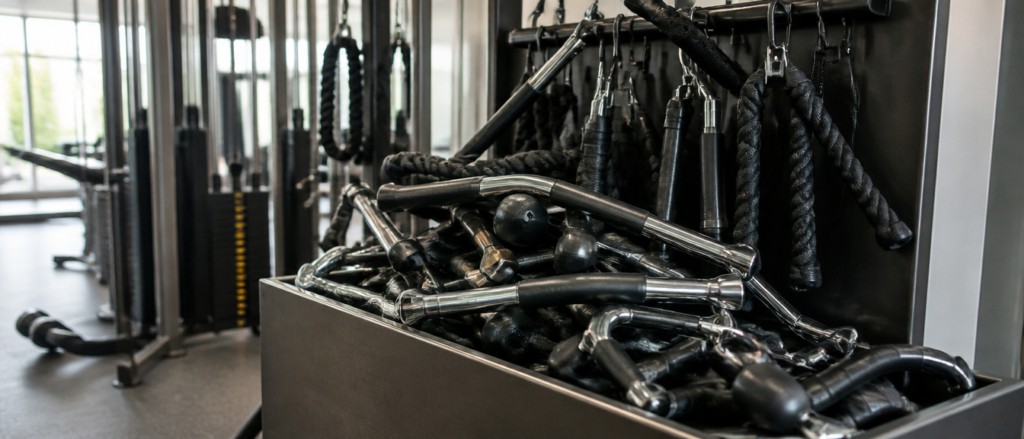
The first problem is tangling. Cable ropes — tricep ropes, battle rope extensions, attachment cables — interlock under their own weight when stored horizontally or in bins. A member looking for a V-bar must first excavate and untangle the ropes above and around it. During peak hours, this takes thirty to sixty seconds per selection. Across a busy cable machine zone with multiple users per hour, this friction accumulates into a measurable disruption to workout flow and creates visible disorder that affects the perception of facility quality.
The second problem is space. Long horizontal wall racks — the most common solution for commercial cable attachment storage — require continuous wall surface alongside or behind the cable machine zone. In facilities where wall space is shared with mirrors, screens, or other equipment, or where the cable machine zone is positioned in the centre of the floor, no viable wall mounting surface exists. The alternative of floor bins or cabinet storage creates a trip hazard and limits visibility of what is available.
The third problem is equipment damage. Cable attachments stored in bins experience repeated metal-on-metal contact as they are retrieved and returned. Chrome finishes on handles lose their surface quality. Rope fibres on tricep ropes fray at the attachment point. Swivel mechanisms develop play from being levered sideways under pile weight. This damage is incremental and invisible until it is advanced — at which point expensive attachments require replacement that could have been avoided by vertical hanging storage from the point of first use.
Traditional Storage Approaches: Limitations at a Glance
Before evaluating the rotating rack solution, it is useful to map the existing storage approaches against their specific failure modes in commercial settings. The table below summarises the four most common conventional approaches.
| Storage Approach | Space Requirement | Access Experience | Equipment Protection | Commercial Limitation |
|---|---|---|---|---|
| Floor bin / storage box | Moderate floor footprint | Poor — contents tangled; requires excavation | Poor — metal-on-metal contact; rope fraying | Trip hazard; requires bending; messy appearance |
| Horizontal wall rack | Requires 8–14 ft continuous wall surface | Moderate — visible but can tangle at high density | Good for individual hooks; poor under overloading | Not usable without dedicated adjacent wall space |
| Top of cable machine surface | Uses machine surface — blocks access | Poor — piled, no organisation system | Poor — drops during use cause damage | Unintended use; degrades machine appearance |
| Vertical wall peg panel | Requires fixed wall space with bolt-down mounting | Good if low density; poor when fully loaded | Moderate — longer attachments sag; ropes knot | Not freestanding; requires permanent installation |
The Revolver Rack: How 360° Rotation Changes the Equation
The core design insight of the Revolver Rack is that conventional storage problems are problems of access angle, not of volume. A wall rack with twenty hooks has sufficient capacity — the issue is that all twenty hooks face the same direction, requiring the user to walk the full length of the rack to see all available attachments. A floor bin has sufficient volume — the issue is that items at the bottom are invisible and inaccessible without moving everything above them.
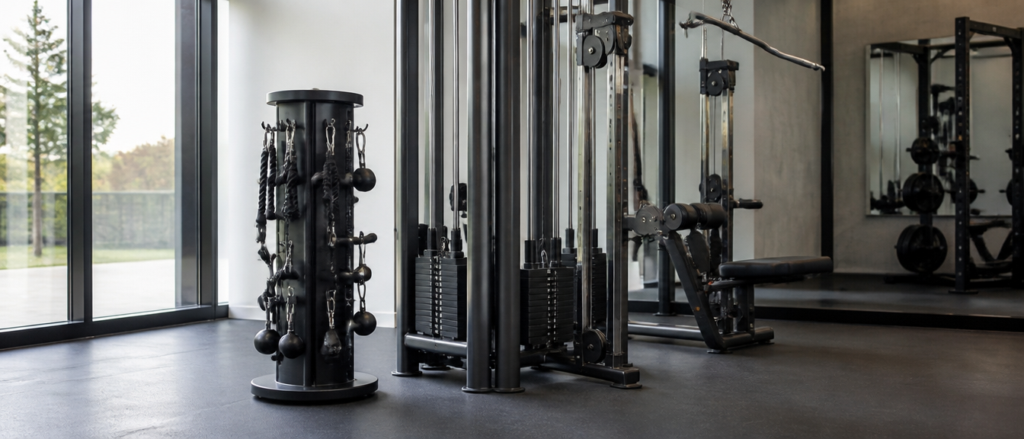
A 360° rotating carousel on a vertical tower eliminates both problems simultaneously. Every attachment hangs vertically — protected from tangles, hanging from its natural attachment point, maintaining the correct tension on rope fibres and swivel mechanisms. The entire inventory is visible and accessible by standing in one position and rotating the carousel. The footprint of the unit is the diameter of its base — typically comparable to or smaller than a standard weight plate — regardless of how many attachments it holds.
This is the principle behind high-density vertical storage: using the Z-axis (height) and rotation rather than the X-axis (floor area) to create access. As noted in commercial gym layout planning research published by WodGuru, organised storage that reduces clutter is directly correlated with better gym navigation, faster workout flow, and improved member experience — all of which are operational outcomes that floor space optimisation supports.
Five Operational Benefits for Commercial Gym Operators
The Revolver Rack’s commercial value can be mapped to five distinct operational outcomes that standard storage approaches do not achieve simultaneously.
1. Floor footprint reduction without capacity sacrifice. The Revolver Rack stores a full cable attachment collection in a footprint that traditional horizontal storage would require at wall scale. In a cable machine zone where every square metre has a use, this translates directly to additional training space or improved traffic circulation.
2. Instant visual inventory. A single rotation of the carousel gives the user a complete view of all available attachments — without walking, bending, or untangling. This reduces selection time from twenty to sixty seconds (typical for bins or long wall racks) to under ten seconds. During peak hours, with multiple users cycling through the cable zone, this improvement compounds.
3. Attachment protection as standard. Every attachment hangs vertically from its designated hook. There is no pile pressure, no metal contact between adjacent items, and no rope fibre stress from horizontal coiling. Chrome finishes and rope attachments remain in original condition for longer, directly reducing replacement frequency and protecting the capital investment in cable accessories.
4. Placement flexibility. The Revolver Rack is freestanding and requires no wall mounting. It can be positioned adjacent to the cable machine, in the centre of a functional training zone, or in a corner that would otherwise be dead space. This flexibility is operationally valuable in facilities where wall surfaces are committed to mirrors, screens, or structural constraints.
5. Professional presentation signal. A fully loaded Revolver Rack is a visible demonstration of organisation. It shows members that accessories are categorised, maintained, and expected to be returned properly. According to Hamilton Home Fitness‘s commercial gym layout guidance, organised storage walls and accessory systems are among the most effective non-equipment means of improving how a facility feels to use — creating the perception of a well-managed environment rather than a crowded one.
Optimal Placement Scenarios in Commercial Facilities
The Revolver Rack’s freestanding design makes it adaptable to multiple commercial facility contexts. The following scenarios describe where it delivers the highest operational return.
Cable machine cluster zones: For facilities with three or more cable machines in a dedicated zone, a single Revolver Rack positioned centrally serves all machines simultaneously. Members at any cable station can access the full attachment inventory with a few steps rather than walking to a wall rack. This centralised model also concentrates return behaviour: members know the single location for every attachment, which improves re-racking compliance compared to distributed hooks near individual machines.
Functional training zones: Functional training areas typically use a diverse mix of attachments across cable trainers, battle rope anchors, and suspension training systems. The range of attachment types — handles, ropes, bars, straps — makes this zone particularly prone to the tangling and disorder that bin or flat-hook storage produces. A Revolver Rack in the functional zone keeps all accessories visible, separated, and accessible without interrupting the floor’s open training space.
Boutique studios with limited wall space: Small functional studios and boutique training facilities often have no dedicated wall surface near cable or functional training equipment. The Revolver Rack’s freestanding, compact footprint allows placement in corners, beside machines, or between equipment clusters without requiring any structural installation — a practical advantage in leased studio spaces where permanent mounting may not be permitted.
Comparing the Revolver Rack Against Conventional Alternatives
| Criterion | Revolver Rack | Horizontal Wall Rack | Floor Bin |
|---|---|---|---|
| Floor footprint | Minimal — base diameter only | Zero floor (wall-mounted), but requires wall space | Moderate — box footprint |
| Wall space required | None — freestanding | 8–14 ft continuous wall surface | None |
| Selection speed | Fast — full inventory visible in one rotation | Moderate — must walk the rack length | Slow — requires excavation and untangling |
| Tangle prevention | Yes — vertical hanging, items separated | Partial — horizontal items can tangle if overloaded | No — tangling is the primary failure mode |
| Equipment protection | High — vertical hang, no contact stress | Moderate — hooks protect individual items | Low — pile pressure damages finishes and ropes |
| Placement flexibility | High — any location, no installation required | Low — fixed to specific wall location | High — portable but creates floor hazard |
| Professional appearance | High — organised carousel display | Moderate — organised if not overloaded | Low — chaotic regardless of effort |
Storage as a Facility Management Metric
The Health & Fitness Association (IHRSA) consistently identifies member-perceived facility cleanliness and organisation as a primary driver of membership retention and net promoter score. The cable attachment zone — often the most visibly disorganised area of a commercial gym floor — has a disproportionate effect on this perception. Members who cannot find the attachment they need, who spend time untangling equipment, or who see accessories piled without organisation draw conclusions about facility management quality that extend beyond the cable zone itself.
Treating storage as a facility management metric — rather than a secondary equipment consideration — aligns directly with the competitive positioning goals of premium commercial gyms. The Revolver Rack is not an expensive solution to a peripheral problem: it is a targeted investment in one of the highest-friction points of the daily member experience, with a footprint and cost profile appropriate for broad commercial deployment across storage rack solutions for the free weight training floor.
Frequently Asked Questions
What types of accessories can the Revolver Rack store?
The Revolver Rack is designed primarily for cable machine attachments — lat bars, tricep ropes, V-bars, D-handles, straight bars, and ankle straps — but is also suitable for resistance bands, lifting belts, wrist wraps, and other accessory items that can be hung from a hook. Its high-density hook capacity and 360° rotating design make it particularly effective for collections of twenty or more individual items where conventional storage creates selection and tangling problems.
Does the Revolver Rack require wall mounting or floor anchoring?
No. The Revolver Rack is a freestanding unit with a heavy weighted base designed to resist tipping even under uneven loading. No wall mounting or floor anchoring is required, making it suitable for leased studio spaces, facilities where permanent installation is restricted, and operators who want placement flexibility to adjust the layout over time.
How stable is the Revolver Rack when loaded unevenly?
The Revolver Rack’s base is engineered to maintain stability under asymmetric loading — the typical condition in a commercial gym where attachments are retrieved and returned unevenly throughout the day. The heavy steel base provides a low centre of gravity that counteracts the leverage effect of attachments hung at height. The unit is designed to commercial safety standards for exactly this use case: continuous, asymmetric loading in high-traffic environments.
How many cable attachments does the Revolver Rack hold?
The Revolver Rack is a high-density storage solution capable of holding the full accessory collection for a multi-cable-machine commercial gym zone. Exact capacity depends on the mix of attachment sizes and weights. For detailed capacity specifications based on your specific attachment inventory, contact our team with the full list of items you need to store.
Is the Revolver Rack appropriate for a small boutique studio as well as a large commercial gym?
Yes. The Revolver Rack’s compact footprint and freestanding design make it equally well-suited to small boutique studios and large commercial facilities. For small studios, its minimal floor footprint is particularly valuable — it provides full accessory storage capacity without requiring the wall space that horizontal rack alternatives demand. For large commercial gyms, multiple Revolver Racks can be positioned across cable machine zones for distributed, high-capacity storage across the floor.
Conclusion
Cable attachment storage is a daily operational friction point that most commercial gym operators solve imperfectly — with wall racks that require unavailable wall space, bins that tangle expensive accessories, or surface piling that damages equipment and signals poor management. The Revolver Rack resolves all three failure modes simultaneously: its 360° rotating carousel stores a full attachment collection vertically in a minimal freestanding footprint, provides instant single-rotation access to every item, and protects attachment finishes and rope integrity through correct vertical hanging from the first day of use.
For facility operators who want to address this overlooked storage problem, contact our team to discuss the Revolver Rack’s specifications and how it integrates with your cable machine zone layout.