Gym operators treat equipment procurement for a renovation or expansion as a large purchasing event. The reality is that it is a project management challenge — one where the sequence of decisions, the timing of orders relative to construction milestones, the assessment of existing inventory, and the structure of the budget all determine whether the renovation opens on time and delivers the ROI that justified it. Most renovation procurement failures are not caused by choosing the wrong equipment. They are caused by starting the equipment conversation too late, underestimating lead times, and failing to structure the procurement decision across three distinct categories: what to replace, what to upgrade, and what to add.
This guide provides a practical framework for commercial gym equipment procurement during expansion or renovation — from the initial lifecycle audit through phased delivery coordination and the supplier questions that protect the project timeline.
Start With an Equipment Lifecycle Audit
Before a single new equipment order is placed, a renovation procurement plan requires an honest assessment of every existing piece on the floor. This is the equipment lifecycle audit — a systematic evaluation of each unit’s structural condition, surface quality, functional completeness, and remaining service life relative to the renovation’s investment horizon.
The audit produces three categories. Equipment that is structurally compromised, functionally incomplete, or so visually degraded that it undermines the post-renovation aesthetic must be replaced — regardless of its remaining mechanical function. Equipment that remains structurally sound but is limiting programming options, showing surface wear that will look incongruous against new flooring and wall finishes, or failing to meet current commercial safety standards should be evaluated for upgrade or replacement. Equipment that is in good structural and functional condition and will perform well in the new environment can be retained — often representing a significant CAPEX saving that can be redirected to higher-priority new equipment categories.
The audit also generates utilisation intelligence that should drive the procurement plan. As noted by Fitness Design Group, effective fitness facility procurement begins with lifecycle modelling that anticipates how equipment will perform over 5–12 years — not with a catalogue selection. The audit provides the data for this modelling: which equipment categories show the highest usage wear, which are consistently under-utilised, and where member demand is exceeding current supply.
The Three Procurement Decision Categories
Once the lifecycle audit is complete, every equipment category in the facility should be mapped to one of three procurement decisions. This mapping drives the budget allocation and the procurement sequence.
Replace: Equipment that must be removed and substituted with new units. Replacement is driven by structural failure, safety non-compliance, surface degradation so severe that refurbishment is uneconomical, or a programming model change that makes the category obsolete. Replacement procurement should be prioritised early in the planning cycle — these are units where delay means operating with known-deficient equipment through the renovation period.
Upgrade: Equipment that remains functional but is limiting the facility’s offering or will look inconsistent post-renovation. Common upgrade triggers include foam and upholstery degradation on benches and pads, rubber coating failure on dumbbells and plates, outdated footprint configurations that conflict with the new layout, and equipment that cannot accommodate the expanded membership programming model. Upgrades often have more lead time flexibility than replacements, allowing cost optimisation through advance ordering.
Add: New equipment categories being introduced in the renovation — expanding the programming offer, filling demonstrated usage gaps identified in the audit, or introducing entirely new training zones (functional training area, recovery zone, dedicated free weight expansion). This is typically the largest single procurement investment in a renovation and the category where the most detailed needs analysis — member demographics, programming model, revenue forecast — should inform the selection.
Building the Procurement Budget: CAPEX Structure
Equipment procurement budget for a renovation or expansion should be structured as a component of the total project CAPEX alongside construction, flooring, electrical, and facility improvements — not as a separate conversation. As Gymdesk’s expansion guide notes, the most common renovation budget failure is focusing on construction and equipment costs while underestimating or excluding the hidden costs: installation, freight, staging, waste removal of replaced equipment, and the revenue impact of downtime during the renovation period.
A practical CAPEX allocation for equipment in a full-floor renovation typically follows a 70/20/10 structure: approximately 70% on the Phase 1 essential equipment that opens with the facility, 20% on Phase 2 additions based on member feedback in the first three to six months of operation, and 10% in contingency. Entering a renovation with 100% of the equipment budget allocated to opening day inventory leaves no financial flexibility for the programming adjustments that always follow actual member usage patterns.
The Health & Fitness Association (IHRSA) consistently identifies member experience and programming quality as primary drivers of membership retention — and a post-renovation Phase 2 equipment addition that responds to actual member demand is a more effective retention investment than front-loading the opening with every anticipated need.
Equipment Decision Framework
| Equipment Condition | Procurement Decision | Priority | Budget Phase |
|---|---|---|---|
| Structural failure or safety non-compliance | Replace — immediate | Critical | Phase 1 |
| Surface degradation significant (peeling, cracks, fading) | Replace or upgrade | High | Phase 1 |
| Functional limitations constraining programming | Upgrade or replace | High | Phase 1 or 2 |
| Aesthetic inconsistency with post-renovation environment | Replace or retain with cosmetic refurbishment | Medium | Phase 1 or defer |
| Under-utilised but structurally sound | Retain and reassess at 6 months | Low | Phase 2 if replaced |
| Good condition, high utilisation | Retain | No action | Budget saving — redirect |
| New category — demand identified in audit | Add | Based on utilisation gap | Phase 1 if core; Phase 2 if supplementary |
| Technology upgrade (screens, connectivity) | Upgrade or add | Low to medium | Phase 2 or 3 |
Lead Time Reality: What Takes How Long
One of the most consequential and most consistently underestimated variables in renovation equipment procurement is lead time. Unlike consumer furniture or standard commercial supplies, commercial gym equipment often involves manufacturing lead times that must be coordinated with the construction schedule months in advance — not weeks.
Standard commercial gym equipment from established manufacturers typically requires 4–8 weeks lead time from confirmed order to delivery. Custom colour specifications, private label branding, and non-standard configurations extend this to 12–20 weeks. Large order volumes may require production scheduling coordination that affects lead time further. Flooring installation should be completed before heavy equipment arrives on the floor — which adds a sequencing dependency that must be built into the procurement timeline.
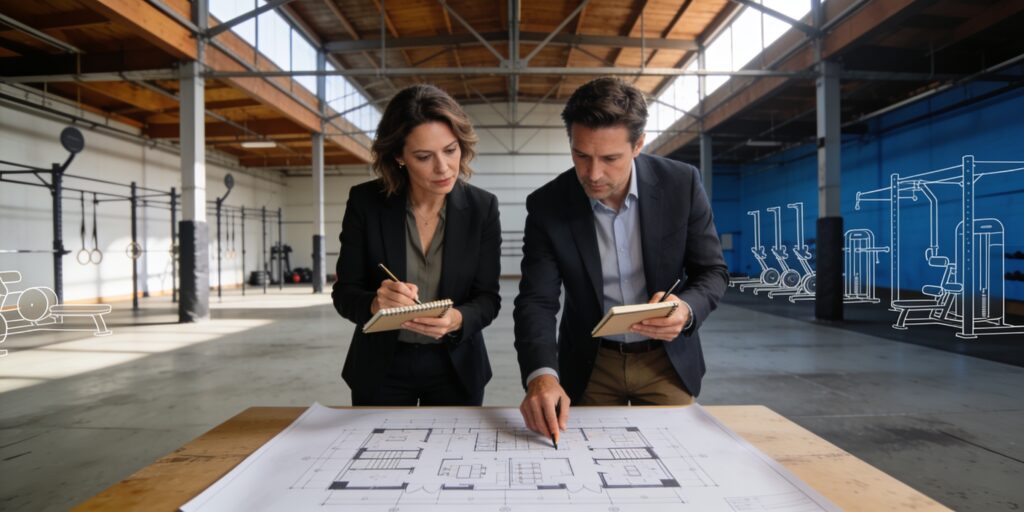
The practical implication is that equipment procurement decisions should be finalized when architectural plans are completed and before construction commences — not when construction is nearing completion. A renovation that begins construction in month one and places equipment orders in month three will experience equipment delivery delays that extend the downtime period, add carrying costs for a facility that is not generating revenue, and create installation pressure that produces setup errors.
Phased Delivery for Live Facilities
Renovations of operational facilities — where the gym continues serving members in some capacity during construction — require a more nuanced delivery phasing strategy than ground-up buildouts. The goal is to minimise the period during which member experience is degraded while maintaining procurement efficiency.
A practical approach zones the renovation spatially: one section of the floor is taken offline for renovation while adjacent zones remain operational, then the completed zone reopens while the next section is taken down. Equipment procurement for this approach must be sequenced to match the zone completion schedule — equipment for Zone A delivered and installed when Zone A construction completes, not when the full renovation is done. This requires the supplier to confirm phased delivery capability at the procurement stage, and the operator to have storage arrangements for early-arriving equipment that cannot yet be installed.
Member communication during a phased renovation is a retention management task as much as a logistics one. Gymdesk’s guidance on expansion planning recommends proactive communication about disruption timelines, regular progress updates, and visible commitment to the improvement outcome. Members who understand why equipment is temporarily unavailable and can see progress toward the new configuration are significantly more likely to maintain their membership through the disruption period than those who encounter unexplained changes without context.
Timing the Renovation Relative to the Revenue Calendar
Commercial gym revenue has a distinct seasonality that should inform renovation timing. Peak membership acquisition months — January through March in most markets — represent the highest opportunity cost for any facility disruption. Renovations timed to begin in late spring or summer, when membership acquisition rates are lower, minimise the revenue impact of downtime and position the facility to reopen before the autumn acquisition cycle begins.
For facilities serving university populations or school-year-dependent communities, summer months may actually represent a lower revenue period regardless of membership disruption — making them a lower-opportunity-cost renovation window. The renovation timing decision should be informed by actual monthly revenue data from the last two to three years, not by calendar assumptions.
Renovation Procurement Timeline Template
| Milestone | Timing (relative to construction start) | Key Actions |
|---|---|---|
| Equipment lifecycle audit complete | 12+ weeks before construction | Categorise all existing equipment: retain / replace / upgrade / add |
| Architectural plans finalised | 10–12 weeks before construction | Confirm equipment footprints, electrical points, access routes, flooring spec |
| Equipment orders confirmed — Phase 1 | 10–12 weeks before construction | Place all standard orders; confirm custom lead times for specialty items |
| Custom / long-lead orders placed | 16–20 weeks before target opening | Private label, custom colour, or non-standard configurations ordered separately |
| Flooring installation complete | Week before equipment delivery | Confirm with contractor that flooring is cured and ready for heavy equipment |
| Phase 1 equipment delivery and installation | Week of opening | White-glove delivery, installation, safety check, warranty registration |
| Member communication — renovation update | Throughout disruption period | Progress updates, disruption rationale, expected completion date, phase openings |
| Soft reopening — functional review | Week 1 post-opening | Member flow assessment, equipment commissioning verification, punch list |
| Phase 2 equipment assessment | 3–6 months post-opening | Utilisation data review; order additions based on actual member demand patterns |
What to Ask Equipment Suppliers During Renovation Planning
The supplier relationship for a renovation procurement should be evaluated as carefully as the equipment specification. Key questions to raise at the RFQ stage include: What are your standard lead times for the specific SKUs in this order, and are they subject to seasonal production constraints? Can you confirm phased delivery to match our zone-by-zone construction schedule? What is the process for warranty registration and who is responsible for confirming installation completion? What is your freight and delivery process for upper-floor installations or buildings with freight elevator constraints? Can you provide references from comparable renovation projects where phased delivery was successfully coordinated?
The answers to these questions reveal whether a supplier has the operational infrastructure to support a renovation project or is primarily set up for single-delivery new-facility buildouts. For commercial strength equipment and free weight training equipment categories, suppliers with 40+ years of international commercial delivery experience are meaningfully better positioned to manage phased delivery complexity than newer-market entrants.
Frequently Asked Questions
How far in advance should equipment procurement begin for a gym renovation?
Equipment procurement decisions should be finalised when architectural plans are complete — typically 10–12 weeks before construction begins for standard commercial equipment. Custom specifications, private label branding, and large-volume orders may require 16–20 weeks lead time, meaning some orders must be placed before construction starts. Treating equipment procurement as a post-construction decision is the most common cause of renovation timeline delays and extended downtime in commercial gym projects.
Should all gym equipment be replaced during a renovation, or can existing equipment be retained?
A systematic lifecycle audit of all existing equipment should determine what is replaced, upgraded, and retained based on structural condition, surface quality, functional adequacy, and aesthetic compatibility with the post-renovation environment. Retaining well-conditioned, high-utilisation equipment avoids unnecessary CAPEX expenditure and redirects budget to new categories where member demand is under-served. Industry guidance suggests that replacing the 30% of most heavily used equipment can revitalise a facility significantly — full replacement of all equipment is rarely the most capital-efficient approach.
What is the best phasing strategy for equipment procurement in a renovation?
A 70/20/10 CAPEX allocation is a practical starting framework: 70% on Phase 1 essential equipment for opening, 20% reserved for Phase 2 additions based on actual member utilisation patterns at three to six months post-opening, and 10% in contingency. This structure ensures the facility opens with a complete, functional equipment floor while preserving budget flexibility for the programming adjustments that actual member behaviour reveals. Front-loading 100% of equipment budget on opening day leaves no room for demand-driven additions that are the most effective retention investment in the first year of operation.
How should equipment procurement be coordinated with construction timing during a renovation?
Equipment delivery must be sequenced after flooring installation is complete in the target zone — heavy commercial equipment cannot be safely delivered over freshly installed rubber flooring before it has cured. Coordinate with the general contractor to confirm the flooring completion date for each zone, and schedule equipment delivery a minimum of one week after that date. For phased zone-by-zone renovations, each delivery must be timed to its specific zone’s construction completion rather than to an overall project completion date.
Is it better to purchase or lease commercial gym equipment for a renovation?
Purchasing foundational equipment — free weights, strength equipment, benches, racks — delivers the most cost-effective long-term outcome for facilities with a five-plus year investment horizon. The total cost of a lease over five years consistently exceeds the purchase price for equipment with a strong service life. Leasing makes more sense for technology-intensive equipment — connected cardio with integrated display systems, for example — where the technology obsolescence cycle is faster than the mechanical service life. A hybrid approach — purchase the foundational equipment, lease the technology-dependent cardio — is typically the most capital-efficient structure for a commercial renovation.
Conclusion
Equipment procurement for a gym renovation or expansion succeeds when it is treated as a project management challenge rather than a purchasing event. The sequence matters: lifecycle audit before procurement planning, orders placed before construction begins, phased delivery coordinated with construction milestones, and budget structured to include Phase 2 additions rather than committing 100% to opening day. The most expensive renovation procurement failures are not caused by poor equipment selection — they are caused by compressed timelines, underestimated lead times, and the assumption that equipment is a final step rather than a parallel workstream.
For operators planning a renovation or expansion and looking to discuss equipment specification, phased delivery scheduling, and procurement timeline support, contact our team. Our warranty policy and pre-shipment QC process are designed specifically for the commercial projects where delivery scheduling and equipment reliability from day one are operational requirements.