Benefits of the Keynimax Bench
The Keynimax Bench is designed around one idea: remove the restrictions a conventional bench places on your shoulders and shoulder blades. Its benefits are:
1. Maximum ROM (range of motion) 2. Uninhibited movement 3. Increased proprioceptive sense 4. Better flexibility for the upper body 5. Core stability
Bench Press Comparison: Regular Bench vs. Keynimax Bench
The comparison below applies when the shoulders are flared out at 90 degrees with the elbows level with the shoulders:
| Shoulder/Scapular Movement | Regular Bench | Keynimax Bench |
| Shoulder Flexion | Restricted at top phase (~130°–150°) | Full ROM (~150°–180°) |
| Shoulder Extension | Elbows cannot drop below (0°) | Elbows drop below (~15°–30°) |
| Shoulder Abduction/Adduction | Fixed plane (~0°–120°) | Dynamic free-floating plane (~0°–120°) |
| Shoulder Internal Rotation | Restricted (~0°–30°) | Full ROM (~70°–90°) |
| Shoulder External Rotation | Restricted (~0°–30°) | Full ROM (~80°–90°) |
| Scapular Protraction | Restricted (~0°–5°) | Full ROM (~15°–20°) |
| Scapular Retraction | Restricted (~10°–15°) | Full ROM (~30°–35°) |
Full Range of Motion (ROM) vs. Partial/Restricted ROM During Resistance Training
Over the last few years, extensive studies have been conducted on resistance training with different ROM parameters. It has been concluded that resistance training with a full ROM is generally superior for maximizing muscle hypertrophy, muscle activation and muscle growth compared with partial ROM (Schoenfeld, 2020; Pallares, 2021; Wolf, 2025). Below is a brief chart comparing full ROM vs partial ROM:
| Benefits | Full ROM | Partial/Restricted ROM |
| Muscle Hypertrophy | Maximized | Restricted (depends on top-end vs bottom/stretch phase) |
| Muscle Activation | Balanced & maximized | Restricted (depends on lengthened or shortened position) |
| Muscle Growth | Balanced across the entire length of the muscle fascicles | Targeted regional growth of muscle fascicles |
| Strength Adaptation | Joint-angle specific & eliminates weak points | Pushes past strength sticking points |
| Overall Joint Health & Mobility | High | Moderate |
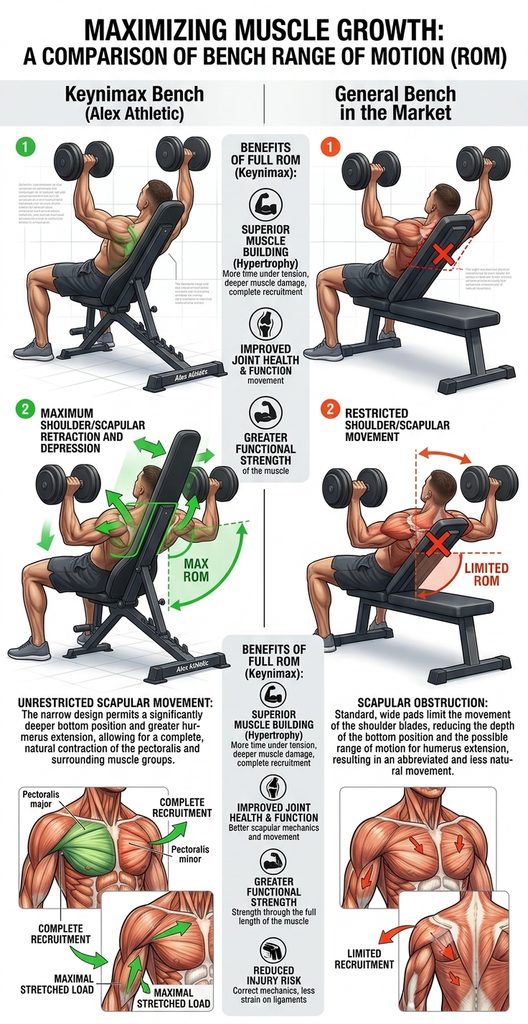
(Infographic: Maximizing muscle growth — a comparison of bench range of motion, Keynimax Bench vs. a general bench in the market)
First Time User Guide
New to Keynimax? Start here. Discover greater freedom of movement. Build control. Progress with confidence.

01 — Reset Your Body Alignment
Begin by lying back on the Keynimax Bench, allowing your spine and body to rest comfortably against the supporting pads. This supported supine position helps reduce unnecessary muscular effort and encourages a more natural, neutral body alignment before training. Training focus: Body Support · Neutral Alignment · Relaxation
02 — Start Light and Explore Your Range
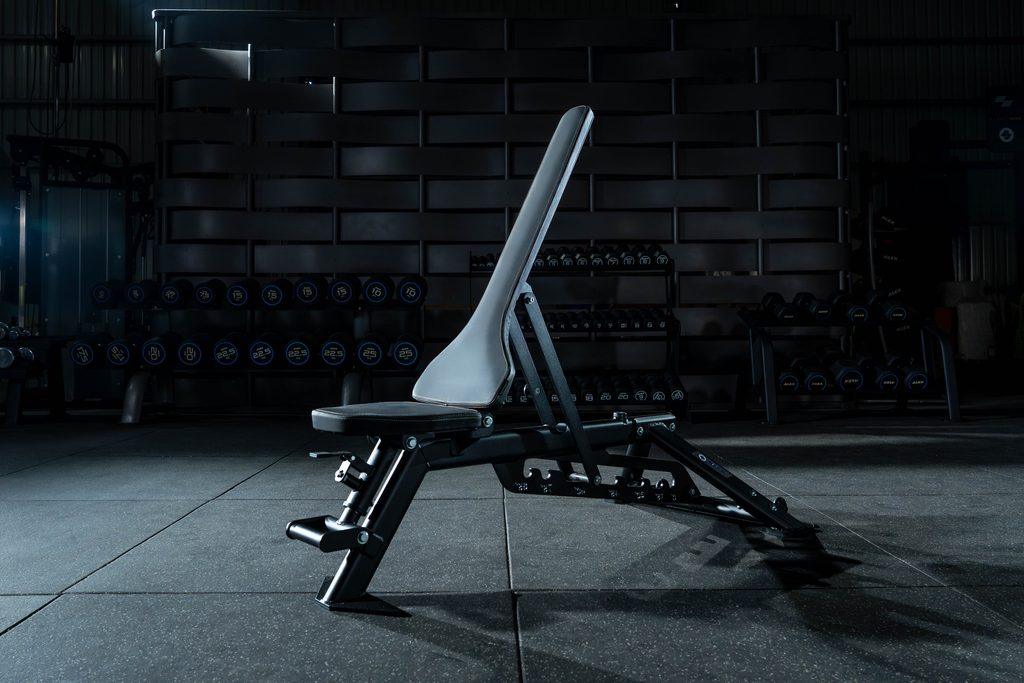
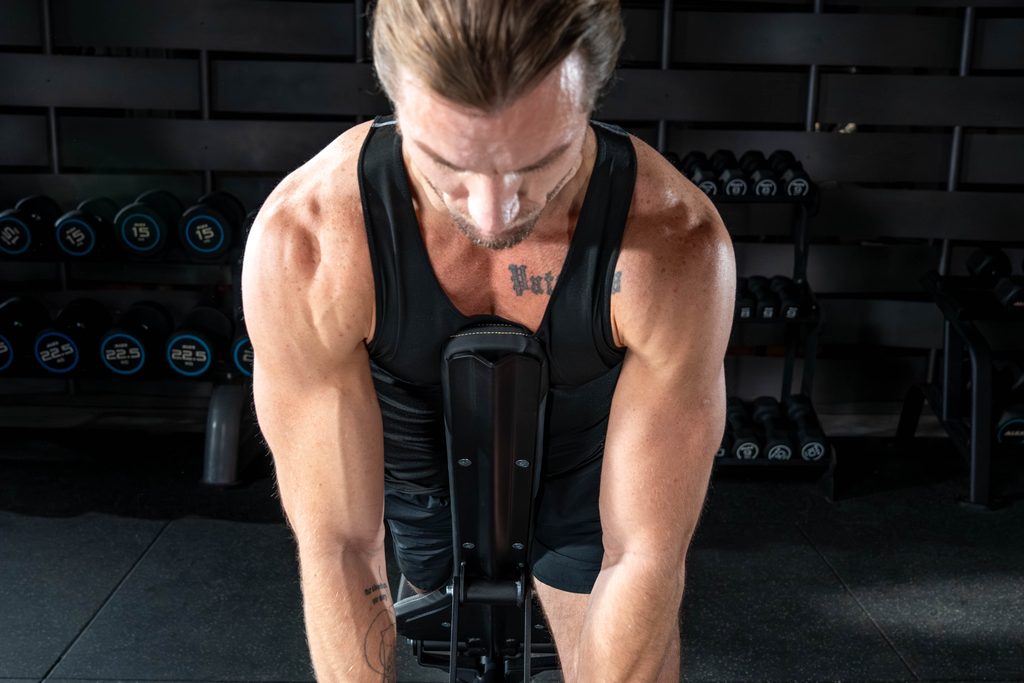
The Keynimax Bench features a unique key-shaped back pad designed to allow greater scapular freedom and upper-body range of motion compared with a conventional bench. When using it for the first time, begin with lighter weights and focus on smooth, controlled movements. Take time to become familiar with the increased freedom of movement while maintaining proper body positioning and stability. First time user tip: For your first session, consider starting with approximately 30–50% of your usual training weight on a conventional bench. Focus on movement quality, stability, and control before gradually increasing the load. This is a suggested starting range only — adjust according to individual strength, comfort, and movement control. Training focus: Scapular Freedom · Range of Motion · Movement Control
03 — Build Control and Progress with Confidence
As you become more comfortable with the Keynimax Bench, gradually increase resistance while maintaining proper technique, body stability, and controlled movement throughout your comfortable range of motion. Prioritize movement quality over heavier loads. Progress at your own pace as your strength, coordination, and confidence improve. Training focus: Stability · Coordination · Progressive Resistance
04 — Take It Further with the IsoMotion Press
Take your training further by pairing the Keynimax Bench with the IsoMotion Press. The Keynimax Bench provides stable body support while allowing greater scapular freedom. The IsoMotion Press features independent, converging press arms that deliver controlled resistance for bilateral and unilateral strength training. Together, they create a versatile training setup with consistent body positioning, controlled movement, and integrated equipment safety features — helping users build strength with greater confidence. Training focus: Consistent Positioning · Independent Resistance · Safety Support
Frequently Asked Questions
What is the Keynimax Bench?
The Keynimax Bench is a flat training bench with a unique key-shaped back pad that leaves the shoulder blades free to move. Unlike a conventional bench, whose wide pad blocks scapular movement, its narrow central design allows full shoulder and scapular range of motion during pressing — including deeper elbow depth, fuller flexion, and free protraction and retraction.
What makes it different from a regular bench?
The difference is range of motion. On a regular bench, the pad restricts shoulder flexion at the top phase, stops the elbows dropping below neutral, and limits scapular protraction and retraction to a few degrees. The key-shaped pad removes those restrictions, allowing roughly 150°–180° of flexion, 15°–30° of elbow drop, and full scapular movement, as the comparison table above details.
Is full range of motion better for muscle growth?
Generally, yes. Systematic reviews and meta-analyses (Schoenfeld, 2020; Pallares, 2021; Wolf, 2025) conclude that full-ROM resistance training is generally superior for muscle hypertrophy, activation and growth compared with partial ROM, with growth balanced across the entire length of the muscle fascicles. Partial ROM retains specific uses, such as pushing past strength sticking points.
How much weight should I use on it for the first time?
Start with approximately 30–50% of your usual training weight on a conventional bench. The increased freedom of movement recruits stabilizing muscles your body is not yet accustomed to, so focus on movement quality, stability and control first, and increase the load gradually. This is a suggested starting range only — adjust it to your individual strength, comfort and movement control.
Can it be used together with the IsoMotion Press?
Yes — the two are designed to pair. The bench provides stable body support with greater scapular freedom, while the IsoMotion Press adds independent, converging press arms that deliver controlled resistance for bilateral and unilateral training. Together they offer consistent body positioning, controlled movement and integrated safety features, so users can train close to their limits with greater confidence.
Find Your Range and Build Your Strength
Every great movement starts with control. Experience greater freedom, develop stability, and build strength one rep at a time with the Keynimax Bench. Your first four steps: 01 RESET — Find your natural alignment. 02 EXPLORE — Start light. Discover your range. 03 PROGRESS — Build control. Increase resistance. 04 ADVANCE — Train with the IsoMotion Press.
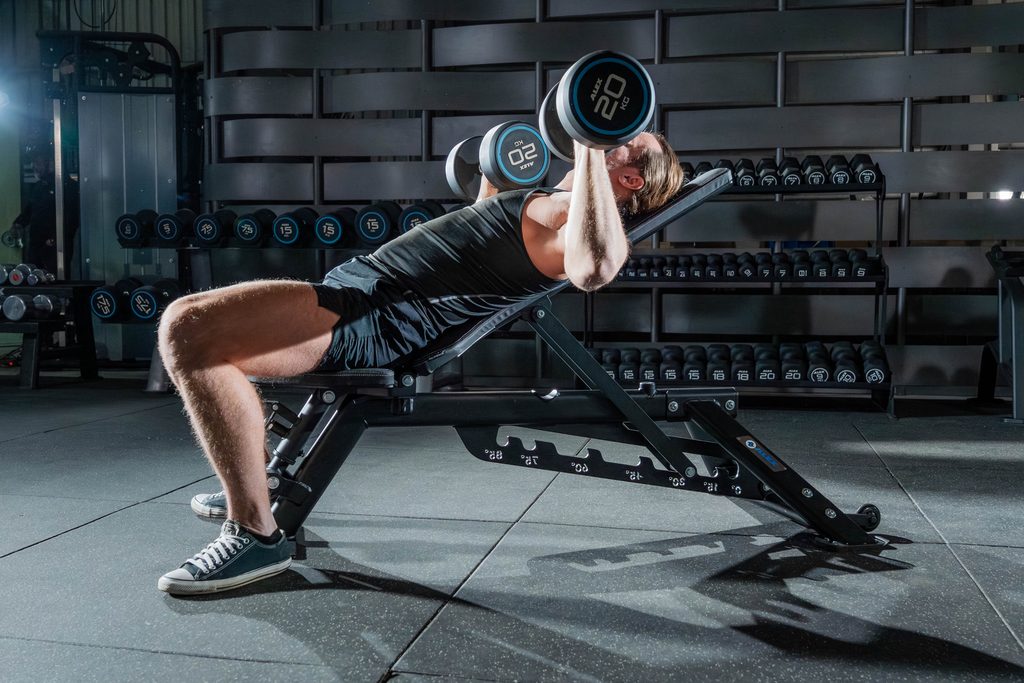
For complete pressing technique on this bench, see our step-by-step guide on how to bench press with the Keynimax Bench, and for the machine pairing, our iso lateral chest press buying guide.
References
[1] Schoenfeld, B. J., & Grgic, J. (2020). Effects of range of motion on muscle development during resistance training interventions: A systematic review. SAGE Open Medicine, 8, 2050312120901559. https://doi.org/10.1177/2050312120901559
[2] Pallares, J. G., et al. (2021). Effects of range of motion on resistance training adaptations: A systematic review and meta-analysis. Scandinavian Journal of Medicine & Science in Sports, 31(10), 1866–1881. https://doi.org/10.1111/sms.14006
[3] Wolf, M., et al. (2025). Lengthened partial repetitions elicit similar muscular adaptations as full range of motion repetitions during resistance training in trained individuals. PeerJ, 13, e18904. https://doi.org/10.7717/peerj.18904