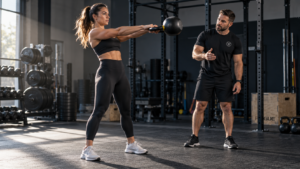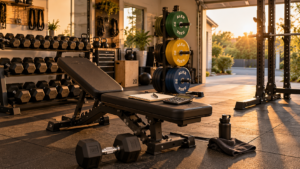
A boutique fitness studio is not a small version of a large commercial gym. The procurement logic that applies to a 2,000 sqm multi-zone facility — prioritise variety, maximise machine count, cover every exercise category — produces exactly the wrong outcome when applied to a 100 sqm studio. In a boutique context, equipment that looks comprehensive in a catalogue can make the training environment feel crowded, limit the coaching sightlines that are the studio’s primary service differentiator, and create the kind of member flow problems that surface only after installation.
This guide provides a practical framework for boutique studio equipment configuration — the principles, the priority categories, and three concrete templates for studios of different sizes and programming orientations.
Understanding the Boutique Studio Context
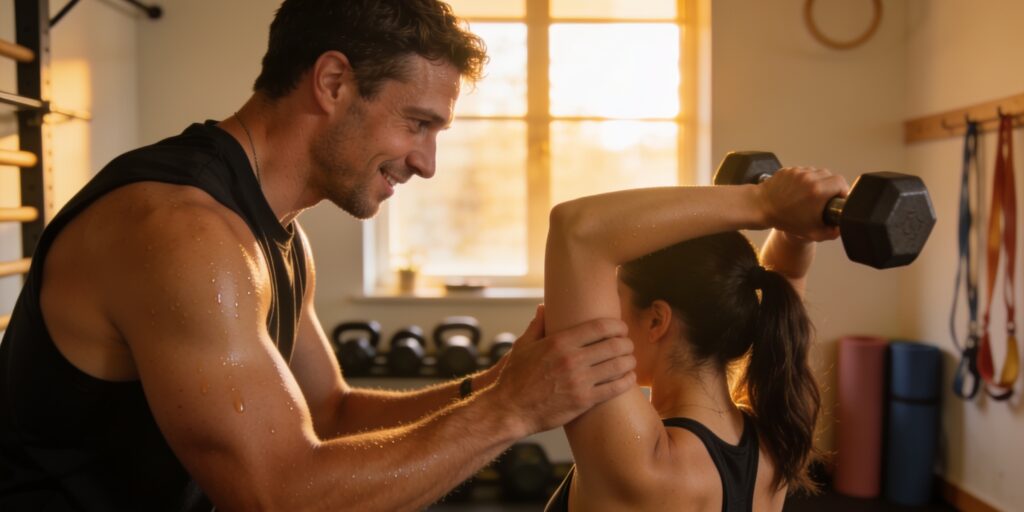
According to guidance from Alpha Fitness, most boutique facilities are designed for 5 to 15 simultaneous users — a session capacity where coaching interaction and member experience matter more than equipment throughput or machine variety. This is the defining structural difference from large commercial gyms: a boutique studio serves a small, often relationship-driven membership at a premium price point. The equipment configuration must support a coaching environment, not replace it.
The programming model matters more in a boutique context than in any other facility type. A strength-focused studio, a HIIT conditioning studio, a personal training studio, and a functional fitness studio serving 12 members per session all have fundamentally different equipment requirements. Getting the configuration right begins with a clear training model, not a catalogue selection.
Space allocation guidelines from Glofox specify approximately 60–70 sqft (5.5–6.5 sqm) per strength machine including surrounding access space, and approximately 35 sqft (3.3 sqm) per person for group fitness movement. These numbers matter because they determine equipment capacity before any equipment is purchased — not after.
Five Equipment Configuration Principles for Boutique Studios
Principle 1: Open space is a product, not a leftover. In coaching-led environments, open floor area enables demonstration, supervision, correction, and the movement patterns that give boutique training its experiential value. Reserve at least 30–40% of your training floor for open space before selecting equipment.
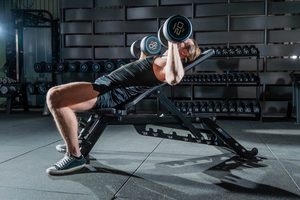
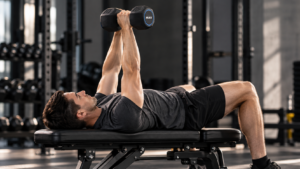
Principle 2: Multi-function beats category coverage. An adjustable bench that supports flat, incline, and hip thrust across one footprint is more valuable in a boutique studio than a dedicated flat bench plus a separate incline bench consuming twice the space. Prioritise equipment that expands programming options within a fixed footprint.
Principle 3: Quality over quantity at every weight. In a boutique context, members handle equipment directly and repeatedly — the quality of the surface, the balance of the dumbbell, and the smoothness of the adjustment mechanism are part of the experience that justifies premium pricing. Compromising equipment quality to increase variety reduces the perceived value of the studio environment.
Principle 4: Storage is equipment. A boutique studio with excellent training equipment and inadequate storage will look disorganised within two weeks of opening. Storage solutions — dumbbell racks, kettlebell shelves, accessory organisers — are not secondary purchases. They are part of the equipment budget.
Principle 5: Configure for peak session, not average use. The relevant constraint is not average daily utilisation but peak session functionality. If your studio’s peak session runs 10 members simultaneously through a circuit, the equipment configuration must support that session without bottlenecks — even if average daily traffic is lower.
Zone 1: The Free Weight Foundation
Free weights are the most versatile, space-efficient, and member-facing equipment category for boutique studios. A complete dumbbell set, a kettlebell selection, and a barbell with plates cover the overwhelming majority of programming requirements for strength, conditioning, and functional training — in a wall footprint that a single selectorised machine cannot match in versatility.
For most boutique studios, the free weight training equipment configuration should include a full dumbbell set from 2.5 kg to at least 30–40 kg (2 sets per studio up to 20 kg for small studios, 1 set from 20–40 kg), a kettlebell selection covering 8–40 kg in useful progressions (typically 8, 12, 16, 20, 24, 28, 32 kg), and a barbell with calibrated or standard plates for studios where barbell training is part of the programming model.
The dumbbell rack should be positioned against a wall with mirror access, allowing members to maintain visual form feedback during all dumbbell exercises. Allow 1.5–2 m of clearance in front of the dumbbell rack for exercise performance — members will step back from the rack, and the clearance is part of the dumbbell station’s functional footprint.
Zone 2: The Pressing and Strength Machine Zone
For boutique studios that include strength machine training, the equipment selection should prioritise footprint-to-versatility ratio more aggressively than any other category. A single adjustable pressing machine that covers flat, incline, and multi-angle movements within one footprint is preferable to three separate fixed-angle pressing stations that provide the same exercise options at three times the floor area.
In studios where a barbell bench press station is a programming requirement, an adjustable quality bench — like those in Alex Athletics’ commercial strength equipment range — paired with a compact half rack or squat stands is the efficient configuration. This combination supports bench press, incline press, squatting movements, and overhead pressing from a combined footprint comparable to a single large machine.
For studios incorporating cable-based movements, a single dual-cable tower provides the broadest exercise variety per footprint. Position it at the perimeter, not in the centre of the floor, to maintain open training space in the room’s core and to allow cable work in multiple directions without interfering with adjacent activities.
Zone 3: Functional Training Accessories
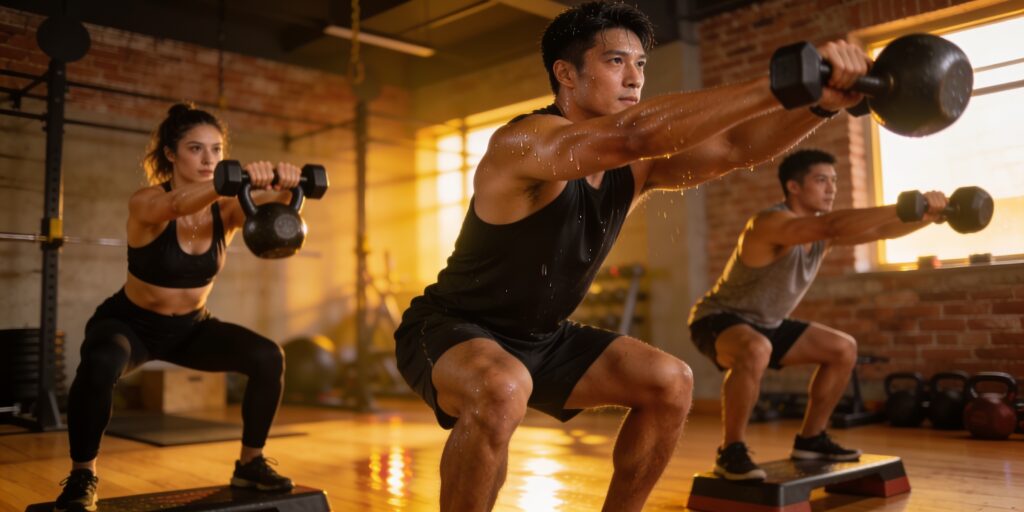
Functional training accessories — plyo boxes, battle ropes, resistance bands, suspension trainers, medicine balls, and kettlebells — provide programming variety and conditioning training options without significant equipment footprint. In boutique studios where functional movement is part of the brand, these accessories should be treated as a priority procurement category, not an afterthought.
Plyo boxes (in stackable configurations where space allows), battle rope anchors, and floor exercise accessories have minimal resting footprints but expand programming significantly. A 3-in-1 plyo box that provides three working heights in a single unit is the boutique studio version of the multi-function equipment principle — maximum programming options per square metre stored.
Zone 4: Storage — The Often-Underestimated Zone
The Health & Fitness Association (IHRSA) consistently identifies facility cleanliness and organisation as a top-tier driver of member experience and retention. In a boutique studio where member experience is the primary value proposition, equipment that cannot be quickly and easily returned to an organised state after each session creates persistent disorder that undermines the studio’s positioning.
Boutique studio storage should be wall-mounted or placed at the perimeter, freeing the central floor for training. A compact Revolver Rack for cable attachments and accessories eliminates the accessory storage disorder that is one of the most common visible quality problems in otherwise well-equipped boutique studios. Kettlebell storage should be integrated into the wall dumbbell rack system or provided as a dedicated floor-level unit — not stacked or placed loosely on the floor.
Equipment Priority Matrix by Studio Programming Model
| Equipment Category | Strength Studio | HIIT / Functional Studio | PT Studio | General Boutique |
|---|---|---|---|---|
| Full dumbbell set (2.5–40 kg) | Essential | Essential | Essential | Essential |
| Kettlebell selection (8–32 kg) | High priority | Essential | High priority | High priority |
| Barbell + plates | Essential | Moderate | High priority | Moderate |
| Adjustable bench (quality) | Essential | Moderate | Essential | High priority |
| Half rack / squat stands | Essential | Low priority | High priority | Moderate |
| Cable machine (single unit) | Moderate | High priority | High priority | High priority |
| Plyo boxes / functional accessories | Moderate | Essential | High priority | High priority |
| Strength machine (iso-lateral press) | High priority | Low priority | Moderate | Moderate |
| Organised storage solutions | Essential | Essential | Essential | Essential |
Three Configuration Templates
The following templates provide starting-point equipment configurations for three common boutique studio sizes. These are not rigid prescriptions — they are calibrated starting points that should be adjusted to the specific programming model, target member profile, and ceiling height of each space.
| Configuration | Studio A (50 sqm) | Studio B (100 sqm) | Studio C (200 sqm) |
|---|---|---|---|
| Typical use | Private PT / 1-on-3 semi-private | Small group (6–10) / specialty strength | Group (10–15) / mixed strength and conditioning |
| Dumbbells | 1 set 2.5–30 kg on compact rack | 1 set 2.5–40 kg on full-length rack | 2 sets 2.5–50 kg on mirrored racks |
| Kettlebells | 6–8 kg selections (8/12/16/20/24 kg) | 7–8 kg selections up to 32 kg | Full range 8–48 kg on dedicated storage |
| Barbell station | 1 bar + plates + squat stands | 2 bars + plates + compact half rack | 3 bars + full plate set + 2 half racks |
| Adjustable bench | 1 premium adjustable bench | 2 adjustable benches | 4 adjustable benches |
| Cable / machine | Optional: 1 compact cable unit | 1 dual-cable tower at perimeter | 2 cable towers + 1 pressing machine |
| Functional accessories | 2 plyo boxes, bands, AB mat | 4 plyo boxes, battle rope, resistance bands | 6 plyo boxes, sled track, battle ropes, hanging bags |
| Open floor target | ~20 sqm (40%) | ~40 sqm (40%) | ~70 sqm (35%) |
| Storage | Wall-mounted dumbbell + kettlebell rack; accessory hooks | Full dumbbell rack + kettlebell shelf + Revolver Rack for accessories | Mirrored dumbbell racks + kettlebell units + plate trees + cable attachment rack |
The Most Common Boutique Studio Configuration Mistakes
Over-machining the space. Every additional fixed machine takes permanent wall or floor space. Boutique studios that add a third, fourth, or fifth machine because “we have room” consistently create the same problem: the open floor that enabled coaching, demonstration, and movement quality disappears, and the studio begins to feel like a compressed version of a large commercial gym rather than a premium training environment.
Under-investing in dumbbell range at the top end. Most boutique studio dumbbell purchases are weighted toward the lower range — 2.5 to 20 kg — on the assumption that the lighter weights see higher utilisation. This is often true. But members who outgrow the studio’s dumbbell ceiling typically leave for facilities with heavier options. Investing in a dumbbell range to at least 40 kg creates headroom for members to progress within the studio.
Treating storage as a secondary purchase. Boutique studio owners routinely plan their equipment spend on training equipment and allocate a residual budget to storage. The result is ad hoc storage solutions that compromise the aesthetic and organisation of the studio from the first week. Storage should be specified as a zone in the initial layout and budgeted alongside training equipment.
Not accounting for delivery access. Commercial gym equipment — particularly adjustable benches, half racks, and cable machines — is heavy and requires maneuvering through building access routes. Studios on upper floors of mixed-use buildings, or with narrow doorways or freight elevator restrictions, should verify equipment dimensions against access constraints before ordering.
Frequently Asked Questions
How much floor space does a boutique fitness studio typically need per member?
For strength training configurations, plan for approximately 60–70 sqft (5.5–6.5 sqm) per station including surrounding access space. For group fitness movement, approximately 35 sqft (3.3 sqm) per person provides adequate room for most exercise types. These figures suggest that a 100 sqm boutique studio can comfortably serve 8–12 members simultaneously in a well-configured layout — less if a significant machine footprint is included, more if the configuration is primarily free weights and functional accessories.
What is the minimum dumbbell range for a boutique studio?
A starting range of 2.5–30 kg in standard increments covers the majority of exercises for most boutique member populations. For studios serving a stronger or more experienced demographic — or any programming that includes heavy dumbbell pressing or rowing movements — extending to 40–50 kg is important for member retention. Members who outgrow your dumbbell range typically seek facilities that can support their progression. The incremental cost of adding higher-weight dumbbells at configuration time is significantly lower than the member retention cost of leaving them underserved.
Should a boutique studio invest in strength machines or focus on free weights?
Free weights deliver more programming versatility per square metre than fixed machines in most boutique studio contexts. A quality dumbbell set and kettlebell range support dozens of exercise variations. A single selectorised machine typically supports three to five. For studios where floor space is the binding constraint, free weight investment should come before machine investment. Machines make sense where they address a specific programming need that free weights cannot replicate effectively — an iso-lateral pressing machine for member populations with shoulder concerns, for example, or a cable system for pulling movement variety.
How important is ceiling height for a boutique studio equipment configuration?
Ceiling height directly determines which equipment categories are usable. A minimum of 2.75m (9 ft) is required for most overhead dumbbell and barbell exercises. Rigs, wall balls, pull-up bars, and battle rope anchor points require 3.0–4.3m (10–14 ft) of clear ceiling height. Programming that includes overhead movements, pull-ups, or suspension training should confirm ceiling clearance before equipment selection — not after installation.
What is the best starting equipment configuration for a new boutique personal training studio?
The highest-priority starting configuration for a PT studio is a complete dumbbell set (2.5–40 kg), a quality adjustable bench, a kettlebell selection (8–32 kg), and a cable machine or functional trainer. This combination supports the full range of pressing, pulling, hinging, squatting, and core programming that constitutes most PT sessions — in a combined footprint that leaves sufficient open floor space for movement-based coaching work. Add a half rack if barbell training is part of the programming, and a compact accessory storage solution from day one.
Conclusion
Boutique fitness studio equipment configuration is not about maximising equipment count — it is about maximising training quality, coaching effectiveness, and member experience within a limited floor area. The guiding principles are consistent: open space is a product, quality beats variety, storage is non-negotiable, and configuration should be planned around the peak session model before a single unit is ordered.
Alex Athletics provides free weight training equipment and commercial strength equipment appropriate for boutique studio deployment, with the quality standards and durability profiles that premium training environments require. To discuss equipment configuration for a specific studio size and programming model, contact our team.