Weight plates are the single highest-volume product category on any commercial gym floor. They are handled dozens of times each day, loaded and unloaded by members with varying technique, and expected to maintain dimensional and weight accuracy across years of heavy use. Yet when most facility operators specify their plate floor, they focus on aesthetics and unit price rather than the technical specification that determines day-to-day performance: weight tolerance.
The choice between calibrated weight plates and standard Olympic plates for a commercial gym is not simply a budget question. It is a decision that affects barbell loading capacity per sleeve, training accuracy for serious lifters, member perception of facility quality, and the long-term consistency of the weight floor. This guide examines each category on its technical merits and maps the decision to specific facility contexts.
What Are Calibrated Weight Plates?
Calibrated weight plates are precision-manufactured plates engineered to a defined weight tolerance — typically within ±10 grams of their stated mass. This specification aligns with the requirements of the International Powerlifting Federation (IPF) Technical Rules, which mandate that competition plates must be calibrated to the nearest 10 grams and conform to a standardised diameter of 450mm for plates 20kg and above.
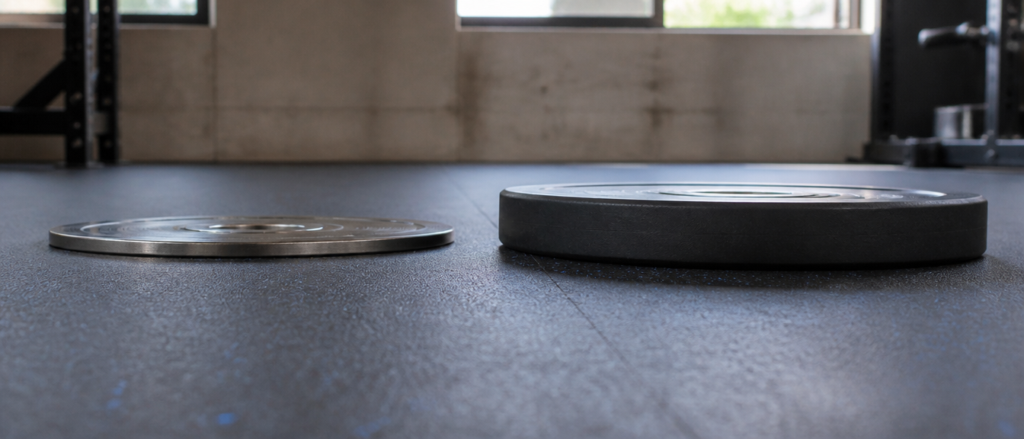
To achieve this precision, calibrated plates are typically manufactured from solid steel, machined to tight dimensional tolerances, and fitted with calibration plugs — small lead or steel inserts in the plate body — that fine-tune the final mass to within specification. The result is a plate that is substantially thinner than its standard counterpart at the same weight, allowing significantly more weight to be loaded onto a standard Olympic bar sleeve. At 25kg, a calibrated steel plate is typically 20–30% thinner than a standard cast iron plate of equivalent mass.
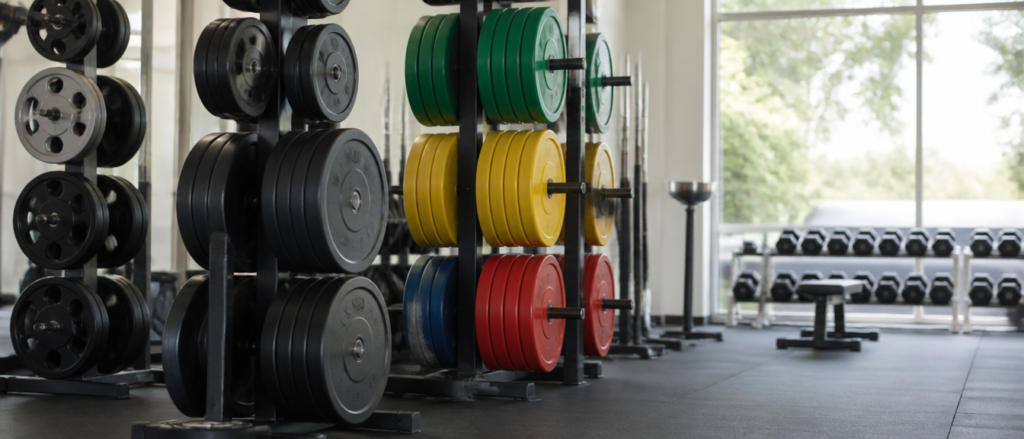
Colour coding is standardised: red plates for 25kg, blue for 20kg, yellow for 15kg, green for 10kg, white for 5kg, and black for 2.5kg. This coding allows athletes and coaches to read a loaded bar at a glance — a practical advantage in any training environment where multiple stations are loaded simultaneously. Our Calibrated Plate follows these international specifications exactly.
What Are Standard Olympic Weight Plates?
Standard Olympic weight plates — the category that covers cast iron plates, rubber-coated plates, and urethane-coated plates commonly found in commercial gyms — are manufactured to a broader weight tolerance. Most cast iron and rubber-coated Olympic plates are produced to a ±3–5% tolerance. On a nominally 20kg plate, this means actual weight may range from 19.0 to 21.0 kg. Across a bar loaded with six plates per side, this tolerance variation can compound to a meaningful discrepancy from the stated total load.
Standard Olympic plates use a 50mm centre hole (fitting standard Olympic barbells) and are available in a wide range of materials and finishes: cast iron, rubber-coated cast iron, urethane-coated cast iron, and steel-core bumper plates with rubber overmoulding. Each material combination produces different characteristics in terms of noise, floor protection, and durability — variables that are relevant to facility design but distinct from the weight accuracy question.
Standard Olympic plates dominate most commercial gym floors for a straightforward reason: they are significantly lower in unit cost than calibrated alternatives and are entirely adequate for the majority of gym users who are not training for powerlifting competition or operating close to maximum barbell loading capacity.
Calibrated vs Standard Plates: Side-by-Side Technical Comparison
The table below compares the two categories across the specifications that matter most for commercial gym procurement decisions.
| Specification | Calibrated Weight Plates | Standard Olympic Plates |
|---|---|---|
| Weight tolerance | ±10 grams (±0.04–0.25% depending on plate weight) | ±3–5% of stated mass |
| Material | Solid steel (machined); calibration plugs for fine-tuning | Cast iron, rubber-coated iron, or urethane-coated iron |
| Plate thickness (25kg) | ~22–28mm — 20–30% thinner than standard equivalent | 35–50mm depending on material and coating |
| Diameter (20kg+) | Standardised 450mm — consistent across all brands meeting IPF spec | Varies by manufacturer; typically 450mm but not guaranteed |
| Colour coding | International standard (IPF: red/blue/yellow/green/white/black) | Varies by manufacturer and product line |
| Bar loading capacity | Higher — thinner profile allows more plates per sleeve | Lower — thicker profiles reduce maximum load per sleeve |
| Floor drop suitability | Not designed for repeated drops; steel construction | Bumper variants designed for Olympic drop; standard iron is not |
| Typical unit cost | Higher — precision manufacturing reflects in price | Lower — broader tolerance reduces production cost |
| Competition compliance | IPF and major federation compliant when certified | Not competition-compliant for IPF-sanctioned events |
Three Scenarios Where Calibrated Weight Plates Are the Right Choice
1. Facilities Serving Competitive Powerlifters or Strength Sport Athletes
For athletes who train for powerlifting, Olympic weightlifting, or Hyrox-style competition, training with calibrated plates is not a preference — it is a practical training requirement. Competition platforms use calibrated plates by regulation. An athlete who trains exclusively on plates with ±5% tolerance faces a meaningful loading discrepancy on competition day: their perceived maximal lifts may be up to 5–10% heavier or lighter than the weight they’ve trained against. Calibrated plates eliminate this discrepancy entirely, ensuring that training loads match competition conditions precisely.
Facilities positioning themselves in the performance or competition-prep segment — either as specialist strength clubs or as large commercial gyms with a dedicated performance zone — should stock calibrated plates on at least their primary training platforms.
2. High-Volume Platforms Where Maximum Bar Loading Matters
At elite strength levels, barbell sleeve space becomes a material constraint. A standard 45cm Olympic bar sleeve accommodates approximately 50–60cm of plates. Standard rubber-coated 25kg plates at 45–50mm width each consume sleeve space rapidly. Calibrated steel plates at 22–28mm width allow significantly more weight to be loaded on the same sleeve — a practical consideration for facilities serving advanced lifters who regularly approach 300kg+ total loading.
3. Facilities Where Consistent Member Experience Across Stations Is a Priority
The ±3–5% tolerance of standard plates creates a subtle but measurable inconsistency between stations: two bars nominally loaded to the same weight can differ by 3–6kg when standard plates are mixed across the floor. For members tracking strength progression meticulously, this inconsistency is a friction point. Calibrated plates across the weight floor eliminate station-to-station variation and give members confidence that their progress data is reliable.
Where Standard Olympic Weight Plates Are Sufficient
Standard Olympic plates remain the correct choice for a large portion of commercial gym use cases. For general fitness members whose training objectives are conditioning, weight management, or broad strength development, the ±3–5% weight tolerance is entirely inconsequential. The difference between 24.2kg and 25.8kg on a general fitness programme is not training-relevant.
Standard plates are also more practical for high-traffic zones where plates are moved frequently and the risk of accidental drops is higher. Rubber-coated or urethane-coated Olympic plates offer floor protection, noise dampening, and durability under casual handling conditions that calibrated steel plates do not provide. Hospitality gyms, corporate wellness centres, and general fitness clubs with no performance-focused programming segment can build an excellent weight floor entirely on standard Olympic plates without any technical compromise.
Cost Implications at Commercial Scale
The cost comparison between calibrated and standard Olympic plates is most usefully framed as a total investment decision for a defined weight floor configuration, rather than a per-unit price comparison. A typical commercial gym requires between 500kg and 1,500kg of plate inventory to equip a complete free weight floor. The table below illustrates the approximate cost structure for a mid-scale free weight area at two procurement approaches.
| Configuration | All Standard Olympic Plates | Mixed: Calibrated for Platforms + Standard for General |
|---|---|---|
| Recommended for | General commercial gyms, hospitality, corporate wellness | Performance studios, strength clubs, premium commercial gyms |
| Relative unit cost | Base index (1×) | Calibrated portion: 2.5–3.5× base; mixed floor: 1.4–1.8× overall |
| Durability | Good — commercial rubber/urethane coatings resist heavy daily use | Calibrated steel very durable; finish maintenance required |
| Weight accuracy | ±3–5%; adequate for general programming | ±10g on competition platforms; consistent training data |
| Member perception | Standard for most commercial facilities | Signals performance-grade facility to serious athletes |
| Long-term replacement | Rubber/urethane degradation over 5–8 years under heavy use | Calibrated steel: minimal degradation; very long service life |
According to research published by the Health & Fitness Association (IHRSA), strength and free weight training areas have consistently shown the highest member utilisation rates among all equipment categories in commercial gym environments. This utilisation intensity makes the durability and long-term accuracy of plate selection directly relevant to facility economics: plates that degrade or accumulate dimensional inaccuracy require earlier replacement and generate member dissatisfaction in the highest-traffic zone of the facility.
Alex Athletics and the Origin of Commercial Calibrated Plates
Alex Athletics’ connection to calibrated weight plate manufacturing is not a recent development. When the brand was formally established in 1982, its defining first act was securing a patent for the calibrated weight plate — a precision-engineered product category that was then emerging as the standard for competitive strength sport. That patent represented a manufacturing commitment to accuracy and dimensional consistency that has shaped Alex Athletics’ product engineering philosophy for over four decades.
This heritage is directly relevant to commercial operators today: when you specify Alex Athletics commercial weight plates, you are sourcing from a manufacturer whose institutional knowledge of plate precision engineering predates most of today’s fitness industry suppliers. The brand’s history and patent programme reflect a long-term commitment to the quality standards that commercial facilities need to build on.
Practical Plate Floor Configuration for Commercial Gyms
Based on facility type, the following approach to plate floor configuration balances technical performance with procurement efficiency.
General commercial gym (500–2,000 m²): Specify high-quality rubber-coated or urethane-coated standard Olympic plates for the full free weight floor. Prioritise commercial-grade coating durability over budget-grade alternatives — coating integrity is the primary failure mode for standard plates under heavy daily use. Rubber-coated plates are appropriate for general use; urethane-coated plates offer superior abrasion resistance and a longer finish lifespan for premium facilities.
Performance-focused commercial gym or hybrid facility: Equip primary barbell platforms (typically four to six platforms) with calibrated steel plates in the full weight range. Equip the broader dumbbell and general free weight area with commercial-grade standard Olympic plates. This mixed approach provides competition-ready accuracy where it matters most, at a materially lower investment than calibrating the entire floor.
Specialist strength club or competition preparation facility: Calibrated plates across all primary lifting platforms. The American College of Sports Medicine (ACSM) has long emphasised that measurement consistency is fundamental to progressive overload — the principle underpinning all strength training adaptation. In a facility where this principle is the primary service value, calibrated plates are not optional.
Frequently Asked Questions
What is the weight tolerance difference between calibrated plates and standard Olympic plates?
Calibrated plates are manufactured to a tolerance of ±10 grams — less than 0.05% variation on a 25kg plate. Standard Olympic plates are typically produced to ±3–5% tolerance, which on a 25kg plate means actual weight may range from approximately 23.75kg to 26.25kg. For general training this difference is inconsequential, but for performance training or competition preparation, the precision of calibrated plates is operationally significant.
Are calibrated weight plates required for powerlifting competitions?
Yes. The International Powerlifting Federation (IPF) Technical Rules specify that competition plates must be calibrated, colour-coded to the international standard (red/blue/yellow/green/white/black), and conform to a diameter of 450mm for plates of 20kg and above. Standard gym plates do not meet these specifications and cannot be used in IPF-sanctioned or most major federation competition events.
Do calibrated plates last longer than standard Olympic plates in commercial gym use?
Calibrated steel plates have a very long service life because solid steel does not degrade in the way that rubber and urethane coatings do. Well-maintained calibrated steel plates can remain in service for 15–20+ years. Standard rubber-coated plates typically require coating replacement or product replacement after 5–8 years of heavy commercial use, as the rubber and urethane compounds develop surface wear, cracking, or delamination. The higher upfront cost of calibrated plates is partly offset by this extended service life when considered on a per-year cost basis.
Can calibrated weight plates be dropped during Olympic lifting movements?
No — calibrated steel plates are not designed for repeated dropping. The steel construction, while highly durable under loading and unloading, is not engineered to absorb the impact of being dropped from overhead. Bumper plates — which use a high-density rubber overmoulding around a steel or iron hub — are the appropriate plate category for Olympic weightlifting movements that involve intentional bar drops. Facilities programming Olympic lifting should stock both calibrated plates (for strength platform work) and bumper plates (for Olympic lifting platforms) as separate categories.
How many calibrated plates does a commercial gym need?
A practical starting point for a performance-focused commercial gym is to equip four to six primary barbell platforms with full calibrated plate sets, while supplying the broader free weight area with commercial-grade standard Olympic plates. Each primary platform typically requires one set of calibrated plates in the full weight range (2.5kg through 25kg), with duplicates for the most common working weights (10kg, 15kg, 20kg, 25kg). Contact us for a specific plate floor configuration recommendation based on your facility dimensions and programming model.
Conclusion
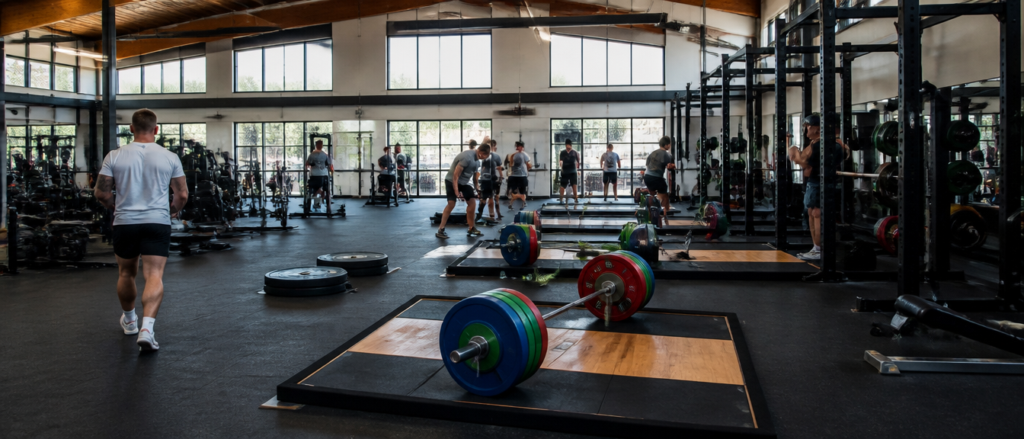
The question of calibrated weight plates versus standard Olympic plates for commercial gyms does not have a single universal answer — it depends on your member profile, programming model, and facility positioning. For general commercial gyms, high-quality standard Olympic plates are technically sufficient and represent sound value. For performance-focused facilities, competition preparation centres, or any gym serving serious strength athletes, calibrated weight plates on primary barbell platforms are a meaningful investment that supports accurate training, higher bar loading, and long-term consistency across the weight floor.
Alex Athletics has manufactured precision weight plates to commercial standards since 1982. To discuss plate floor configuration for your facility — volume, weight range, platform count, and specification — contact our team for a detailed recommendation.