Commercial fitness equipment has always evolved — but the pace and direction of that evolution has changed. Where previous generations of gym equipment development were driven primarily by aesthetic trends, marketing differentiation, and manufacturing economics, the current wave of innovation in commercial fitness equipment is increasingly grounded in sports science research. Biomechanics studies, grip force analysis, kinematic data from wearable sensors, and evidence-based rehabilitation protocols are now translating directly into design decisions that affect how equipment performs in daily commercial use.
For gym operators and equipment buyers, this shift matters. It means that the gap between equipment that looks similar in a catalog can represent a significant performance difference in practice — and that the specification language used to describe those differences is increasingly derived from research literature rather than marketing convention. This article explains the key research areas currently driving commercial fitness equipment design, and what that means for buyers evaluating equipment for commercial deployment.
The Sports Science-to-Equipment Pipeline
Understanding how sports science research influences commercial equipment requires understanding the pipeline through which research findings become design specifications. The process is neither immediate nor automatic — it typically involves several stages: peer-reviewed research publication, adoption by elite athletic programs and coaching communities, translation into design principles by engineers, prototyping and testing, and finally commercial production.
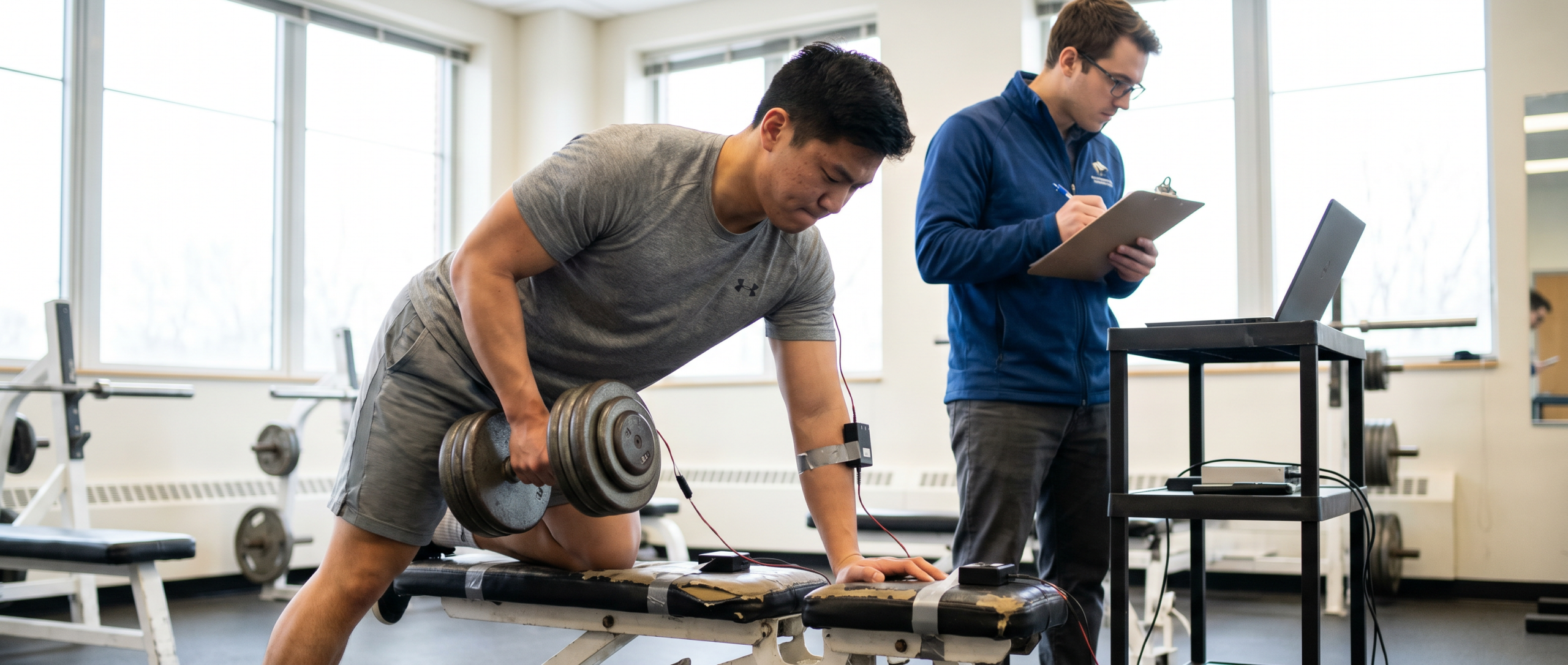
A review published in Bioengineering on cutting-edge research in sports biomechanics identifies the key translational technologies driving this pipeline: force plates, motion capture systems, electromyography (EMG), inertial measurement units (IMUs), and wearable sensors are providing increasingly precise data on how the human body interacts with training equipment under realistic conditions. This data is revealing design problems in conventional equipment that were previously invisible — and pointing toward solutions that manufacturers who are paying attention to the research literature are now building into new product generations.
A separate review from 2024, published by the University of Innsbruck and University of Almería on wearable and portable devices in sport biomechanics, documents how miniaturized IMU sensors and accelerometers are now making continuous movement analysis accessible in training environments rather than only in laboratory settings. Equipment manufacturers are increasingly incorporating the findings from this class of research directly into design iteration processes — shortening the gap between research insight and commercial product.
Five Key Research Areas Reshaping Equipment Design
1. Grip Interface Science and Handle Engineering
The interface between the human hand and the training implement is one of the most intensively studied aspects of strength training equipment, and the research findings have direct implications for commercial equipment specification. Grip science examines how handle diameter, surface texture, material, and knurling pattern affect force transmission, fatigue onset, neural activation, and injury risk across different populations and loading conditions.
Handle diameter is one of the most consequential variables. Research consistently shows that handle diameter affects both the maximum grip force a user can generate and the fatigue profile across a training session. For dumbbell handles in commercial settings, the optimal diameter for the widest cross-section of adult users falls in the 28mm to 32mm range — below or above this range, grip efficiency drops for large portions of the member population. Commercial-grade haltères engineered to this specification allow more members to maintain secure grip throughout high-rep sets without grip becoming the limiting factor rather than the target musculature.
Knurling specification is equally science-informed. As documented in research by Stronger by Science, knurling on barbells and dumbbells significantly enhances grip force compared to smooth surfaces — research using dynamometers confirms that knurled surfaces enable measurably greater grip force. However, knurling depth and pattern require calibration for the use context: aggressive knurling appropriate for competitive powerlifting causes skin abrasion that becomes a comfort problem in high-rep commercial training. Commercial-grade handles are increasingly specified with medium knurl patterns — sufficient depth for grip security without the skin wear that turns off recreational members.

2. Unilateral and Iso-Lateral Loading Biomechanics
One of the more significant research findings in strength training science over the past two decades is the documentation of the bilateral deficit — the phenomenon in which the combined force produced by both limbs simultaneously is less than the sum of the forces each limb can produce independently. This finding, replicated across numerous studies, has elevated the scientific rationale for unilateral and iso-lateral training modalities.
Iso-lateral training — where each limb works independently on the same piece of equipment, without mechanical coupling — allows the stronger limb to compensate through the full range of motion in bilateral loading, masking asymmetries and potentially reinforcing imbalances. Iso-lateral machines, iso-lateral barbell loading patterns, and single-limb dumbbell exercises address this by forcing each limb to generate force independently against its own resistance.
The equipment design implication of this research stream is that iso-lateral functionality is increasingly considered a baseline specification for commercial strength equipment rather than a premium feature. Machines with independent arm and leg movement paths, barbells designed for asymmetrical loading protocols, and dumbbell sets configured for full single-limb programming have all seen commercial demand growth directly attributable to the filtering of bilateral deficit research into coaching and training program design. Explore how équipements de musculation de niveau professionnel is engineered to support both bilateral and iso-lateral loading modalities.
3. Force Curve Optimization and Accommodating Resistance
Every exercise has a force curve — the relationship between joint angle and the mechanical advantage of the muscles involved across the full range of motion. In most free weight exercises, the mechanical challenge is highest at specific joint angles and lower at others, creating an uneven stimulus across the range. Sports science research has clarified how this mismatch between force curve and resistance curve limits the effectiveness of training, particularly for hypertrophy and maximal strength development.
Accommodating resistance — resistance that increases as the mechanical advantage of the lift increases — addresses this mismatch by matching the resistance curve more closely to the force curve. Bands attached to barbells and plates, and specialty bar designs that alter the effective moment arm, are commercial implementations of this principle. The growing popularity of these modalities in commercial gym programming is a direct reflection of research findings on force curve optimization reaching coaches and gym operators.
For equipment buyers, the implication is that specifications related to band pegs, plate loading geometry, and barbell diameter now carry genuine performance implications that go beyond mere product differentiation. Commercial barbells engineered with the shaft diameter, whip characteristics, and sleeve weight appropriate for accommodating resistance work perform differently under this application than standard general-purpose barbells.
4. Joint Loading Research and Ergonomic Handle Angles
A growing body of research on wrist, elbow, and shoulder joint loading during resistance training exercises has directly influenced handle angle specifications in commercial equipment. The research consistently shows that wrist and elbow joint stress during pressing and pulling movements varies significantly with grip angle — neutral grip (thumbs-up orientation) reduces the pronation stress on the forearm and wrist compared to fully pronated grip positions that are inherent to standard barbell configurations.
This research has driven commercial adoption of neutral-grip bar attachments, hex bar designs that allow neutral grip for deadlift patterns, and dumbbell handle configurations that allow the wrist to assume a more natural pronation angle throughout pressing exercises. For commercial gyms serving member populations that include adults with existing wrist or elbow issues — which in a general-population commercial gym is a substantial proportion of members — equipment that accommodates neutral grip alternatives reduces the injury risk and attrition associated with pain-mediated workout avoidance.
| Research Area | Key Finding | Equipment Design Response | Commercial Relevance |
|---|---|---|---|
| Grip interface science | Knurling increases grip force vs. smooth surfaces; optimal handle diameter 28–32mm for commercial populations | Medium knurl specification on commercial barbells and dumbbells; diameter standardization | Reduces grip-limited reps; improves member safety and experience |
| Bilateral deficit | Combined bilateral force < sum of unilateral forces; limb asymmetry masked in bilateral loading | Iso-lateral machine configurations; unilateral loading capability in equipment design | Supports evidence-based programming in commercial training environments |
| Force curve optimization | Standard free weights create uneven stimulus across range of motion; accommodating resistance addresses this | Band peg integration, specialty bars, variable resistance attachments | Enables more sophisticated programming for performance and hypertrophy |
| Joint loading ergonomics | Grip angle significantly affects wrist and elbow stress; neutral grip reduces injury risk | Neutral-grip bars, hex bar designs, adjustable handle angles | Reduces injury risk and pain-mediated attrition in commercial member populations |
| Load management precision | Weight accuracy affects programming precision; calibration standards matter at competitive loads | Calibrated plate production, tighter weight tolerance specifications | Supports structured progressive overload programs in commercial training environments |
5. Load Management and Weight Precision Research
Progressive overload — the systematic increase of training load over time — is the fundamental mechanism through which strength and hypertrophy adaptations occur. Research on programming precision has clarified that the accuracy of weight increments matters more than commonly assumed, particularly at higher loads where small percentage differences in load represent meaningful training stimuli differences.
Standard commercial weight plates are manufactured to tolerances that can allow significant variation between nominal and actual weight — in some product categories, variations of 5% or more from labeled weight are not unusual. For a member loading 100kg on a barbell, a 5% variance means the actual load could be anywhere from 95 to 105kg — a 10kg spread that makes structured progressive overload programs significantly less precise than their design intends.
Calibrated weight plates, produced to tighter tolerances (typically ±0.1% to ±0.25% of labeled weight), address this directly. The growing commercial adoption of calibrated plates in higher-quality facilities is a direct result of sports science research on the precision requirements of evidence-based programming reaching facility operators through coaches and athletic trainers who demand the same equipment accountability in commercial settings that they expect in athletic performance centers.
How Science-Informed Equipment Design Translates Into Procurement Decisions
For commercial gym operators who are not themselves sports scientists, the practical challenge is translating research awareness into actionable procurement decisions. The following framework helps structure that translation.
| Catégorie d'équipement | Science-Informed Specification | What to Ask Suppliers |
|---|---|---|
| Commercial Barbells | Shaft diameter (28–29mm standard; 25mm for women’s bar), knurl pattern and depth, tensile strength ≥190,000 PSI | What is the knurl specification? What testing supports the stated tensile strength? |
| Haltères | Handle diameter 28–32mm, knurl or texture type, head geometry (hex preferred commercially) | What is the nominal handle diameter? What surface finish and texture specification? |
| Weight Plates | Weight tolerance (±1–2% commercial, ±0.1–0.25% calibrated), outer diameter precision, grip surface | What is the published weight tolerance for this product line? |
| Power Racks | J-cup adjustability (2-inch increments minimum), band peg provision, upright gauge (11 gauge minimum) | What are the j-cup increments? Are band pegs included or optional? |
| Specialty Bars | Hex bar for neutral grip deadlift, safety squat bar for reduced shoulder stress, EZ curl for wrist comfort | Does the hex bar have a high and low handle position? What is the EZ curl angle specification? |
What Buyers Should Expect From Science-Literate Equipment Manufacturers
Equipment manufacturers who are genuinely integrating sports science research into their design process tend to exhibit several distinguishing characteristics that buyers can identify during the procurement process. They publish specific, verifiable specifications — tensile strength figures with test methodology, handle diameter measurements, weight tolerance ranges with production control data — rather than vague descriptors like “commercial grade” or “professional quality.” They can explain the design rationale behind specific choices: why a particular knurl depth was selected, what research informed the handle diameter specification, how the plate production tolerance was established.
Manufacturers with genuine research integration also tend to partner with, or at minimum reference, academic and professional sports science bodies in their product development narrative. They participate in industry standard-setting processes (ASTM, ISO, EN 957) and can articulate how their products meet or exceed applicable standards. The products they deliver can be tested against their stated specifications — handle diameter, weight accuracy, tensile strength — without the results diverging materially from published claims.
Our manufacturing capabilities and quality assurance processes are designed to support these levels of specification accountability. Learn more about our commercial strength equipment range and the production standards behind it.

Questions fréquemment posées
How does handle diameter actually affect performance in commercial gym equipment?
Handle diameter affects the maximum grip force a user can generate and how quickly grip fatigue develops during a training set. For the broadest cross-section of adult users, handle diameters in the 28mm to 32mm range optimize grip mechanics. Handles that are too thin allow excessive finger overlap that reduces grip security; handles that are too thick prevent full finger closure, reducing grip force. In commercial settings where equipment must serve diverse member populations, this specification directly affects training safety and effectiveness across your full membership base.
What is the bilateral deficit and why does it matter for equipment selection?
The bilateral deficit is the research finding that the combined force produced by both limbs simultaneously is less than the sum of what each limb can produce independently. It matters for equipment selection because it provides the scientific basis for iso-lateral training equipment — designs where each limb works independently without mechanical coupling. Facility operators whose members follow evidence-based programming increasingly need equipment that supports iso-lateral loading patterns, not just bilateral ones.
Do weight plate tolerance differences really matter in a commercial gym?
For recreational gym members doing general training, standard plate tolerances (±2–5%) have minimal practical impact. For members following structured progressive overload programs — particularly strength athletes, performance-oriented members, and those working with personal trainers — weight inaccuracy adds noise to programming that makes strength progression harder to track and less reliable. Calibrated plates (±0.1–0.25%) eliminate this variable, which is why they are standard in performance facilities and increasingly adopted in quality commercial environments.
What is accommodating resistance and which equipment supports it?
Accommodating resistance refers to resistance that increases as the mechanical advantage of the lift increases — most commonly achieved by attaching elastic bands to a loaded barbell. As the bar rises through the lift and the lifter’s mechanical advantage improves, band tension increases, maintaining challenge throughout the range of motion. Equipment that supports this method includes power racks with integrated band pegs and barbells of appropriate shaft diameter that accommodate band attachment without shaft damage.
How can a gym operator stay current with sports science research that affects equipment decisions?
Following publications from the American College of Sports Medicine (ACSM), the National Strength and Conditioning Association (NSCA), and peer-reviewed journals such as the Journal of Strength and Conditioning Research provides access to primary research. Practically, building a relationship with certified strength and conditioning coaches (CSCS credential) who translate research into training program design gives operators access to applied interpretations of current research findings that are directly relevant to equipment procurement decisions.
Conclusion
Sports science is not an abstract academic exercise — it is increasingly the driver of meaningful design differences between commercial fitness equipment that performs well and equipment that merely resembles it. From grip interface research that informs handle diameter and knurling specification, to bilateral deficit studies that validate iso-lateral loading design, to load management research that sets the case for calibrated weight tolerance, the evidence base for evidence-informed equipment selection is deeper and more accessible than ever.
For commercial gym operators and equipment buyers, the practical implication is that specification literacy pays dividends. Knowing what questions to ask, what research underpins the design choices being made, and what distinguishes science-informed manufacturing from marketing convention enables better procurement decisions — and better member outcomes. If you are ready to evaluate commercial strength equipment against these criteria, contact Alex Athletics to discuss specifications in detail and review how our manufacturing processes address the design requirements the research supports.