When a commercial gym operator receives equipment, the product they see has already passed through a process that is invisible to them — and that invisibility is precisely the problem with most discussions of quality control in fitness equipment manufacturing. Suppliers claim “commercial grade” and “QC certified” with no documentation behind either phrase. Operators discover the reality of their supplier’s QC standards between months three and eighteen of operation, when the components that were never properly inspected begin to fail under the daily demands of commercial use.
We are not interested in QC as a marketing claim. We have been manufacturing commercial gym equipment since 1980, and we understand that our warranty policy is only as credible as the QC process behind it. This article documents our three-stage quality control system — Incoming Quality Control, In-Process Quality Control, and Outgoing Quality Control — the international standards we test to, and what each stage actually involves on the production floor.
The Standards We Test To
Quality control in fitness equipment manufacturing is grounded in a set of internationally recognised standards that specify exactly what must be tested and what the pass criteria are. Understanding which standards apply to your market is the first step in evaluating any equipment supplier’s QC claims.
EN ISO 20957 (ISO 20957) is the primary international standard for stationary training equipment, covering safety, strength, and stability requirements across a wide range of fitness equipment categories. It specifies stability assessment under static and dynamic load conditions, endurance testing requirements (including 10,000+ cycle dynamic load testing for key components), safety gap requirements, and edge and corner specifications. ISO 20957 compliance is the baseline for international procurement and is required for CE marking in European markets.
ASTM F2276 is, as noted in Atlantis Strength’s certification guide, the gold standard for commercial fitness equipment in the United States market. It establishes design and manufacture parameters for stability, support structures, moving parts in accessible areas, squeeze and shear points, adjustment and locking mechanisms, and endurance loading requirements. Many US commercial gym chains and hotel fitness operators require ASTM F2276 documentation as a condition of procurement.
CE Marking (combined with EN 957 series standards) is legally required for fitness equipment sold in the European Economic Area. It certifies that equipment meets the essential safety requirements of applicable EU directives — including the Machinery Directive — and is verified through conformity assessment procedures that our European market exports undergo as standard.
SGS certification applies to specific materials and components in our production — particularly upholstery materials and chemical compliance requirements (RoHS, REACH) that are increasingly scrutinised by European and North American market regulators. As detailed in ASTM F2276’s scope, commercial-grade fitness equipment must address not just structural performance but materials safety across all user-contact surfaces.
Stage 1: Incoming Quality Control (IQC) — Raw Materials and Components
Our QC process begins before a single weld is made. Incoming Quality Control covers the verification of every raw material and purchased component that enters our production facility. A product’s structural integrity is only as reliable as the materials used to build it — and material variability is the source of the most common QC failures in fitness equipment manufacturing at commercial scale.
Steel verification at IQC covers the grade and wall thickness of all structural steel sections — the specification our engineering team has validated against the load requirements of each product. Steel arriving below the specified wall thickness, or to a lower grade alloy than ordered, is rejected at this stage rather than incorporated into production. This matters because a steel frame that meets our wall thickness specification at IQC will behave predictably under our structural load testing at OQC. A frame built from undersized steel may pass visual inspection but fail under sustained commercial loading.
At IQC we also inspect upholstery foam density and cover materials against our specification sheets, hardware components (fasteners, bearings, pulleys, cable systems) for dimensional accuracy and material compliance, powder coat materials for approved composition and performance properties, and rubber components (feet, grips, handle wraps) for hardness, elasticity, and chemical compliance. Every incoming batch is documented against the purchase order specification, and non-conforming materials are quarantined and rejected with documented cause before entering the production line.
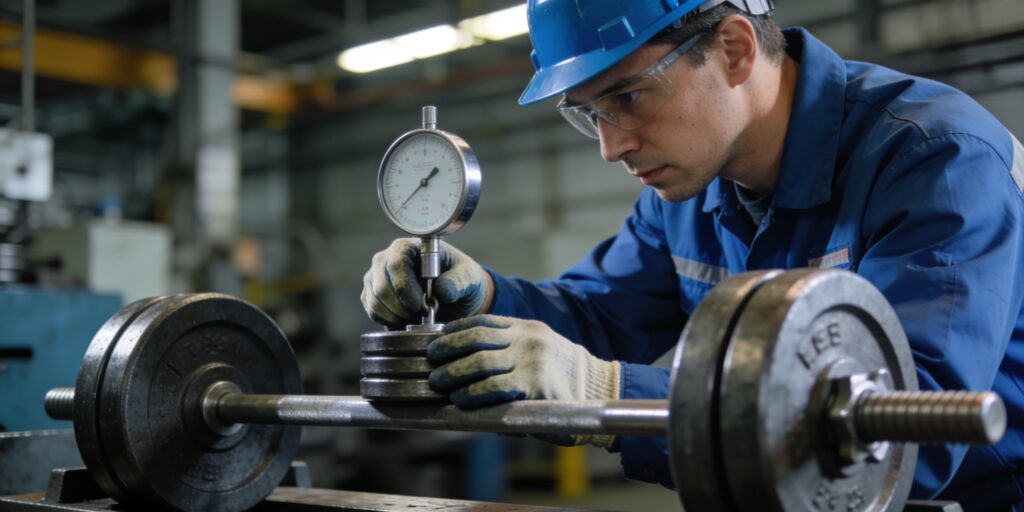
Stage 2: In-Process Quality Control (IPQC) — Production Checkpoints
IPQC checkpoints are embedded throughout our production sequence, not applied as a single inspection at the end of manufacturing. This is the distinction between finding a defect before it becomes a structural component and finding it after it has been built into a finished product. The cost of correcting a weld defect at the frame assembly stage is a fraction of the cost of scrapping a finished, powder-coated, upholstered unit.
At the frame assembly stage, our IPQC inspectors check weld quality against our weld specification: penetration depth, bead consistency, absence of porosity or incomplete fusion, and correct alignment of frame members. Our welding procedures are documented and our welders are certified to the specifications required for the structural steel grades we use. A frame with a weld defect does not proceed to the next production stage.
At the machining and finishing stages, IPQC verifies that hole positions, thread quality, and surface finishes meet our dimensional tolerances. Dimensional accuracy in commercial gym equipment is not simply an aesthetic standard — it determines whether adjustment mechanisms lock correctly, whether cables and pulleys run true under load, and whether assembly produces a unit that is geometrically correct and safe for the intended use.
At the powder coating stage, IPQC inspects coating adhesion, coverage uniformity, and film thickness against our specification. The powder coating on commercial gym equipment is the primary corrosion protection mechanism — it must be uniformly applied to the minimum specified thickness to provide the rust resistance our warranty covers. Coating below specification thickness is a silent defect that does not present visually but fails early under gym humidity and cleaning agent exposure.
Stage 3: Outgoing Quality Control (OQC) — Pre-Shipment Verification
OQC is the final verification before a unit is approved for shipment. Every unit undergoes OQC — this is not a statistical sampling process for our commercial equipment product lines. The OQC inspection covers assembly completeness and correctness, functional testing of all adjustment and locking mechanisms, structural verification through applied load testing, surface quality assessment, and documentation completeness verification.
Structural load testing at OQC applies calibrated load to each unit at or above the rated capacity specified for that product, verifying that the frame maintains rigidity and that no permanent deformation occurs under the test load. For benches rated at 1,000 lbs, for example, the OQC structural test applies a load that validates the frame’s behaviour under the rated capacity — not just a visual inspection of the welds. This test is performed on every unit, not on a production sample.
Functional testing verifies that cables run true under load without twist or abrasion against frame contact points, that adjustment mechanisms engage and lock correctly at every position, that pivot points and bearing systems operate smoothly without play or binding, and that safety features (where applicable) engage as designed. A unit that fails any functional test at OQC is returned to production for correction — it does not ship.
Three-Stage QC Process Overview
| QC Stage | When | What We Inspect | Disposition of Failures |
|---|---|---|---|
| IQC — Incoming | Before materials enter production | Steel grade and wall thickness; hardware dimensions; upholstery materials; rubber compliance; powder coat formulation; SGS material certifications | Non-conforming batches quarantined and rejected; returned to supplier with documented cause |
| IPQC — In-Process | At defined production checkpoints | Weld quality (penetration, bead, porosity, alignment); dimensional accuracy at machining; powder coat thickness and adhesion; assembly sequence and fastener torque | Non-conforming units held at checkpoint; rework before proceeding; no defective unit advances to next stage |
| OQC — Outgoing | Before every unit is approved for shipment | Assembly completeness and correctness; structural load test at rated capacity; functional test of all mechanisms; surface quality assessment; documentation completeness | Failed units returned to production; not released for shipment; documentation of failure mode and correction |
Structural Load Testing: What the Numbers Mean in Practice
The American College of Sports Medicine (ACSM) emphasises in its facility guidelines that equipment must be maintained in safe operational condition — but safe operational condition begins with equipment that was built safely in the first place. Structural load testing at OQC is the primary mechanism by which we verify this for every commercial unit we ship.
Load testing applies a defined force to the unit’s primary load-bearing elements — the pad surface and frame of a bench, the weight stack mechanism of a selectorised machine, the sleeve and frame connection of a barbell holder — and measures the unit’s response. For a weight bench rated at 1,000 lbs, the OQC load test verifies that the frame maintains dimensional stability under the rated load and that adjustment mechanisms do not disengage under load. For free weight storage solutions, the test verifies that loaded racks do not flex beyond specified tolerances at maximum stated capacity.
This testing is not theoretical — it is applied to every unit before shipment. A facility operator who receives Alex Athletics commercial equipment is receiving a unit that has already been physically tested at its rated capacity, not one that carries a capacity rating based on design calculations alone.

The Hyrox Validation: Competition as a QC Outcome
The most demanding environment for commercial fitness equipment is not a typical gym floor — it is a competition event where hundreds of athletes use the same equipment at maximum intensity across a compressed multi-hour window. For four consecutive years (2019–2022), Alex Athletics was the official equipment partner for Hyrox USA — one of the fastest-growing competitive fitness formats in North America.
This was not simply a sponsorship arrangement. It placed our equipment under conditions that no QC test replicates perfectly: maximum-intensity use by hundreds of competitive athletes, equipment set up and broken down repeatedly across event days, and the scrutiny of a competition environment where equipment failure has immediate, visible consequences for athlete performance and safety. Four years of continuous participation without equipment-related safety incidents is the real-world validation that our QC process produces equipment appropriate for the most demanding commercial fitness applications. Our brand history reflects this commitment to performance under competitive conditions.
How Our QC Process Informs Warranty Terms
Our warranty terms are not determined by commercial convention — they reflect the confidence that our QC process gives us in the structural integrity of our equipment. Our strength equipment and bench product lines carry three to five year structural frame warranties precisely because our IQC, IPQC, and OQC process gives us high confidence in the steel grade, weld quality, and load-test results of every unit we ship.
A supplier offering a one-year warranty on commercial strength equipment is communicating something specific about how confident they are in the product they are shipping. Our warranty terms reflect the opposite: that after 40+ years of manufacturing, documented QC processes at every production stage, and validated structural testing before shipment, we are prepared to stand behind our equipment’s structural integrity for the duration of a typical facility investment cycle.
What to Ask Any Equipment Supplier About Their QC Process
| Question | What a Strong Answer Looks Like | Red Flag Response |
|---|---|---|
| What standards do you test to? | Specific standards named: EN ISO 20957, ASTM F2276, CE/EN 957; documentation available on request | “We meet all international standards” without specifics |
| Is your QC process product-level or company-level? | Product-level: specific test procedures for each SKU documented | “We have ISO 9001” (company management system, not product testing) |
| Is load testing applied to every unit or sampled per batch? | “Every unit is structurally load tested before shipment” | “We sample test representative units per production batch” |
| Can you share your OQC checklist? | Yes — a documented checklist with defined pass/fail criteria is provided | Verbal description only; no documented checklist available |
| What happens to a unit that fails OQC? | Returned to production; rework completed; re-inspected before release | Uncertainty about the correction process, or no documented process |
| How do your warranty terms relate to your QC confidence? | Structural frame warranty of 3–5 years backed by specific QC process documentation | One-year warranty without explanation; warranty terms vague on covered scope |
Frequently Asked Questions
What is the difference between ISO 9001 and EN ISO 20957 for fitness equipment procurement?
ISO 9001 is a quality management system standard — it certifies that a company has documented processes for consistent quality management across its operations. It does not certify that any specific product meets safety or performance standards. EN ISO 20957 is a product-level standard — it specifies the structural, safety, and performance requirements that stationary training equipment must meet. When evaluating a fitness equipment supplier, ISO 9001 is a useful indicator of management system discipline, but EN ISO 20957 (or ASTM F2276 for US markets) is what verifies the equipment itself meets commercial fitness safety requirements.
Is QC documentation available for Alex Athletics products?
Yes. We can provide documentation of the standards our products are designed and tested to, as well as certificates of conformity relevant to your target market — CE marking documentation for European deployments, and standard specification compliance documentation for North American and international procurement. Contact our team with specific product and market requirements, and we will provide the relevant certification documentation as part of the procurement process.
How does QC affect the total cost of ownership of commercial gym equipment?
Rigorous QC at production directly reduces total cost of ownership by minimising the failure rate under commercial daily use. Equipment that passes IQC, IPQC, and OQC — with structural load testing at rated capacity — has a substantially lower early failure rate than equipment where QC is limited to visual inspection or statistical sampling. Early mechanical failures in commercial gym environments generate repair costs, equipment downtime, member dissatisfaction, and in the worst cases, safety incidents. The incremental cost difference between QC-verified commercial equipment and unverified alternatives is typically recovered within the first two years through reduced maintenance expenditure.
What are the key differences between commercial-grade and residential-grade fitness equipment in terms of testing standards?
Commercial-grade equipment is tested to standards that reflect multi-user, high-frequency daily operation — EN ISO 20957’s endurance testing requirements, for example, specify 10,000+ cycles for key mechanical components, simulating years of commercial use in a compressed test period. Residential-grade equipment is tested to lower duty cycle assumptions. ASTM F2276 specifically addresses commercial settings where equipment withstands thousands of cycles daily. Residential equipment that carries commercial-sounding claims but is not tested to commercial standards is the category where the gap between claimed and actual performance is largest.
How does the Hyrox partnership relate to your QC process?
The Hyrox USA partnership (2019–2022) placed our equipment in one of the most demanding competitive fitness environments available — hundreds of athletes at maximum intensity, repeated setup and breakdown cycles, and the full scrutiny of a competition context where equipment failure is immediately visible. Four consecutive years of Hyrox participation without equipment safety incidents is real-world performance validation that our QC process produces equipment capable of sustaining extreme commercial loading conditions. It is the kind of third-party operational proof that no internal test protocol can fully replicate.
Conclusion
QC is where the gap between a manufacturer’s claims and their actual product quality is determined. Three documented stages — IQC for incoming materials, IPQC at production checkpoints, and OQC before every unit ships — with structural load testing at rated capacity and compliance to EN ISO 20957 and ASTM F2276 standards: this is what we mean when we say every piece of Alex Athletics equipment is QC-certified before shipment. Our warranty terms reflect the confidence this process gives us. Our Hyrox record reflects what the process produces in practice.
For facility operators who want to review QC documentation for specific product categories before procurement, contact our team with your requirements and we will provide the relevant certification and testing documentation.