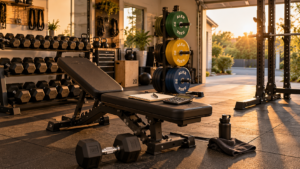
Conventional resistance training equipment is built on a set of assumptions: metal is strong, rigid is safe, heavier is harder. These assumptions have served the fitness industry well for decades. But they also define a ceiling. Fixed dumbbells require a static grip. Barbells demand bilateral symmetry. Cast iron plates are hard and loud. They do not bend, flow, adapt, or rehabilitate. For many training populations — studio members seeking variety, rehabilitation patients managing injury, seniors building functional strength, group fitness participants needing engagement — conventional resistance tools create friction rather than motivation.
LOOPA is Alex Athletics’ response to that ceiling. The LOOPA product line is a family of four distinct resistance tools designed around a shared philosophy: resistance should adapt to the human body, not the other way around. Each product in the series introduces a different mechanical principle — dynamic load, torsional resistance, variable accommodating resistance, and kinetic auditory feedback — to expand what resistance training can accomplish in a commercial facility context.
The LOOPA Design Philosophy
Most resistance equipment is designed to isolate and load a muscle in a fixed plane. This is effective for hypertrophy and maximal strength development, but it represents only one dimension of human movement. Real-world physical demands involve rotation, instability, grip variation, multi-planar loading, and reactive force absorption. LOOPA products are engineered to train these qualities directly — not as supplementary exercises, but as primary movement patterns.
Three design principles run consistently across the LOOPA range. First, soft materials replace hard surfaces wherever biomechanically appropriate, reducing injury risk and expanding the environments where training can safely occur. Second, dynamic or variable resistance replaces static load, engaging stabiliser systems and neuromuscular coordination beyond what fixed-weight training addresses. Third, the form factor invites movement patterns that conventional equipment makes awkward or impossible — the ring shape, the flexible bar, the chain-like weighted link each enable a specific class of movements that have no equivalent in traditional free weight design.
The Four Products of the LOOPA System
Donut Weight: Flow, Grip, and Multi-Plane Loading
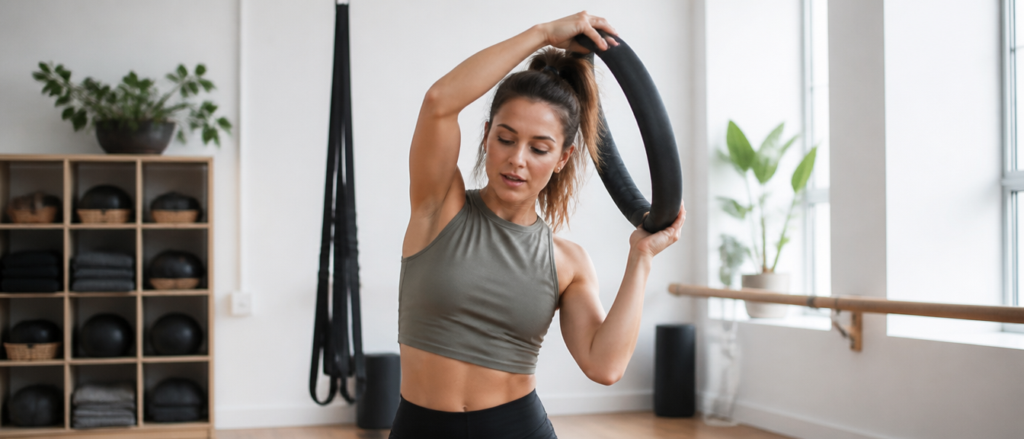
The Donut Weight is a soft, ring-shaped resistance tool available from 1 to 5 kg. The ring geometry creates a 360-degree grip surface — unlike any dumbbell or kettlebell — allowing the user to hold it at any point, pass it through and around the body with fluid continuity, and perform halo movements that train shoulder mobility and rotational core engagement simultaneously.
The soft fill (polyester fabric, metal flakes) means the Donut Weight will not cause injury if it contacts the body or is dropped on a hard floor. This property is particularly valuable for yoga and Pilates studios where floor protection is a priority, for environments where children or seniors are present, and for partner-based tossing drills where a hard object would present unacceptable risk. Its approachable aesthetic also reduces the psychological barrier to exercise that conventional iron equipment can create for first-time gym users.
From a programming standpoint, the Donut Weight functions as a weighted yoga prop (assisting in seated and supine positions), a core rotation tool (halos, figure-eights), and a reactive training implement (toss-and-catch partner drills). This versatility across distinct programming contexts is unusual for a product in the 1–5 kg weight class.
Thera Bell: Torsional Resistance for Rehabilitation and Grip Development
The Thera Bell is a soft, flexible bar (195–240 mm length, 1–2 kg) filled with a resistance core and covered in neoprene. Its function is distinct from every other product in the LOOPA line: it provides torsional, oscillatory resistance. When twisted, bent, or oscillated, it engages the extensor and flexor tendons of the forearm through a full range of eccentric motion.
This mechanism is clinically relevant. The “Tyler Twist” and reverse Tyler Twist — eccentric exercises performed with a flexible twist bar — have established research backing as effective conservative treatments for lateral epicondylitis (tennis elbow) and medial epicondylitis (golfer’s elbow). The Thera Bell is sized and weighted specifically to enable these protocols. At 1–2 kg with a 72–85 mm grip diameter, it is accessible to users with compromised hand or wrist function while still providing meaningful resistance progression.
Beyond rehabilitation, the Thera Bell develops grip endurance and forearm stability for athletes in climbing, racquet sports, and combat disciplines where sustained grip strength is a performance variable. Its compact size (fits in a gym bag or desk drawer) enables consistent daily use — a critical factor in both rehabilitation adherence and progressive grip development.
Weight Link: Accommodating Resistance Without the Metal
The Weight Link is LOOPA’s most technically sophisticated product — a 2,000 mm soft-shell chain available in 3, 6, and 10 kg. Its design principle is directly derived from the use of metal loading chains in elite powerlifting: as the chain is lifted from the ground, more of its length leaves the floor, progressively increasing the load. This “accommodating resistance” matches the resistance curve to the human strength curve, which is weaker at the bottom of a movement and stronger at the top.
A systematic review published in Sport Sciences for Health (Springer Nature) confirmed that variable resistance training allows the demands of an exercise to be matched to the muscle’s ability to exert force, consistently producing greater muscle activation compared to conventional constant-load resistance. The Weight Link makes this training stimulus accessible in a format that is safe, quiet, floor-friendly, and applicable in any facility context — eliminating the noise, sharp edges, and installation requirements of traditional metal chains.
The Weight Link’s secondary function is equally valuable: when draped over the bar or attached to a dumbbell, its free-hanging segments create oscillating instability that engages deep stabilisers and proprioceptive systems. This “chaos training” effect has been validated in rehabilitation research contexts. A randomised controlled trial published in Heliyon (National Institutes of Health PMC) demonstrated that accommodating variable resistance training produced significant improvements in muscle architecture, peak torque, and functional performance compared to conventional exercise regimens.
Rhythm Bar: Kinetic Auditory Feedback for Group and Accessible Fitness
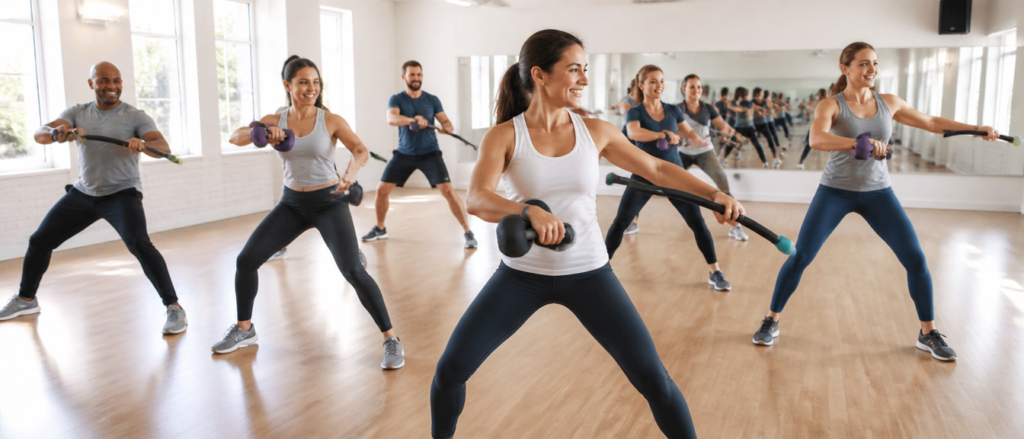
The Rhythm Bar (0.25–0.5 kg) is the lightest and most accessible product in the LOOPA series. A steel-and-PVC bar filled with shifting iron sand, it produces a rhythmic percussive sound when moved — providing immediate auditory feedback that helps users maintain tempo during aerobic movement. The shifting mass also creates reactive impulse forces: when the bar changes direction, the sand strikes the end walls, requiring the stabiliser muscles of the arm and shoulder to absorb and control the impact.
At 0.25–0.5 kg, the Rhythm Bar is designed for high-repetition aerobic use, not strength loading. Its primary applications are Zumba, dance fitness, walking programmes, group aerobics, and any setting where engagement, coordination, and accessibility are higher priorities than progressive overload. This makes it a specialist product for senior fitness programming, children’s activity programmes, and facilities positioning themselves around inclusive wellness rather than performance training.

LOOPA Product Comparison: Applications and Specifications
The table below provides a consolidated reference for all four LOOPA products, their mechanical principle, weight range, and primary facility applications.
| Product | Mechanical Principle | Weight Range | Primary Applications |
|---|---|---|---|
| Donut Weight | 360° grip / multi-plane dynamic load | 1–5 kg | Yoga/Pilates studios, flow training, partner drills, senior fitness, home gym |
| Thera Bell | Torsional / eccentric oscillatory resistance | 1–2 kg | Rehabilitation centres, physiotherapy, grip training, racquet sports, RSI recovery |
| Weight Link | Accommodating variable resistance / oscillation instability | 3–10 kg | Strength facilities, athlete development, home gym, bodyweight programmes |
| Rhythm Bar | Kinetic auditory feedback / reactive impulse | 0.25–0.5 kg | Group aerobics, Zumba, senior fitness, children’s programmes, dance fitness |
The Science Behind LOOPA: Why Conventional Resistance Has Limits
Standard constant-load resistance training — the dumbbell, the barbell, the plate-loaded machine — applies a fixed gravitational force regardless of where the user is in the range of motion. This is biomechanically inefficient. The human strength curve is not flat: every exercise has a “sticking point” where mechanical leverage is worst, and a “lockout” position where the muscle is mechanically stronger. A fixed load that is challenging at the sticking point is submaximal at the lockout, and vice versa.
Variable resistance training addresses this directly. As the American College of Sports Medicine (ACSM) notes in its resistance training guidelines, varying the resistance profile throughout the range of motion can increase total mechanical work per set, improve neuromuscular recruitment patterns, and provide training stimuli that constant-load equipment does not deliver. The LOOPA Weight Link operationalises this principle in a format accessible to any commercial gym without the installation requirements or hazards associated with metal chains.
The soft materials common across the LOOPA range also enable a distinct class of training benefits: they permit the kind of full-contact, high-velocity, multi-plane movement that hard implements prohibit. A soft weighted ring can be tossed, caught, passed around the body, and worn — expanding the movement vocabulary far beyond what any barbell or dumbbell allows.
Which Facility Types Benefit Most From the LOOPA System?
LOOPA products do not replace conventional strength equipment. They extend it. The following table maps each product to the facility contexts where it delivers distinct value that conventional equipment cannot provide.
| Facility Type | Most Relevant LOOPA Products | Primary Value Delivered |
|---|---|---|
| Yoga / Pilates studio | Donut Weight, Thera Bell | Weighted prop resistance; safe for studio floor; no intimidation factor |
| Physiotherapy / rehab centre | Thera Bell, Donut Weight | Eccentric tendon loading; safe grip for compromised hands; low impact |
| Senior fitness centre | Donut Weight, Rhythm Bar, Thera Bell | Safe soft surface; coordination training; accessible grip; auditory engagement |
| Boutique functional studio | Donut Weight, Weight Link | Flow training variety; accommodating resistance; programming differentiation |
| Performance / strength facility | Weight Link | Accommodating resistance for power development; chaos instability training |
| Group fitness / aerobics studio | Rhythm Bar, Donut Weight | Auditory tempo cue; tossing engagement; approachable resistance for all levels |
| Hotel / hospitality gym | Donut Weight, Thera Bell | Floor safe; quiet; compact storage; diverse guest fitness levels |
Frequently Asked Questions About LOOPA
What does LOOPA stand for, and what is its design concept?
LOOPA is Alex Athletics’ proprietary line of soft, adaptable resistance training tools. The design concept centres on three principles: soft materials that enable safe, dynamic movement; variable or torsional resistance that matches the body’s natural strength curve; and form factors that unlock movement patterns conventional equipment cannot support. The product line includes the Donut Weight, Thera Bell, Weight Link, and Rhythm Bar — each addressing a distinct training or rehabilitation context.
Is LOOPA suitable for commercial gym use, or is it primarily a home fitness product?
LOOPA products are designed and manufactured to commercial standards and are appropriate for commercial gym deployment. They are particularly well-suited to boutique studios, Pilates and yoga facilities, rehabilitation centres, senior fitness programmes, and group fitness environments. While individual LOOPA products also suit home gym use, their durability, weight range options, and programming versatility are aligned with commercial facility requirements.
How does the Weight Link differ from traditional lifting chains used in powerlifting?
Both the Weight Link and traditional metal chains operate on the same biomechanical principle of accommodating resistance — load increases as more of the chain leaves the floor. The Weight Link differs in its soft PVC and neoprene shell construction, which makes it safe against the body, quiet to use, compatible with any floor surface, and storable without the corrosion or sharp-edge hazards of metal chains. It delivers the variable resistance stimulus in a format accessible to commercial gyms that would not install metal chains.
Can the Thera Bell be used for clinical rehabilitation programmes?
Yes — the Thera Bell’s torsional resistance mechanism is specifically designed to enable the eccentric forearm exercises used in evidence-based protocols for lateral and medial epicondylitis (tennis elbow and golfer’s elbow). Its 1–2 kg weight range and 72–85 mm diameter are appropriate for users with compromised hand or wrist function. Facility operators can incorporate it into prescribed rehabilitation protocols, though individual patient use should be overseen by a qualified physiotherapist or sports medicine professional.
Which LOOPA product is the best starting point for a boutique studio looking to add variety?
The Donut Weight is typically the highest-impact first addition for boutique studios seeking programming variety. Its 360-degree grip, soft construction, 1–5 kg weight range, and applicability across Pilates, yoga, flow training, and group fitness make it the most versatile entry point. For studios serving populations with injury or rehabilitation needs, pairing the Donut Weight with the Thera Bell covers both movement variety and rehabilitation support within a compact product set.
Conclusion
The LOOPA resistance training system does not compete with conventional free weight equipment — it occupies different territory entirely. Where barbells and dumbbells train maximal strength in fixed planes, LOOPA tools train grip versatility, variable resistance, torsional stability, and aerobic engagement in ways that hard, constant-load equipment cannot replicate. This makes LOOPA a meaningful addition to the equipment floor of any facility serving diverse populations, programming group fitness, supporting rehabilitation, or seeking to differentiate its offering from standard commercial gyms.
For facility operators interested in expanding their resistance equipment offer beyond conventional free weights, contact our team to discuss LOOPA product configurations, volume pricing, and programming support for your specific facility context.