The barbell is the oldest piece of strength training equipment still in active commercial use and the one most likely to be specified without reference to its technical characteristics. Gym operators ordering barbells for a new facility typically focus on weight (20 kg), length (7 feet), and price — and treat everything else as the manufacturer’s problem. In practice, the specifications that determine how a barbell performs under commercial daily use, how long it remains straight and functional, and whether it is appropriate for the training styles your members actually practice are far more nuanced than weight and price capture.
This guide explains the six barbell specifications that commercial gym buyers should evaluate before placing an order — and maps bar type to facility context so that the right bar ends up in the right training zone.
Specification 1: Shaft Diameter — The Foundation of Whip and Grip
Shaft diameter is the single most consequential specification for a barbell’s training behaviour. It determines two things simultaneously: the degree to which the bar oscillates under dynamic load (“whip”), and the grip geometry experienced by the user’s hand.
Both the Internationaler Powerlifting-Verband (IPF) and the International Weightlifting Federation (IWF) specify that competition bars must fall between 28mm and 29mm in shaft diameter for men’s bars, with 25mm for women’s weightlifting bars. In practice, these diameters define three distinct commercial bar categories.
28mm is the IWF standard for men’s Olympic weightlifting competition. The narrower shaft provides more elastic whip under dynamic load — useful during cleans and snatches, where the natural oscillation of the bar assists the lifter’s transition from pull to receive. The narrower grip also makes hook grip easier for smaller hands. The Alex Athletics Weightlifting Barbell (Male) is built to this specification.
28.5mm is the commercial multipurpose standard — a hybrid specification that sits between the whippy Olympic bar and the rigid power bar. It provides enough flex for Olympic lifting movements while maintaining sufficient rigidity for stable squatting and bench pressing. For commercial gyms serving a general population with mixed training goals, the 28.5mm bar is the most practical primary bar specification. Alex Athletics’ Multipurpose Weightlifting Barbell uses this specification with a 195,000 PSI steel shaft.
29mm is the IPF powerlifting standard. The thicker shaft eliminates bar oscillation almost entirely, creating the rigid, stable platform required for maximum-effort squats, bench presses, and deadlifts where unpredictable bar movement is a safety risk. Alex Athletics’ Kraftdreikampf Langhantel uses a 29mm shaft with aggressive knurling specifically for this use case.
Specification 2: Tensile Strength — The Durability Metric That Actually Matters
Tensile strength, measured in PSI (pounds per square inch), quantifies how much pulling force is required to break the steel apart. In the context of commercial gym barbells, it is used as the primary proxy for steel quality and the bar’s resistance to permanent bending under repeated heavy loading.
The practical floor for commercial gym use is 170,000 PSI. Below this threshold, bars are prone to permanent bending under commercial conditions — multiple users per day, heavy loading, and occasional uncontrolled plate drops. Industry guidance consistently places 170,000–190,000 PSI as the appropriate commercial range for general use bars, with 190,000–220,000+ PSI for performance and competition applications.
It is important to understand what tensile strength does and does not tell you. It correlates strongly with yield strength — the load at which the bar permanently bends rather than returning to straight. A bar rated at 195,000 PSI is less likely to take on a permanent set after a heavy drop than one rated at 150,000 PSI. However, tensile strength does not directly specify load capacity, and a high tensile strength rating from an unverified manufacturer is not a substitute for QC testing documentation. The Alex Athletics Multipurpose Weightlifting Barbell achieves 195,000 PSI — appropriate for its commercial daily-driver positioning.
Specification 3: Rotation System — Bearings, Bushings, or Hybrid
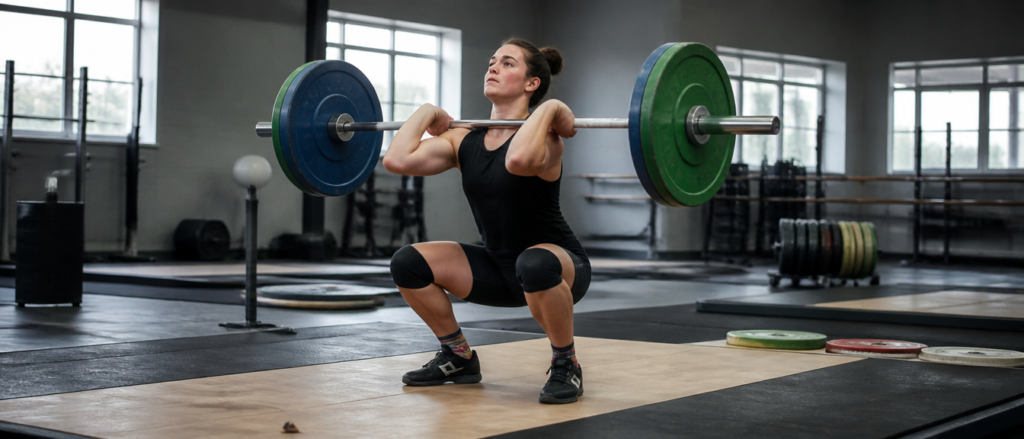
Sleeve rotation is the mechanism by which the loaded sleeve turns independently of the shaft when the bar is in motion. This rotation is not a comfort feature — it is a safety mechanism for Olympic lifting movements. During a clean or snatch, the bar’s natural trajectory requires the sleeve to rotate freely as the lifter transitions from pull to receive. Without adequate sleeve rotation, the torque transfers through the wrist, creating a rotational injury risk that accumulates over high training volumes.
Needle bearings provide the fastest, smoothest sleeve rotation. They minimise friction between the shaft and sleeve through a set of cylindrical rollers arranged radially. Bearing bars spin quickly and consistently — appropriate for any bar used in Olympic weightlifting movements. They are generally more expensive and require more careful maintenance than bushing alternatives.
Bronze or brass bushings provide a controlled, moderate spin. The sleeve rotates against a cylindrical sleeve lined with bronze or brass, which provides adequate rotation for movements with moderate sleeve loading but limits the high-speed spin of bearing bars. Bushing bars are the appropriate specification for powerlifting bars, where controlled rotation is preferred — free-spinning sleeves can destabilise the wrists during heavy bench press or reduce control during heavy deadlifts.
Hybrid systems combine bushings and needle bearings — typically two to four bushings for heavy-load stability with eight or more needle bearings for rotational speed. This is the specification used in Alex Athletics’ Multipurpose Weightlifting Barbell (2 brass bushings + 8 needle bearings), making it genuinely functional for both Olympic and powerlifting movements. Hybrid bars are the optimal specification for commercial gym contexts where a single bar must serve multiple training styles.
Specification 4: Knurling — Grade, Pattern, and Center Knurl
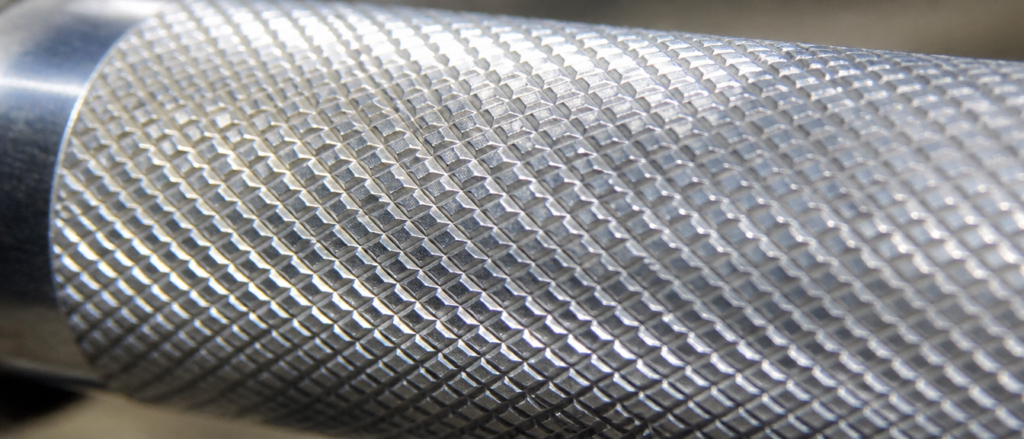
Knurling is the cross-hatched pattern machined into the shaft surface to provide grip. Three variables define a bar’s knurling: its aggressiveness, its pattern geometry, and whether it includes a center knurl.
Knurling aggressiveness ranges from passive (light, fine texture comfortable for high-repetition work) through medium (the commercial standard — sufficient grip for heavy pulling without tearing the hand) to aggressive (deep, sharp cut preferred by competitive powerlifters for maximal deadlifts). Aggressive knurling is not appropriate for high-volume general population training; it creates callus formation and skin abrasion that members find uncomfortable at moderate training volumes.
Knurl mark positions are standardised by federation. IPF requires ring marks at 810mm spacing (81cm apart), identifying the legal grip width for bench press competition. IWF requires marks at 910mm spacing (91cm apart) for weightlifting. Most commercial multipurpose bars include dual knurl marks at both spacings, allowing athletes from both disciplines to identify their legal hand position on the same bar.
Center knurl is the short knurled section in the middle of the bar shaft. It is essential for back squat — the rough texture grips the fabric of the lifter’s shirt or singlet, preventing the bar from sliding down the traps during heavy low-bar squat attempts. Powerlifting bars always include a center knurl. Weightlifting bars deliberately omit it, as the bar contacts the throat during the clean — a center knurl would be painful. Multipurpose bars vary; the Alex Athletics Multipurpose Weightlifting Barbell specifies a passive center to prioritise front squat and clean comfort.
Specification 5: Bar Finish and Corrosion Resistance
The finish on a commercial barbell shaft determines how well it resists the two primary degradation forces in a gym environment: moisture (from sweat and humidity) and mechanical abrasion (from chalk, plates, and contact surfaces).
Hard chrome is the most durable commercial finish. Unlike decorative chrome (which sits in a thin, brittle layer that chips and peels), hard chrome is an industrial-grade plating applied at significantly greater thickness. It resists corrosion, has low friction coefficient for smooth plate loading, and does not interact aggressively with chalk. Hard chrome is the appropriate specification for high-volume commercial use. Both Alex Athletics barbell models above use hard chrome.
Zinc (bright or black) provides good corrosion resistance at lower cost than chrome. Bright zinc has a clean silver appearance; black zinc produces a dark grey-black shaft. Both are appropriate for commercial use and offer consistent performance in typical gym humidity conditions.
Black oxide is an inexpensive finish that provides minimal corrosion protection. It is prone to surface rust in humid environments and is not appropriate as a primary commercial bar finish in markets with significant humidity variation.
Bare steel / raw steel provides no corrosion protection but offers maximum grip feel — the preferred choice for powerlifting purists. It requires regular maintenance (brushing, light oiling) to prevent surface rust. In commercial environments where maintenance discipline is inconsistent, bare steel bars deteriorate quickly without attention.
Specification 6: Load Capacity and Sleeve Length
Load capacity — the maximum weight the bar is rated to hold — and sleeve length — the usable surface area on each sleeve for plate loading — are related but distinct specifications. A 20 kg Olympic bar with a standard sleeve length of approximately 420mm can typically accommodate the plate loads required for general commercial use without reaching sleeve capacity. At elite strength levels (300kg+ working loads), sleeve length becomes a practical constraint, and calibrated plates (thinner profile per kg) become necessary to fit the required load on the available sleeve.
Die American College of Sports Medicine (ACSM) notes in its strength training guidelines that commercial facilities should select equipment capable of supporting the expected maximum user loads — not just average loads. For a general commercial gym, a bar rated at 1,500 lbs (approximately 680 kg) provides an adequate safety margin for all realistic commercial loading scenarios. Performance facilities serving competitive lifters may require bars rated above this threshold.
Barbell Type Specification Matrix
| Bar Type | Durchmesser der Welle | Zugfestigkeit | Drehung | Rändeln | Center Knurl | Primary Use |
|---|---|---|---|---|---|---|
| Olympic Weightlifting (Men’s) | 28mm | 190,000+ PSI | Needle bearings | Mittel | No | Snatch, clean & jerk, high-pull |
| Olympic Weightlifting (Women’s) | 25mm | 185,000+ PSI | Needle bearings | Mittel | No | Same; 15kg, shorter at 2010mm |
| Powerlifting | 29mm | 200,000+ PSI | Bronze bushings | Aggressive | Yes | Squat, bench press, deadlift |
| Multipurpose / Hybrid | 28.5mm | 195,000+ PSI | Hybrid (bushings + bearings) | Mittel | Passive or none | All strength movements; commercial general use |
| Standard Barbell (non-Olympic) | 25–28mm; 25mm sleeves | 140,000–165,000 PSI | Basic bushings | Light to medium | Varies | Entry-level training; not for elite loading |
Male vs Female Bars: When the 15kg Specification Matters
The women’s barbell specification — 15 kg, 2010mm length, 25mm shaft diameter — is not simply a lighter version of the men’s bar. The 25mm shaft diameter is a specific IWF design choice: it provides better hook grip accessibility for athletes with smaller hands, and its narrower profile produces proportionally more whip than the 28mm men’s bar under the same loading conditions — appropriate for the lower absolute loads used in women’s weightlifting competition.
For commercial facilities serving a mixed population, stocking both 20 kg and 15 kg barbells is the operationally correct approach. The lighter bar is not limited to women — it is appropriate for any member with smaller hands, lower strength levels, or who is learning barbell movements. A facility with barbell stations stocked exclusively with 20 kg men’s bars creates a barrier for a substantial segment of its membership. The practical recommendation is a ratio of one 15 kg bar per barbell station in general training areas, with full 20 kg bar complement on dedicated lifting platforms.
Recommended Bar Selection by Facility Context
| Facility Context | Primary Bar Specification | Anmerkungen |
|---|---|---|
| General commercial gym (mixed population) | 28.5mm multipurpose, 190,000+ PSI, hybrid rotation, medium knurl | One bar type covers all training styles; add 15kg bars for women’s stations |
| Olympic weightlifting club / platform area | 28mm men’s / 25mm women’s, 190,000+ PSI, needle bearings, IWF knurl marks | Competition-spec preferred; bumper plates required on platforms |
| Powerlifting gym or dedicated strength area | 29mm, 200,000+ PSI, bronze bushings, aggressive knurl, center knurl | IPF-compliant bar; pair with calibrated plates for competition-prep stations |
| CrossFit / functional fitness studio | 28.5mm multipurpose, hybrid rotation, 195,000+ PSI | High-rep drops require bumper plates; medium knurl preferred for volume training |
| Senior fitness / rehabilitation facility | Standard barbell (lighter), 25mm sleeves, or 15kg Olympic bar | Lower absolute loads; ergonomic grip priority over performance spec |
| Fitnessstudio für Hotels und das Gastgewerbe | 28.5mm multipurpose, chrome finish, medium knurl | General use; chrome finish resists humidity; medium knurl minimises hand damage for infrequent users |
Häufig gestellte Fragen
What tensile strength should a commercial gym barbell have?
For general commercial use, a minimum of 170,000 PSI is the floor — below this, bars are prone to permanent bending under commercial daily-use conditions. The practical commercial standard is 190,000–200,000 PSI for training bars. Performance and competition applications warrant 200,000–220,000+ PSI. Tensile strength should be verified through documentation from the manufacturer, not simply accepted from product listings, as the metric is difficult to verify without independent testing.
What is the difference between a powerlifting bar and an Olympic weightlifting bar?
The primary differences are shaft diameter (29mm powerlifting vs 28mm Olympic), rotation system (stable bushings vs fast needle bearings), knurling aggressiveness (aggressive vs medium), and center knurl presence (powerlifting bars have it; Olympic bars do not). These differences directly reflect the different movement demands of each sport: powerlifting prioritises rigidity and grip security for maximal static lifts, while Olympic weightlifting prioritises bar rotation and flex for explosive dynamic movements.
Should a commercial gym stock both 20kg and 15kg barbells?
Yes. The 15kg women’s bar (25mm shaft, 2010mm length) is not a reduced-specification alternative — it is the IWF-standard bar for female competition and is appropriate for any user with smaller hands, lower strength levels, or who is learning barbell techniques. A commercial gym stocked exclusively with 20kg bars creates a practical barrier for a significant proportion of its membership. The recommended ratio is at minimum one 15kg bar per barbell station in general training areas.
How does bar finish affect commercial gym maintenance requirements?
Bar finish directly determines maintenance frequency. Hard chrome requires no routine maintenance beyond cleaning — it resists moisture and chalk with minimal surface care. Zinc finishes are similarly low-maintenance. Black oxide and bare steel require periodic light oiling to prevent rust, which is manageable in a well-resourced facility but impractical in most commercial gym environments where daily equipment maintenance is limited. For commercial facilities, hard chrome or zinc finish is strongly preferred over bare steel or black oxide.
What is the difference between bushings and needle bearings in a commercial barbell?
Bushings are cylindrical sleeves — usually bronze or brass — that line the interface between the shaft and the rotating sleeve, providing moderate friction and controlled spin. They are durable, low-maintenance, and provide the stable rotation appropriate for powerlifting movements. Needle bearings are thin cylindrical rollers arranged radially, minimising friction between shaft and sleeve for fast, consistent spin required in Olympic lifting. Hybrid systems combining both provide adequate rotation speed for Olympic movements and sufficient stability for powerlifting — the appropriate specification for a commercial multipurpose bar serving a general population.
Fazit
Specifying the right barbell for a commercial gym requires looking beyond weight and price to the six specifications that actually determine how it performs and how long it lasts: shaft diameter, tensile strength, rotation system, knurling, finish, and load capacity. A 28.5mm multipurpose bar with 195,000 PSI steel, a hybrid bearing-bushing system, medium knurling, and hard chrome finish covers the vast majority of commercial gym use cases with one specification. Adding a dedicated 29mm powerlifting bar for squat rack zones and 15kg women’s bars for general barbell stations completes a well-specified commercial barbell floor at any scale.
To discuss Alex Athletics’ full commercial barbell range or receive a barbell floor specification recommendation for your facility, Kontaktieren Sie unser Team.