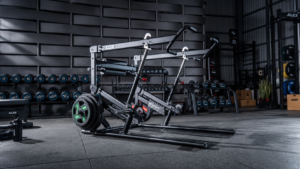
PT Exercises — Looking Beyond Physical Labor & Redefining its Components — By Dr. Jordan K., PT — the second article in his injury-prevention and recovery series for Alex Athletics. The first, on Passive vs. aktive Physiotherapie, explained why passive relief alone keeps pain coming back; this one defines what physical therapy exercises actually are, and why a hard day’s work does not count.
“I Get Plenty of Exercise at Work”: The Misconception Every PT Hears
Over decades of experience as a PT practitioner across various countries, one common misconception concerning exercise which I hear from clients almost every day:
“Doing more exercises? What do you mean? I get plenty of exercise—I’m on my feet all day at work, lifting boxes, walking back and forth, and bending down constantly.”
However, there is a fundamental clinical difference between physical labor or repetitive work movements and active exercise. While both involve certain muscle activity and energy expenditure, they impact the body in vastly differently ways. To have a proper understanding of the differences between them will likely reduce the chance of being injured and thus bring forth a healthier lifestyle.
Why Physical/Occupational Labor is Not Exercise
In order to understand active exercise with its components , we must first address what exercise is not and how physical labor impacts the body differently:
Occupational Stress vs. Controlled Loading
Repetitive bending, heavy lifting, or standing during a work shift imposes asymmetric, prolonged stress on fatigued tissues without structured recovery periods.
Lack of Postural Control
Labor-related tasks are dictated by efficiency or external speed, leading the body to compensate using overactive muscles while underusing core stabilizers.
Micro-Trauma Accumulation
Uncontrolled repetitive movements at work often perpetuate the pain-inflammation cycle rather than building physical capacity.
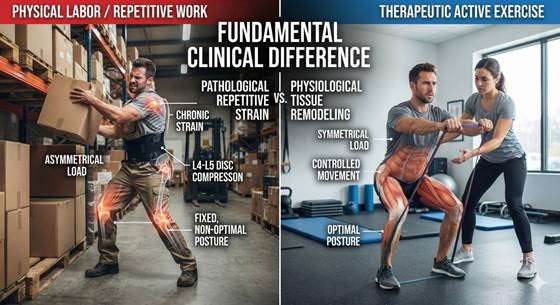
(Diagram: Physical Labor/Repetitive Work vs. Therapeutic Active Exercise)
This distinction is also how public health bodies frame the subject: the Weltgesundheitsorganisation counts occupational activity as part of total physical activity, yet its recommendation for muscle-strengthening work on two or more days per week is a separate, deliberate requirement that a physically demanding job does not automatically satisfy.
What Are Physical Therapy Exercises? Definition and How They Differ from General Exercise
The Clinical Definition: Precise, Directional, Progressive
While general active exercise involves muscle activity and energy expenditure, PT exercise functions in a very definite and specific way. By definition, PT exercise is the systematic and planned execution of bodily movements, postures, or physical activities designed and prescribed by a physical therapist to reduce pain, restore musculoskeletal or/and neuromuscular function, improve mobility, stability and strength, and correct overall physical impairments. Therapeutic active exercise, in simple term, is precise, directional, and progressive.
General Exercise vs. PT-Specific Exercise at a Glance
| Exercise in General | PT-Specific Exercise | |
| Hauptziel | Improves overall health & fitness | Reduce pain & restore impaired movement(s), strength and function(s) |
| Basis | Personal goals & general fitness levels | PT/Medical diagnosis & specific anatomical deficits |
| Focus of Movement | Global conditioning | Targeted biomechanics of muscles, joints and nerves |
(Chart #1: Exercise in General vs. PT-Specific Exercise)
Components of PT Exercise: From Pain Control to Long-Term Resilience
My clinical experiences spans across specialised back and neck rehabilitation with occupational health, elite sports physiotherapy, and post-professional clinical doctorate research in orthopaedics. Across all these settings, one rule always stands: Passive treatments provide necessary pain relief, but active PT exercises will be required from day one to produce long-term resilience. The various components of PT exercises are as follows:
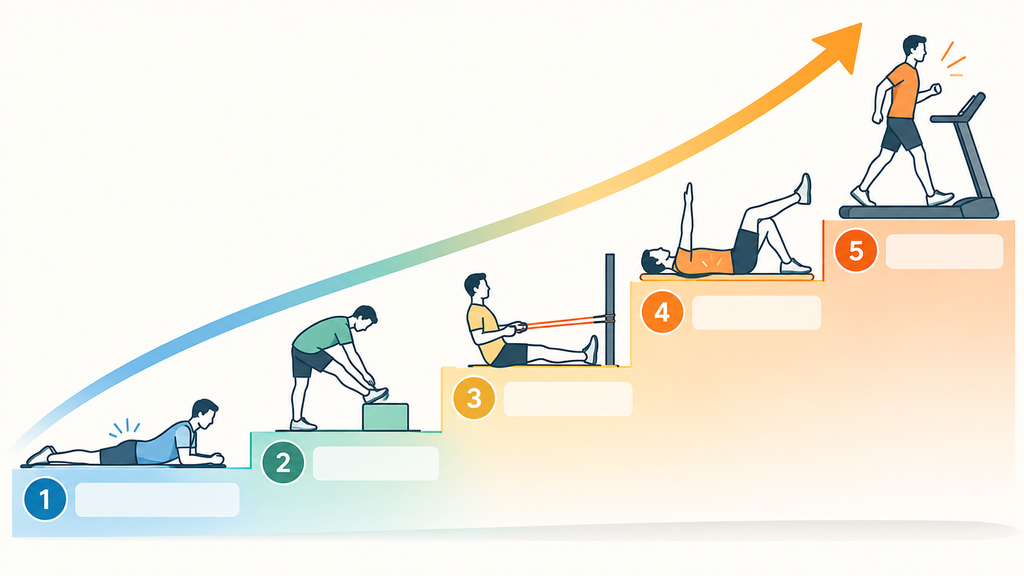
1. Pain Control Exercises
Purpose — Calming or desensitizing the nervous system: When an acute injury or severe pain flare-up occurs, muscle activation is often reflexively inhibited by the nervous system. High pain levels create fear of movement, leading to guarding and stiffness. Pain control exercises are low-intensity, directional, or desensitizing movements and static positions designed to reduce pain thresholds without overloading healing tissues.
Examples: Directional preference movements (such as gentle repeated extension or flexion based on mechanical assessment), or simply positions (such as prone on elbow, or lying flat in bed with pillows underneath knees), and gentle pelvic tilts.
2. Stretching & Flexibility Exercises
Purpose — Restoring Tissue Length, Joint Range and Nerve Mobility: Once acute desensitization begins, shortened or hypertonic soft tissues can limit joint range of motion and alter natural body mechanics. Stretching exercises focus on lengthening tight muscle groups, tendons, and surrounding fascia to restore structural symmetry. Nerve stretching and gliding exercises may also be required to restore nerve mobility, sensitivity, and relieve numbness by lowering pressure and increasing blood circulation.
Examples: Static muscle stretching on the target group(s), hamstring or hip flexor stretches, or dynamic nerve mobility and gliding exercises.
3. Strengthening Exercises
Purpose — Rebuilding Muscle and Tendon Tolerance: With pain under control and range of motion restored, progressive resistance loading becomes necessary. Strengthening exercises focus on hypertrophy, force production, and rebuilding the mechanical capacity of muscles and tendons so they can handle physical stress.
Examples: Resistance band rows, split squats, and cable-resisted variations.
4. Stability Exercises
Purpose — Neuromuscular Control and Joint Stabilization: Force production alone is insufficient if the deep stabilizing structures are inactive. Stability exercises train the neuromuscular system to coordinate local stabilizer muscles (such as core muscles and shoulder and scapular stability muscles) before larger global muscles generate motion.
Examples: bridging, dead bugs, single-leg stance drills, gym ball stability variations and scapular push up.
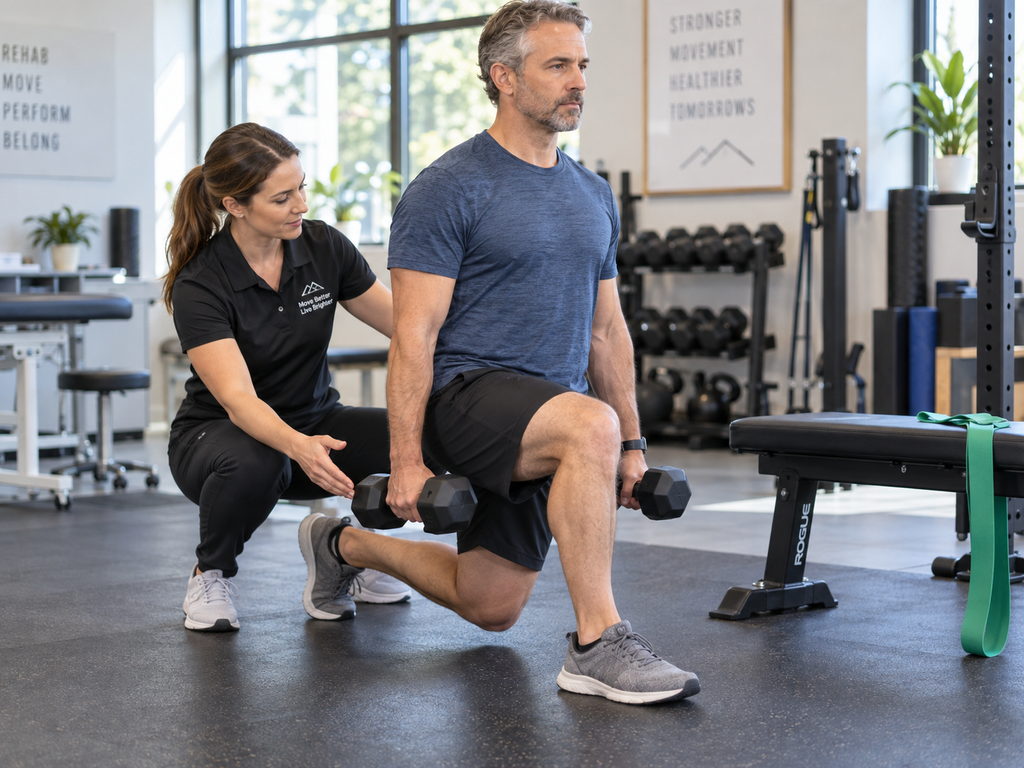
5. Endurance Exercises
Purpose — Preventing Fatigue-Induced Injury: Many re-injuries occur not because a client lacks maximal strength, but because their muscles fatigue during sustained daily activities or prolonged postures. Endurance exercises condition both local muscle groups and the cardiovascular system to maintain output over extended periods.
Examples: Low-impact continuous aerobic work (cycling, hydrotherapy, or brisk walking) alongside high-repetition, low-load muscular endurance holds (e.g., side planks, prolonged wall sits).
| Exercise Components | Purpose |
| 1. Pain Control | Calming or desensitizing the nervous system |
| 2. Stretching | Restoring Tissue Length, Joint Range and Nerve Mobility |
| 3. Strengthening | Rebuilding Muscle and Tendon Tolerance |
| 4. Stability | Neuromuscular Control and Joint Stablization |
| 5. Endurance | Preventing Fatigue-Induced Injury |
(Chart #2: Summary of Exercise Components and Its Purpose)
Real Recoveries: Three Clients, Three Countries
1.) “Overcoming Occupational Overuse” — “I spent 8-10 hours a day lifting crates and walking warehouse floors, assuming that was keeping me fit. Instead, my lower back became so stiff I could barely tie my shoes. We started with back extension pain-control movements and progressed to back stretching and deep core stabilization. exercises. Within two months of targeted active exercises, I returned to work completely pain-free and learned how to incorporate these exercises as I continue to work daily.” — Frank P. (Construction Worker) from Winnipeg, Canada
2.) “Turning Point to Managing My Own Pain” — “Long hours sitting at a desk left me with constant, radiating lower back and hamstring discomfort. I used to rely on massage and acupuncture for quick relief, but the pain kept returning. Transitioning to active rehabilitation—focusing on the progression from back pain relieving exercises , including proper sitting posture at work, to hamstring stretching and sciatica nerve gliding exercises, and core stabilisation exercises—was the turning point. Now I finally know how to control my own pain.” — Ms. Cheung (Bank Manager) in Hong Kong
3.) “From Uncontrollable Pain to Active Living” — “I was suffering from excruciating lower back pain that radiated down my leg, making it painful doing any household chores or walk short distances. I tried rest and passive heating pads and all kinds of therapy but my condition still deteriorated. Finally meeting my PT who has put me on a structured active recovery program—starting with pain desensitization exercises, moving into flexibility, strengthening and stability work, and finishing with endurance training. Today, I am walking miles without pain and have returned to being a happy full-time mother and a housewife” — Ruby P. (Housewife) in New Delhi, India
Anmerkung der Redaktion: Diese Berichte spiegeln persönliche Erfahrungen wider, die dem Autor mitgeteilt wurden; die individuellen Ergebnisse variieren, und der Ausgang hängt von der Diagnose, der Therapietreue und dem allgemeinen Gesundheitszustand ab.
Häufig gestellte Fragen
Is physical labor the same as exercise?
No. Physical labor and exercise both involve muscle activity and energy expenditure, but they affect the body differently. Work tasks impose asymmetric, prolonged stress on fatigued tissues without structured recovery, are driven by speed and efficiency rather than posture, and tend to accumulate micro-trauma. Exercise — and physical therapy exercise in particular — applies controlled, symmetrical, progressive loading that builds capacity instead of wearing it down.
What are physical therapy exercises?
Physical therapy exercises are systematic, planned movements, postures or activities designed and prescribed by a physical therapist to reduce pain, restore musculoskeletal and neuromuscular function, and improve mobility, stability and strength. Unlike general fitness training, they are based on a clinical diagnosis and target specific anatomical deficits, which is why they are described as precise, directional and progressive.
What are the five components of therapeutic exercise?
The five components are pain control, stretching and flexibility, strengthening, stability, and endurance. They follow a logical order: calm the nervous system first, restore tissue length and joint range, rebuild muscle and tendon tolerance through progressive resistance, train deep stabilizers for neuromuscular control, and finally condition the muscles and cardiovascular system to resist fatigue — the point at which many re-injuries occur.
Can I do physical therapy exercises at home without equipment?
Yes — many of them, especially in the early components. Pain-control positions, directional movements, stretches, nerve glides, bridges and dead bugs need only a mat. The strengthening and endurance components benefit from simple tools such as resistance bands, a pair of Freihanteln, or a stable bench, which allow loading to progress. An initial assessment by a physical therapist should guide the program first.
How long does it take for physical therapy exercises to reduce pain?
Pain-control exercises can reduce symptoms within days when the correct directional movements are prescribed, but lasting change takes longer because it depends on tissue adaptation. The client accounts in this article describe meaningful recovery over roughly two months of consistent, progressive work. Timelines vary with the condition, its severity, age, adherence and how early active rehabilitation starts — a clinician’s assessment is the only reliable guide.
The Bottom Line: From Symptom Relief to Physical Empowerment
PT exercise is the bridge between temporary pain relief and permanent functional independence. By distinguishing active rehabilitation from daily physical work, clients can engage in targeted movement strategies that provide pain relief, restore flexility and stability, rebuild strength, and restore quality of life across any environment. By integrating all five components of PT exercise into a structured, phase-based recovery plan, it helps to transit from short-term symptom relief to permanent physical empowerment!

Über den Autor – Dr. Jordan K. (Physiotherapeut / zertifiziert in Akupunktur); BMR (Physiotherapie) – Kanada; MScMP – Hongkong; DPT – USA
This article is provided for educational purposes and does not replace individual medical assessment, diagnosis or treatment. If you are injured, in pain, or managing a long-term condition, consult a qualified health professional before beginning or changing an exercise program. For general guidance on safe activity levels, see the NHS exercise guidelines.
Literaturverzeichnis
[1] World Health Organization. (2024, June 26). Physical activity [Fact sheet]. Retrieved October 23, 2026, from https://www.who.int/news-room/fact-sheets/detail/physical-activity
[2] Mayo Clinic. (2026, June 5). Strength training: Get stronger, leaner, healthier. Retrieved October 23, 2026, from https://www.mayoclinic.org/healthy-lifestyle/fitness/in-depth/strength-training/art-20046670
[3] Alex Athletics. (n.d.). Hexagon Braille Dumbbell-C4 (W03AB001) product specifications. Retrieved October 23, 2026, from https://alexathletics1982.com/hex-dumbbell-with-braille/
[4] Mayo Clinic. (2025, March 25). Core exercises: Why you should strengthen your core muscles. Retrieved October 23, 2026, from https://www.mayoclinic.org/healthy-lifestyle/fitness/in-depth/core-exercises/art-20044751
[5] American Council on Exercise. (n.d.). Push-up — Exercise library. Retrieved October 23, 2026, from https://www.acefitness.org/resources/everyone/exercise-library/41/push-up/
[6] Alex Athletics. (n.d.). Power Strider XC2 body-weight support treadmill product specifications. Retrieved October 23, 2026, from https://alexathletics1982.com/power-strider-xc2/
[7] National Health Service. (n.d.). Exercise. Retrieved October 23, 2026, from https://www.nhs.uk/live-well/exercise/