There is a procurement criterion in commercial gym equipment that did not exist fifteen years ago and is now material enough to influence buying decisions at every price point. It is not load capacity, tensile strength, bearing specification, or warranty length. It is visual appeal — specifically, how equipment looks in the kind of lighting typical of a commercial gym, under the lens of a smartphone camera, in the content that millions of gym members post to social media every day.
This shift is not superficial. It reflects a fundamental change in how commercial gyms acquire new members, how members experience and relate to the facilities they join, and how the value of equipment extends beyond its training utility into its marketing function. Understanding this shift is now a necessary part of commercial gym equipment procurement — and for operators who ignore it, the competitive cost is real.
How Social Media Changed Gym Member Acquisition
Before social media became a dominant force in consumer decision-making, gyms acquired new members through location convenience, price, word-of-mouth, and in-person visits. The visual presentation of the facility mattered — it always did — but the audience for that presentation was limited to people who were already physically present in or near the gym. A prospective member’s first meaningful exposure to a gym’s environment came when they walked through the door for a tour.
Social media has inverted that sequence entirely. Prospective members now frequently develop a detailed impression of a gym’s environment, equipment quality, training culture, and community character long before they visit — through the content that current members and coaches post on Instagram, TikTok, and YouTube. The gym floor has become a broadcast environment, and its content is being produced continuously, voluntarily, and for free by the people who train there.
Fitness remains one of the highest-performing content niches on social media. The Creator Hero fitness niche analysis estimates that the fitness industry will generate over $240 billion in revenue by 2026, with Instagram and TikTok central to that commercial ecosystem. When a gym member posts a workout video or a mirror selfie tagging their gym, the post reaches their entire social network — hundreds or thousands of people who are potential members. When that content is consistently high-quality and visually appealing, the cumulative effect is a persistent, self-reinforcing marketing channel that no paid advertisement budget can fully replicate.
The Measurable Marketing Value of Member-Generated Content
User-generated content (UGC) — content created by real members and customers rather than brands — has proven to be the most trusted and commercially effective form of marketing in the fitness sector. The statistics are striking. According to research cited by Resawod, approximately 80% of consumers believe that UGC helps influence their purchasing decisions — far outpacing the influence of brand-produced content (13%) and paid influencer content (8%). When someone considering a gym membership sees real members training in a real facility, posting authentic content about their experience, the persuasive effect is substantially greater than any produced advertisement for the same facility.
Stack Influence’s fitness marketing research places the UGC impact figure at 79% of consumers saying UGC highly impacts their purchasing decisions — and notes that ads featuring UGC receive four times higher click-through rates than standard brand creative. For gym operators thinking about marketing ROI, these numbers reframe a question that many have not consciously asked: what is the marketing value of equipment that consistently generates member content, versus equipment that does not?
As fitness business consultant Jim Thomas writes for FMC Consulting: “The most successful gyms I’ve worked with have flipped the script. They don’t try to create more content. They try to create more moments worth sharing.” This insight captures precisely the new dynamic in gym equipment procurement — the equipment is part of the moment.

The New Procurement Criterion: Visual Shareability
The practical consequence of the UGC dynamic for gym equipment procurement is the emergence of a new evaluation criterion that sits alongside traditional functional specifications: visual shareability. Equipment that is visually appealing, photogenic under typical gym lighting conditions, and consistent in aesthetic presentation generates more member content than equipment that is functionally equivalent but visually forgettable or mismatched.
This is not an argument that aesthetics should displace functional specifications. Load ratings, material durability, bearing quality, and warranty terms remain the primary procurement criteria for good reason — equipment that fails under commercial load is a safety risk and a financial loss regardless of how good it looks. The argument is that between equipment options of comparable functional specification, visual quality is now a measurable tiebreaker with commercial implications that extend beyond the training floor.
Surface Finish and Material Appearance
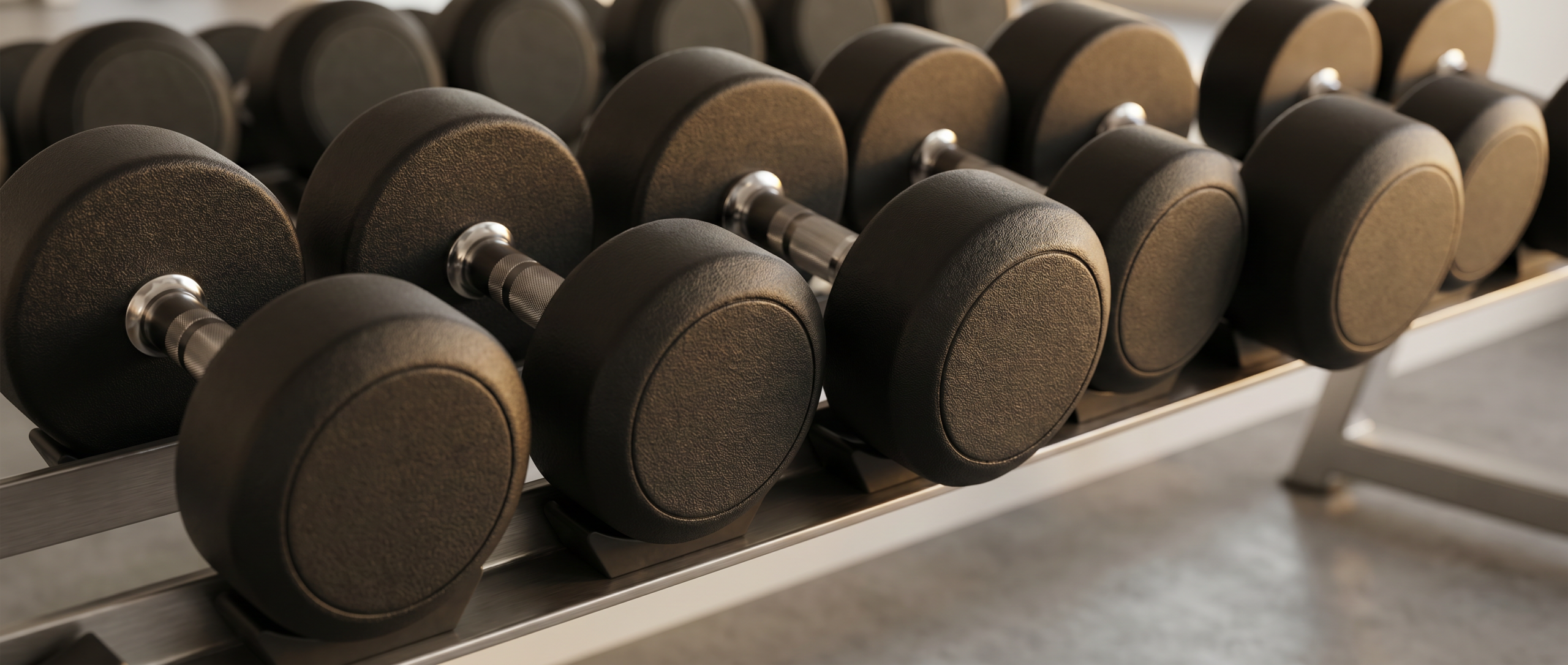
The surface finish of free weight equipment — dumbbells, kettlebells, barbells, and plates — has always been a quality signal. In the social media era, it is also a content quality signal. Polyurethane (PU) coated dumbbells with a matte or semi-gloss finish photograph cleanly under a wide range of lighting conditions and maintain their appearance through intensive commercial use. Chrome-plated equipment catches light attractively but shows wear and finger marks more readily. Rubber-coated equipment in consistent colorways creates visual coherence across a dumbbell rack that appears in member content far more favorably than a mixed set with varied coatings and colors from multiple procurement rounds.
The practical implication is that complete, matched sets — procuring all weight increments in a dumbbell range from a single manufacturer in a consistent coating — create a significantly more photogenic equipment zone than equivalent equipment assembled piecemeal. The commercial dumbbell range should ideally be specified as a complete matched system rather than built up from opportunistic additions over time.
Color Consistency and Visual Coherence
Gyms with a coherent visual identity — where equipment colors align with brand palette, flooring, and environmental design — generate more distinctive and recognizable content than facilities where equipment colors are mixed and uncoordinated. Members who train in a visually distinctive environment produce content that is identifiably from that environment, creating a consistent visual brand presence across all the content generated by the gym’s membership.
This has driven growing commercial interest in custom colorway equipment — dumbbells, kettlebells, and weight plates specified in brand-specific colors rather than standard commercial options. OEM and custom manufacturing capabilities that were previously accessed only by large chains or premium brands are increasingly available to boutique operators and mid-size facilities at commercially viable minimum order quantities. If your facility is considering a custom colorway specification, explore what our OEM/ODM manufacturing services can deliver for equipment personalization at commercial scale.
Equipment Zone Design: Creating “Content Spots”
The most operationally sophisticated response to the UGC dynamic is not simply buying better-looking equipment — it is designing zones within the gym floor that are specifically configured to produce excellent content. These areas combine visually premium equipment, appropriate lighting (warm pendant fixtures create more flattering content environments than flat overhead fluorescents), clear uncluttered background, and a visual anchor — often a branded wall element, a motivational graphic, or a distinctive architectural feature.
When members consistently photograph and film themselves in these zones, the content they generate is visually consistent, recognizably from the facility, and reflective of the quality environment the operator has invested in. The zone becomes a content production asset that is continuously activated by member behavior without any additional marketing cost.
How Social Media Has Shifted Equipment Procurement Logic: Old vs. New
| Procurement Factor | Traditional Logic (Pre-Social Media) | Current Logic (Social Media Era) |
|---|---|---|
| Primary evaluation criteria | Durability, load capacity, warranty, price | Durability, load capacity, warranty, price + visual appeal |
| Surface finish specification | Functional — resistance to wear and rust | Functional + photogenic under gym lighting conditions |
| Color selection | Standard commercial colorways, price-driven | Brand-consistent colorways, visual coherence across zones |
| Set completeness | Buy increments as needed, mixed sources acceptable | Complete matched sets from single supplier for visual consistency |
| Floor zone design | Maximize equipment density per square foot | Create photogenic zones that generate member content |
| Custom colorways | Exclusive to large chains with volume leverage | Accessible to boutique operators through OEM/ODM services |
| Lighting specification | Functional — visibility and safety | Functional + content quality (warm tones, defined shadow) |
| Marketing value of equipment | Indirect — better equipment attracts and retains members | Direct — equipment generates shareable content that acquires new members |
The Balance: Aesthetics Must Not Displace Function
The elevation of visual appeal as a procurement criterion requires a clear-eyed acknowledgment of where it sits in the evaluation hierarchy. Aesthetics as the primary procurement driver — buying equipment that looks impressive but fails under commercial load — is a failure mode that costs facilities far more than any marketing benefit the equipment generates. A premium-looking dumbbell with poor rubber compound adhesion or a structural failure under moderate load is a liability in every dimension.
The commercially intelligent approach is to establish a functional specification floor — minimum acceptable standards for load capacity, material durability, bearing quality, and manufacturer warranty — and then evaluate visual and aesthetic factors among options that clear that floor. This approach ensures that the marketing value of aesthetically premium equipment is captured without compromising the safety, durability, and reliability that commercial deployment demands.
| Categoria de equipamento | Non-Negotiable Functional Specs | Visual/Aesthetic Considerations (among qualifying options) |
|---|---|---|
| PU Dumbbells | High-density PU compound, solid cast iron head, 28–32mm handle diameter | Matte vs. semi-gloss finish, embossed vs. printed weight labeling, head profile |
| Kettlebells | Single-cast iron construction, smooth handle interior, stable flat base | Powder coat color, window size, label placement |
| Rubber Hex Dumbbells | Vulcanized rubber compound, solid cast iron core, corrosion-resistant handle | Rubber color consistency across set, chrome vs. matte handle finish |
| Discos de peso | Weight tolerance ±1–2%, grip cutouts, diameter consistency | Bumper color by weight class, plate surface texture, brand marking style |
| Suportes de musculação | 11-gauge upright minimum, load rating, j-cup adjustability | Powder coat color (black vs. brand color), upright profile (round vs. square) |
What Social Media-Influenced Procurement Means for Equipment Suppliers
For manufacturers, the social media era creates both an opportunity and a pressure. The opportunity is clear: manufacturers who invest in surface finish quality, visual design coherence, and custom colorway capability can access a commercial buyer preference that is increasingly explicit. Gym operators who are building visual-identity-conscious facilities actively seek manufacturers who understand this dimension of commercial equipment design and can deliver it.
The pressure is that visual quality is more immediately verifiable by buyer communities than most functional specifications. A dumbbell’s tensile strength requires a materials test to verify. Its appearance in an Instagram post is visible to anyone with an internet connection. Manufacturers whose products photograph poorly, whose rubber coatings fade or crack at visible rates, or whose color consistency varies across production batches are exposed to public quality assessment in ways they were not before social media became a procurement-influencing force.
O commercial kettlebell and dumbbell ranges available from Alex Athletics are produced to specifications that account for both functional commercial durability and the visual quality standards that the social media era demands. If you are building or redesigning a facility with social-media-aware equipment procurement in mind, contacte a Alex Athletics para discutir as especificações including custom colorway options available through our OEM manufacturing capabilities.

Perguntas mais frequentes
Does the visual appearance of gym equipment really affect member acquisition?
Yes, through the mechanism of user-generated content. Members who train in visually appealing facilities post content featuring that environment — and those posts reach prospective members who form impressions of the facility based on what they see. Research indicates that approximately 80% of consumers say UGC influences their purchasing decisions, and gym membership decisions follow this pattern. Equipment that generates more and better member content therefore has a measurable indirect effect on member acquisition.
What surface finishes on gym equipment photograph best under commercial lighting?
Matte and semi-gloss polyurethane (PU) coatings photograph cleanly under a wide range of lighting conditions, including the warm pendant and directional lighting common in premium commercial gyms. High-gloss finishes can create unflattering reflections in some lighting environments. Chrome-plated surfaces catch light attractively but tend to show finger marks and wear more visibly in close-range photography. Powder-coated matte black equipment creates a clean, consistent visual backdrop that photographs well across multiple content formats.
What is a “content zone” in a commercial gym?
A content zone is a designated area within the gym floor designed specifically to produce high-quality member content. Typically it features visually premium equipment (often the dumbbell or kettlebell rack), flattering directional lighting, a clear visual background (often a branded wall, brick accent, or distinctive architectural element), and sufficient floor clearance for members to frame themselves within the shot. Smart gym operators create content zones intentionally, knowing that members will gravitate to photogenic spots and that the resulting content markets the facility to their social networks.
Is it worth paying more for aesthetically premium equipment when functional equivalents cost less?
When the functional specification of a lower-cost option meets your commercial requirements, the additional cost of aesthetically premium equipment is the cost of its marketing value — the content it generates, the member acquisition it enables, and the retention premium of operating in a visually distinctive environment. For high-visibility facilities in competitive markets where member acquisition through social channels is measurable, this calculation often justifies the premium. For facilities in markets where social media is a less significant acquisition channel, the calculus is different. The answer depends on your specific competitive environment.
Can smaller boutique gyms access custom colorway equipment, or is that only for large chains?
OEM and ODM manufacturing services that were previously only accessible at large-chain minimum order quantities are increasingly available to boutique operators. Minimum order quantities for custom colorway dumbbells and kettlebells have come down significantly in recent years, making branded equipment feasible for facilities with 200 to 500 members. The key is working directly with manufacturers who have in-house coating and customization capability rather than sourcing through distributors who cannot accommodate custom specifications at smaller volumes.
Conclusão
Social media has fundamentally altered the logic of commercial gym equipment procurement without eliminating any of its traditional dimensions. Durability, load capacity, material specification, and manufacturer accountability remain the non-negotiable foundations of sound commercial equipment selection. What the social media era has added is a layer of evaluation that was previously absent from the procurement conversation: how does this equipment look in the content my members will create, and what is the marketing value of that content to my business?
The operators who are navigating this change most effectively are not compromising on functional specification to buy equipment that looks good. They are identifying manufacturers who deliver both — equipment that performs reliably under commercial load conditions and presents with the visual quality that the social media era demands. If your next procurement cycle needs to address both dimensions, contact Alex Athletics to discuss equipment specifications that meet commercial functional requirements and visual quality standards for the content-driven environment your gym operates in.